ElectionChamp
Every Paper Ballot Has an Environmental Cost
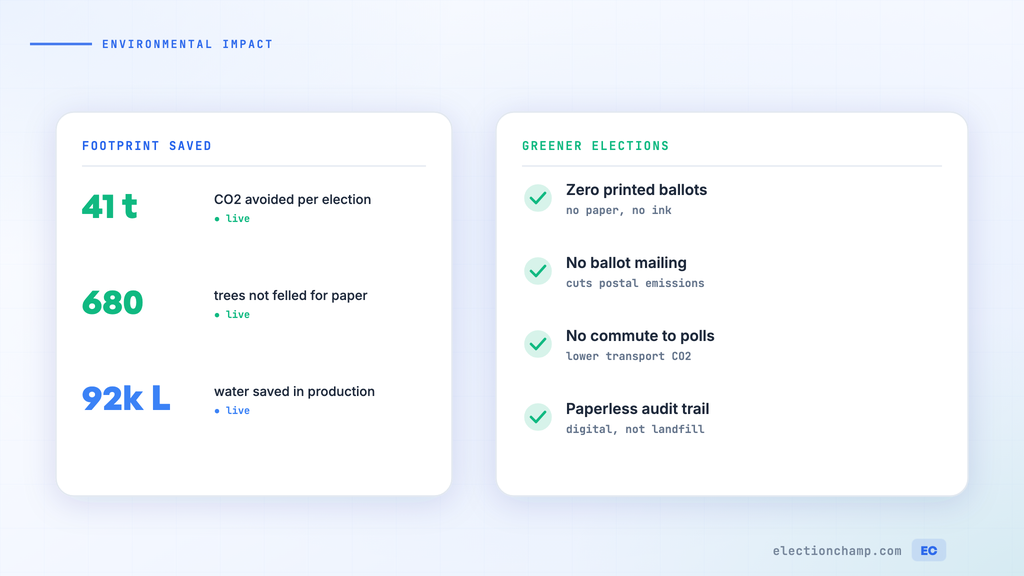
Organizations rarely think about the environmental impact of their elections, but the numbers add up. Printing ballots, envelopes, and accompanying materials consumes paper, ink, and energy. Mailing those materials generates transportation emissions. And after the election, everything goes into the waste stream. For organizations running elections annually, the cumulative environmental footprint is significant.
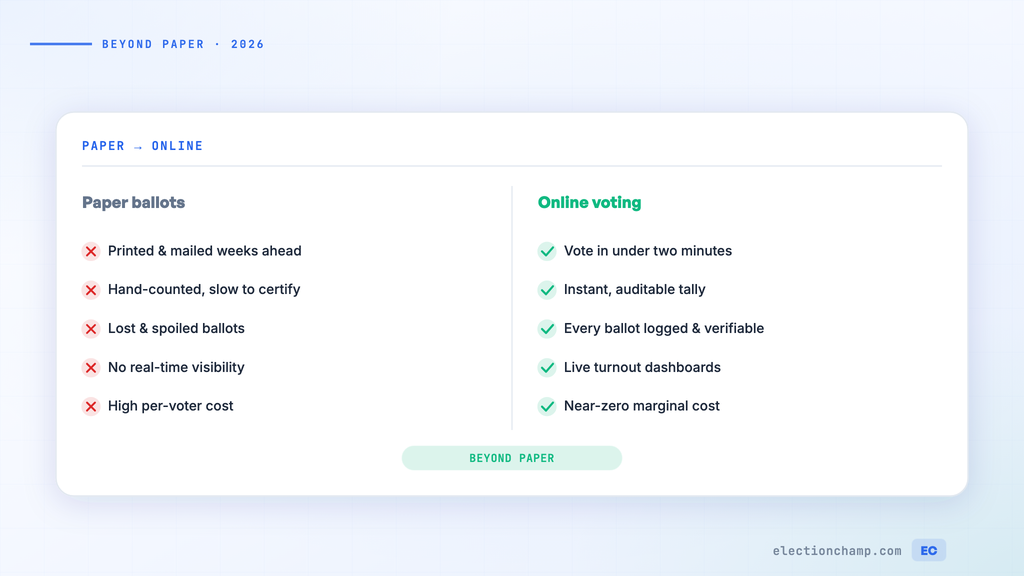
Online voting doesn’t just save money and time — it eliminates the physical waste stream of elections entirely.
The Paper Trail: By the Numbers
|
Resource |
Paper Election (500 voters) |
Online Election (500 voters) |
Savings |
|
Paper sheets |
2,000-3,000 (ballots + envelopes + inserts) |
0 |
2,000-3,000 sheets |
|
Envelopes |
1,000-1,500 (outgoing + return) |
0 |
1,000-1,500 envelopes |
|
Printer ink/toner |
2-3 cartridges |
0 |
2-3 cartridges |
|
Postage miles |
Avg. 500-2,000 collective miles |
0 |
All transportation eliminated |
|
Water usage |
~15-20 gallons (paper production) |
Negligible |
~15-20 gallons |
|
Carbon emissions |
~50-80 lbs CO2 (paper + transport) |
~1-2 lbs CO2 (server energy) |
95%+ reduction |
|
Waste generated |
5-10 lbs of paper waste |
0 |
All waste eliminated |
Paper Production
- Manufacturing one ton of paper requires approximately 24 trees, 20,000 gallons of water, and significant energy
- Even recycled paper requires water, energy, and chemical processing
- Specialty election paper (heavier stock, security features) has a higher environmental footprint than standard paper
Printing
- Commercial printing uses petroleum-based inks and chemical solutions
- Printer energy consumption varies, but typical commercial runs consume significant electricity
- Printing errors (wrong candidates, formatting issues) mean additional waste runs
Transportation
- USPS mail delivery involves trucks, sorting facilities, and local delivery vehicles
- Return mail doubles the transportation footprint
- For organizations with nationwide membership, the aggregate mileage is substantial
Waste Disposal
- Used ballots, envelopes, and election materials enter the waste stream
- Even recyclable materials require collection, transportation, and processing energy
- Some election materials (security-printed ballots) may not be recyclable at all
Online Voting’s Environmental Footprint
Online voting isn’t zero-impact, but its footprint is dramatically smaller:
- Server energy: The energy consumed by ElectionChamp’s cloud servers to run an election is roughly equivalent to keeping a lightbulb on for a few hours
- Device energy: Voters use devices they already own and would be using anyway
- Network energy: Internet infrastructure is shared across millions of users; the incremental energy of an election is negligible
Studies consistently estimate that digital processes reduce the environmental impact by 90-95% or more compared to equivalent paper processes.
ESG and Sustainability Reporting
For organizations with environmental, social, and governance (ESG) commitments, switching to online voting is a tangible, measurable sustainability action:
- Quantifiable waste reduction: Track the paper, envelopes, and ink you no longer consume.
- Carbon footprint reduction: Estimate the transportation emissions eliminated.
- Include in sustainability reports: “Our organization eliminated X pounds of paper waste and Y miles of postal transportation by switching to online voting.”
- Communicate to stakeholders: Members who care about environmental impact appreciate organizations that align practices with values.
Scale Matters: The Cumulative Impact
|
Organization Size |
Annual Paper Savings |
Annual CO2 Reduction |
5-Year Impact |
|
50-member org |
~200 sheets, 50 envelopes |
~5 lbs CO2 |
~1,000 sheets, 25 lbs CO2 |
|
500-member org |
~2,500 sheets, 750 envelopes |
~65 lbs CO2 |
~12,500 sheets, 325 lbs CO2 |
|
5,000-member org |
~25,000 sheets, 7,500 envelopes |
~650 lbs CO2 |
~125,000 sheets, 3,250 lbs CO2 |
|
50,000-member org |
~250,000 sheets, 75,000 envelopes |
~6,500 lbs CO2 |
~1.25M sheets, 32,500 lbs CO2 |
When thousands of organizations each make this switch, the collective environmental benefit is substantial.
Making the Case to Your Members
- Lead with the dual benefit: “Online voting is better for the environment AND increases participation”
- Quantify the savings specific to your organization: “Last year’s paper election used 2,000 sheets of paper and 1,000 envelopes. This year, we’re going paperless.”
- Connect to your organization’s values: If your nonprofit, cooperative, or association has environmental commitments, online voting is a natural alignment
- Offer a paper option for those who need it: printed keys accommodate members without digital access while keeping the overall process predominantly paperless
Planning your next vote? Read about how online elections work and the full feature list, or see pricing: free up to 20 voters, $10 up to 200, then $0.05 per voter.