ElectionChamp
The Tipping Point Has Arrived
For decades, paper ballots were the default for organizational elections. They were familiar, understood, and — critically — perceived as secure. But in 2026, the balance has decisively shifted. Organizations across every sector are abandoning paper in favor of online voting, and the reasons go beyond convenience.
1. Generational Expectations
Members under 45 now make up the majority of most organizations’ voting populations. This generation banks on their phones, files taxes online, and signs documents digitally. Receiving a paper ballot in the mail feels archaic — like getting a fax.
- Organizations report that younger members are significantly more likely to participate when voting is online
- Board members under 40 are the strongest advocates for digital adoption in governance
- The expectation gap between digital-native daily life and paper-based governance is creating credibility problems for organizations that haven’t modernized
2. The COVID Legacy
The pandemic forced organizations to go digital virtually overnight. Many expected to return to paper once the crisis passed. Most haven’t:
- Organizations that switched to online voting during COVID saw participation increases of 30-60%
- When given the choice, overwhelmingly members preferred to keep the digital option
- The logistics of paper voting — printing, mailing, collecting, counting — felt unnecessary once organizations experienced the alternative
3. Cost Pressures
In a period of tight budgets, the cost gap between paper and online is increasingly hard to justify:
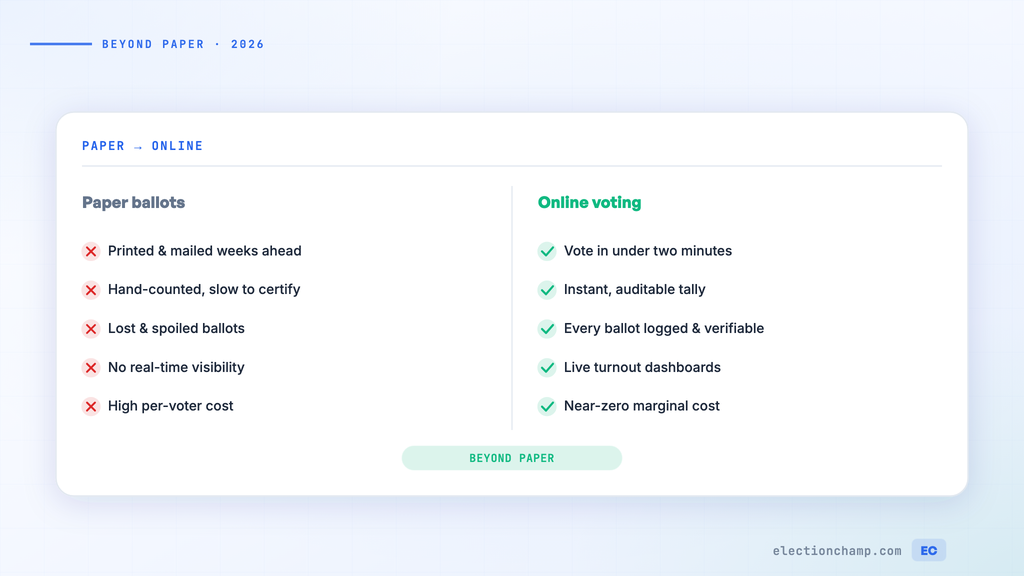
- Paper elections cost $3-15 per voter when you factor in printing, postage, envelopes, counting labor, and venue costs
- Online elections with ElectionChamp cost $0 for up to 20 voters and pennies per voter at scale
- The labor savings alone — hours of counting, data entry, and result compilation replaced by instant automation — make the ROI obvious
4. Regulatory Enablement
State legislatures and regulatory bodies are removing barriers to electronic voting:
- Multiple states have passed or updated laws explicitly authorizing electronic voting for HOAs, cooperatives, and other organizations
- The DOL’s OLMS has provided guidance accepting electronic methods for union elections under certain conditions
- NCUA has issued guidance permitting electronic voting for credit union elections with appropriate safeguards
5. Accuracy and Documentation
- Paper ballot counting errors range from 1-5% depending on ballot complexity and counter fatigue
- Online voting has zero counting errors — results are calculated mathematically
- Paper elections produce boxes of ballots that are stored and eventually discarded
- Online elections produce downloadable CSV files, audit trails, and verifiable records that can be retrieved instantly years later
The Remaining Holdouts: Why Some Organizations Haven’t Switched
|
Reason |
Reality |
Solution |
|
“Our older members can’t use technology” |
92% of Americans over 65 use the internet; 83% own smartphones |
Mobile-optimized voting + printed keys for the truly offline |
|
“Paper is more secure” |
Paper is vulnerable to loss, miscounting, and chain-of-custody issues |
Encryption + unique keys + audit trails provide stronger security |
|
“Our bylaws require paper ballots” |
Most bylaw language says ‘ballot’ not ‘paper ballot’ |
Amend bylaws with a simple Yes/No member vote |
|
“We’ve always done it this way” |
Tradition is not a strategy — and it’s not serving your members |
Start with a pilot (e.g., a survey or advisory vote) to demonstrate the technology |
|
“It’s too expensive” |
ElectionChamp is free for up to 20 voters |
Free tier eliminates cost as a barrier for small organizations |
The Path Forward
Organizations considering the switch don’t need to go all-in immediately. A phased approach works well: start with a low-stakes vote (member survey, advisory poll, or committee election) to build familiarity and confidence. Then expand to your annual board election. Within one cycle, most organizations find they can’t imagine going back to paper.
Planning your next vote? Read about how online elections work and the full feature list, or see pricing: free up to 20 voters, $10 up to 200, then $0.05 per voter.