ElectionChamp
Privacy Is a Governance Obligation
Running an election involves collecting, processing, and storing personal data: names, email addresses, phone numbers, membership identifiers, and of course, votes. As privacy regulations worldwide become more stringent, organizations must understand their obligations when handling voter data — and choose voting platforms that support compliance by design.
This guide covers the major privacy frameworks, their implications for online voting, and practical steps to ensure your elections respect member privacy.
Key Privacy Regulations
|
Regulation |
Jurisdiction |
Who It Applies To |
Key Principle |
|
GDPR |
European Union / EEA |
Any org processing data of EU residents |
Lawful basis, data minimization, right to erasure |
|
CCPA / CPRA |
California, USA |
Businesses with CA consumers above thresholds |
Right to know, delete, opt-out of data sale |
|
PIPEDA |
Canada |
Commercial organizations across Canada |
Consent, limited collection, accountability |
|
LGPD |
Brazil |
Any org processing data of Brazilian residents |
Consent, purpose limitation, data protection |
|
APPI |
Japan |
Businesses handling personal information |
Proper purpose, security, third-party restrictions |
|
Privacy Act 1988 |
Australia |
Government agencies and large private orgs |
Collection limitation, use limitation, openness |
What Data Is Collected in an Online Election
Understanding exactly what data your election involves is the first step toward compliance:
|
Data Type |
What It Includes |
Privacy Sensitivity |
Who Can Access It |
|
Voter identity data |
Name, email, phone, member ID |
High — personal identifiable information |
Election administrator only |
|
Voter keys |
16-character unique keys |
Low — randomly generated, no personal info |
System-generated; voter and admin |
|
Ballot selections |
The actual votes cast |
Very High — must be anonymous |
No one — architecturally separated from identity |
|
Participation data |
Whether a voter has voted (not how) |
Medium — reveals behavior but not opinion |
Administrator (for tracking turnout) |
|
Audit trail |
Administrative actions with timestamps |
Medium — documents process, not voter choices |
Administrator; oversight bodies on request |
Privacy by Design in Online Voting
ElectionChamp implements privacy by design — building privacy protections into the architecture rather than adding them as an afterthought:
- Ballot anonymization: Voter identity and ballot data are architecturally separated. There is no technical mechanism to link a voter to their selections, even for system administrators.
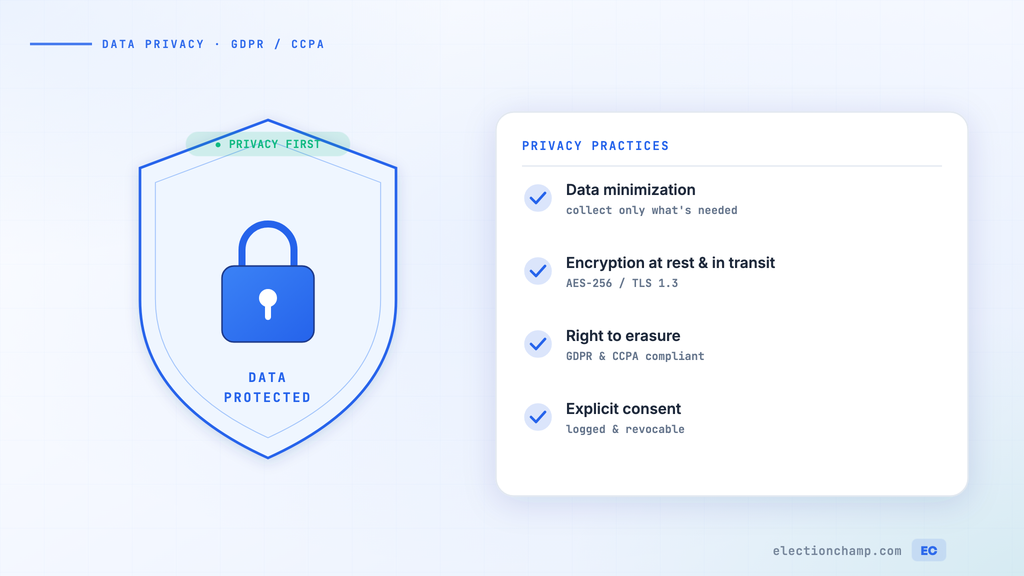
- Data minimization: The platform collects only the data necessary to conduct the election — no tracking cookies, no behavioral analytics, no unnecessary profiling.
- Unique voter keys: Keys are randomly generated with no embedded personal information. They serve as authentication tokens, not identity records.
- Last-5 masking: During active elections, the voting status of the five most recent voters is hidden to prevent real-time identity correlation.
GDPR Compliance for Organizations with EU Members
If your organization has any members who are EU residents, GDPR applies to your election data processing:
- Identify your lawful basis: For elections, the most likely lawful basis is ‘legitimate interests’ (conducting democratic governance) or compliance with your organization’s bylaws (contractual obligation with members).
- Provide a privacy notice: Inform members what data you’re collecting, why, and how long it will be retained. Include this in your election notification.
- Implement data minimization: Collect only the data needed for the election. If you don’t need a member’s home address for an email-based election, don’t collect it.
- Set a retention policy: Election records should be retained for the period required by your bylaws or applicable law, then deleted. Don’t keep voter data indefinitely.
- Enable data subject rights: Members have the right to access their data, correct inaccuracies, and (with limitations) request deletion.
- Assess cross-border transfers: If your voting platform’s servers are outside the EU, ensure adequate data transfer mechanisms are in place.
CCPA/CPRA Compliance
California’s privacy laws give residents specific rights regarding their personal information:
- Right to know: Members can ask what personal information you’ve collected and how it’s been used
- Right to delete: Members can request deletion of their personal data (subject to legal retention requirements)
- Right to opt out: While CCPA’s opt-out mainly applies to data sale (which elections don’t involve), organizations should be transparent about data use
- Privacy policy: Your organization’s privacy policy should cover election data alongside other member data processing
Practical Privacy Checklist for Election Administrators
- Include a brief privacy notice in your election notification email: “Your voter data is used solely for this election. Votes are anonymous and cannot be linked to your identity.”
- Set a data retention policy: How long will you keep voter lists, results, and audit trails?
- Use the minimum data necessary: If you only need email addresses, don’t import phone numbers, home addresses, or membership IDs
- Secure voter lists: Don’t share voter lists via unencrypted email or store them on unsecured devices
- Delete voter data when the retention period expires: Archived results (aggregate) can be kept; individual voter data should be purged
Communicating Privacy to Members
Members are increasingly privacy-conscious. Proactive communication builds trust:
- Explain how ballot secrecy works: “Your vote is anonymous. Even the administrator cannot see how you voted.”
- Address surveillance concerns: “No one — not the board, not the election committee, not ElectionChamp — can link your name to your ballot selections.”
- Describe your data handling: “Your email address is used to send you the ballot link. It will be deleted [X] days after the election closes.”
- Invite questions: Privacy-concerned members may have specific questions. Address them directly rather than dismissively.
Planning your next vote? Read about how online elections work and the full feature list, or see pricing: free up to 20 voters, $10 up to 200, then $0.05 per voter.