ElectionChamp
Representation at Scale
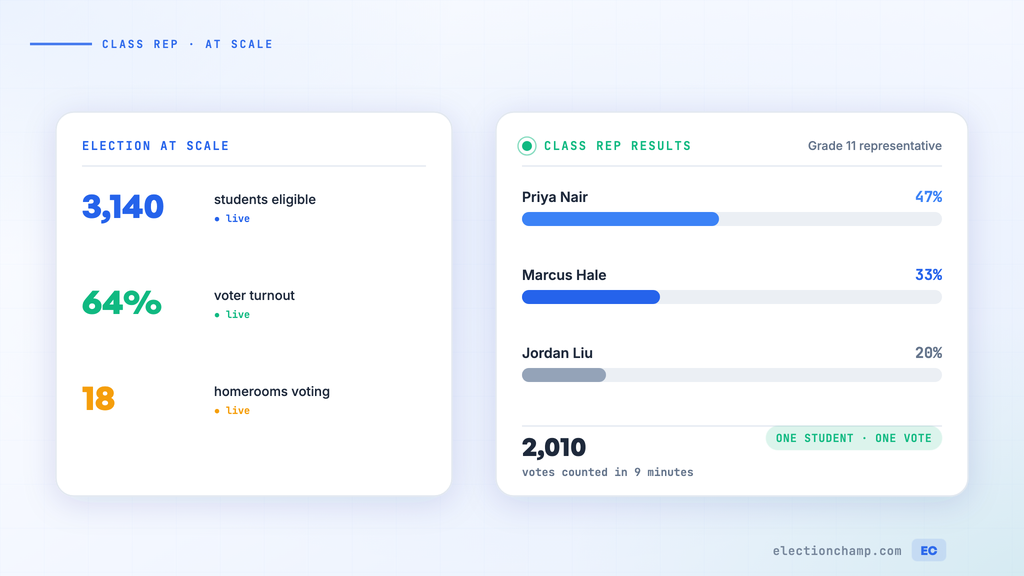
Large universities with thousands of students across dozens of departments need representative governance structures that ensure every student has a voice. Class representatives — elected from each department, program, or year level — form the foundation of student governance. But running elections across 30, 50, or 100+ departments simultaneously is a logistical challenge that paper-based systems simply cannot handle.
Online voting makes university-wide class representative elections manageable, fair, and well-documented.
Electoral Structure Options
|
Structure |
How It Works |
Best For |
|
By department |
Each department elects 1-3 representatives |
Universities organized by academic department |
|
By college/school |
Each college elects representatives proportional to enrollment |
Universities with distinct colleges (Engineering, Arts, Business) |
|
By year level |
Each year (freshman, sophomore, etc.) elects representatives |
Smaller universities or undergraduate-focused institutions |
|
By program type |
Separate representatives for undergrad, master’s, doctoral, professional |
Universities with diverse student populations |
|
Combined |
Department + year level + at-large seats |
Large universities wanting comprehensive representation |
Step-by-Step: Running Multi-Department Elections
- Map your electoral districts: List every department/program that needs a representative. Determine how many seats each gets (often proportional to enrollment).
- Obtain enrollment data: Work with the registrar to get current enrollment lists by department. This becomes your voter list for each election.
- Open nominations: Use a 2-week nomination period. Accept self-nominations and peer nominations. Use ElectionChamp’s Nominations ballot type for departments where you want to crowdsource candidates.
- Create elections: For each department, create a separate election in ElectionChamp. Use a consistent naming convention: “2026-2027 Student Rep — Department of [Name]”
- Build ballots: Plurality voting with Total Winners matching the number of seats. Include candidate photos and brief statements.
- Coordinate launch: Launch all department elections simultaneously for a unified election week.
- Monitor and remind: Track participation by department through each election’s dashboard. Send reminders to low-participation departments.
- Announce results: Compile results from all elections and announce the full student council roster.
Managing Voter Eligibility
Voter eligibility in university elections requires careful attention:
- Use official enrollment data from the registrar — not self-reported department affiliation
- Students enrolled in multiple programs may be eligible to vote in multiple elections — clarify this in your election rules
- Exchange students, visiting students, and auditors may or may not be eligible — define eligibility criteria before the election
- Students who withdraw or graduate between the voter list creation and the election may need to be removed
Campaign Management for University Elections
- Set clear campaign rules: spending limits, poster locations, social media guidelines, debate formats
- Provide equal campaign resources: all candidates get the same profile space on the ElectionChamp ballot
- Schedule candidate forums by college or department — let students hear from candidates before voting opens
- Use the university’s social media channels to promote the election (but not specific candidates)
Handling Large Voter Populations
Universities with 5,000-50,000+ students need efficient processes:
- Batch import voter lists from your student information system (SIS) — export as CSV and upload directly to ElectionChamp
- Use university email addresses for notifications — students are accustomed to receiving official communications there
- ElectionChamp’s pricing scales affordably: even a 10,000-student university-wide election costs approximately $500
- For budget-conscious student governments, consider running department-level elections separately (many will fall under the free tier of 20 voters)
Year-Over-Year Handoff
Student government elections are annual events. Building institutional memory ensures each year runs smoother than the last:
- Document your election procedures in a handbook that transfers to the next election committee
- Archive all election results, participation data, and audit trails for reference
- Note what worked and what didn’t: Which departments had low turnout? What communication strategies were most effective?
- Maintain a template for ElectionChamp setup that can be reused each year with updated voter lists and candidates
Analyzing Representation
After elections, analyze whether your representative structure is achieving its goals:
- Participation rates by department: Are some departments consistently underrepresented? Investigate why.
- Contested vs. uncontested seats: Uncontested elections may indicate low engagement or insufficient outreach
- Demographic representation: Does the elected council reflect the student body’s diversity?
- Use these insights to improve outreach, adjust seat allocation, and strengthen governance legitimacy
Planning your next vote? Read about online voting for universities and officer elections, or see pricing: free up to 20 voters, $10 up to 200, then $0.05 per voter.