ElectionChamp
Introduction
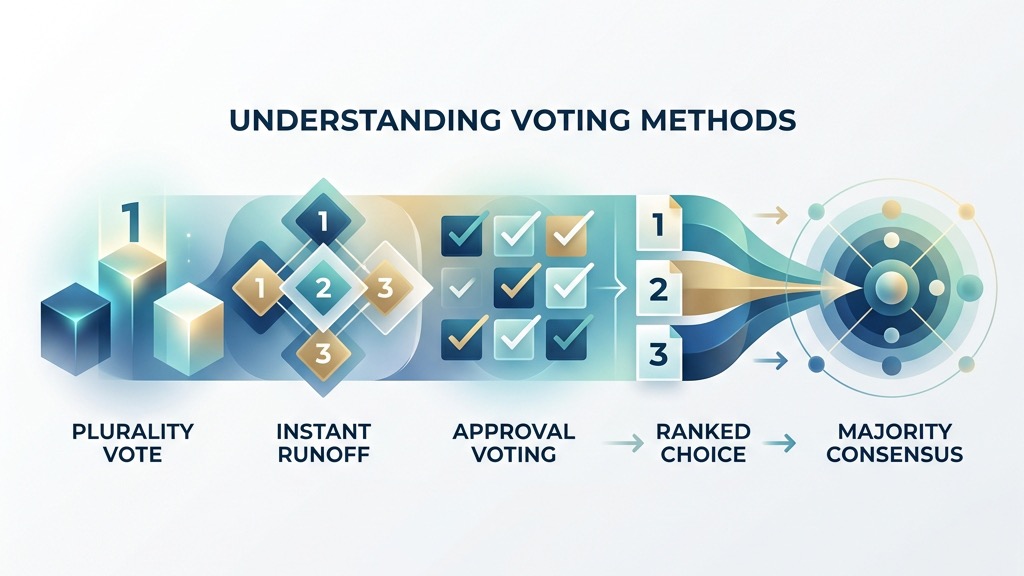
When most people think of voting, they think of “pick one, most votes wins.” That’s Plurality voting, and it’s the simplest and most common method. But it’s not always the best method for every situation.
Different decisions call for different voting methods. Electing a single president is different from selecting a 5-member board. Approving a budget is different from crowdsourcing candidate nominations. Using the wrong method can lead to outcomes that don’t accurately reflect your members’ true preferences.
This guide explains each voting method in plain English, with real-world examples and a clear framework for choosing the right one.
Plurality (First Past the Post)
How It Works
Voters select one or more candidates (depending on how many seats are available). The candidate(s) with the most votes win. It’s that simple.
Example
Your HOA is electing a Board President. Three candidates are running. 100 members vote: Alice gets 45 votes, Bob gets 35 votes, Carol gets 20 votes. Alice wins.
Best For
- Single-winner elections (President, Chair, Treasurer)
- Multi-seat boards where you need the top N vote-getters (“Vote for up to 3 of 7 candidates”)
- Yes/No decisions (bylaw amendments, budget approvals)
- Any straightforward vote where the majority preference is clear
Limitations
In elections with many candidates, a winner can emerge with a relatively small share of the total vote. In our example, Alice won with only 45% — meaning 55% of voters preferred someone else. For most organizational elections, this is perfectly acceptable. But for decisions where broad consensus matters, consider Ranked Choice.
Ranked Choice Voting (Borda Count)
How It Works
Instead of selecting one candidate, voters rank all candidates in order of preference. ElectionChamp uses the Borda Count method: the first-choice rank receives the maximum points, the second choice receives one fewer point, and so on down to the last rank. The candidate with the highest total points wins.
Example
Your professional association is selecting a Keynote Speaker from 4 nominees. 50 members rank their preferences. After tallying points across all rankings, the candidate with the broadest support (strong second and third choices, not just first) wins. This often produces a different winner than Plurality would.
Best For
- Elections where consensus matters more than a simple majority
- Selecting candidates who need broad support across the membership
- Avoiding a winner who is polarizing (loved by some, disliked by many)
- Award selections, priority rankings, or any decision where preference order matters
Nominations (Write-In Voting)
How It Works
Instead of choosing from a predefined list, voters type in a name. The system groups exact matches and displays results with vote counts for each unique name. This is essentially a crowdsourcing mechanism.
Example
Your nonprofit wants to identify potential board candidates before a formal election. You run a Nominations ballot asking “Who would you like to see run for the Board of Directors?” Members type in names, and the results show which names were most frequently suggested.
Best For
- Pre-election nomination periods
- Open-ended suggestion collection
- Identifying emerging leaders or popular ideas
- Situations where the candidate slate isn’t yet defined
STV (Single Transferable Vote)
How It Works
STV is a proportional representation system designed for multi-seat elections. Voters rank candidates in order of preference (like Ranked Choice), but instead of just picking a single winner, STV fills multiple seats while ensuring that each elected candidate represents a proportional share of the electorate.
The system calculates a “quota” (the number of votes needed to win a seat). Candidates who reach the quota are elected, and their surplus votes are transferred to remaining candidates based on voters’ next preferences. Candidates with the fewest votes are eliminated and their votes are also transferred. This continues until all seats are filled.
Best For
- Multi-seat elections where proportional representation matters
- Diverse boards that need to represent different constituencies
- Elections where minority viewpoints should still gain representation
- Organizations committed to fair representation principles
Choosing the Right Method: A Decision Framework
Ask yourself these questions:
- How many winners? One winner = Plurality or Ranked Choice. Multiple winners = Plurality (top N), STV, or multiple Ranked Choice questions.
- Does consensus matter? If you just need the most popular option, use Plurality. If you need the option with the broadest support, use Ranked Choice.
- Is proportional representation important? If yes, use STV.
- Is the candidate list not yet defined? Use Nominations first, then follow up with a formal vote.
- Is it a simple Yes/No decision? Use Plurality with two options.
Remember: On ElectionChamp, you can mix different methods within the same election. Use Plurality for your President vote, Ranked Choice for your Board, and Nominations for a suggestions question — all on the same ballot.
Ready to run your first election? Start for free at ElectionChamp.com — no credit card required for up to 20 voters. All features included on every plan.