ElectionChamp
Anonymity Is Not Privacy — It’s Architecture
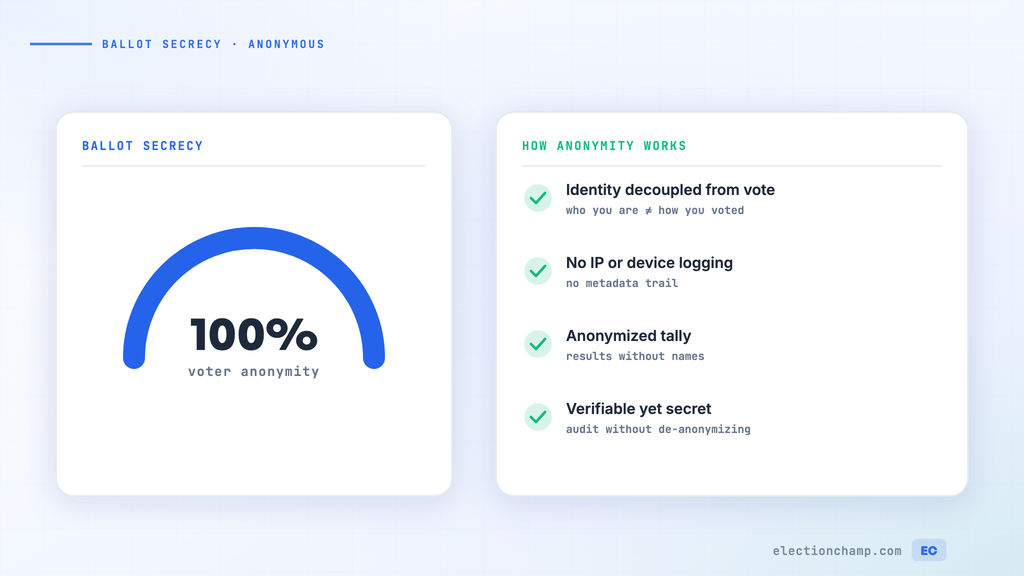
Many online voting platforms claim ballot secrecy, but the implementation varies dramatically. Some platforms simply promise that administrators won’t look at individual votes. Others architecturally prevent anyone from ever linking a voter to their ballot — making it physically impossible, not just policy-prohibited.
The difference matters. A promise can be broken. Architecture cannot.
Policy-Based vs. Architectural Anonymity
|
Approach |
How It Works |
Risk Level |
Example |
|
Policy-based |
Votes are stored with voter identifiers, but administrators promise not to look |
High — any admin or database query could reveal individual votes |
“We don’t share how you voted” (but technically could) |
|
Access-controlled |
Votes are linked to voters but access is restricted to certain roles |
Medium — insiders or hackers with admin access could reveal votes |
“Only the system administrator can see individual votes” |
|
Architecturally anonymous |
Voter identity and ballot data are stored in separate, unlinked systems with no way to reconnect them |
Very Low — even with full database access, individual votes cannot be identified |
ElectionChamp’s approach |
How Architectural Anonymity Works
In an architecturally anonymous system, the voting process separates into two independent data streams:
- The voter authenticates using their unique 16-digit key. The system records that this voter has participated (changing their status from ‘Pending’ to ‘Voted’). The key is permanently deactivated.
- The voter’s ballot selections are recorded separately — without any identifier linking them to the voter. The ballot is just a set of choices attached to the election and question, not to any person.
- These two records — the participation record and the ballot record — are stored independently with no technical mechanism to reconnect them.
- When results are calculated, the system counts all ballot records for each question. It never needs to know or reference which voter submitted which ballot.
What This Means in Practice
- The administrator can see that John Smith has voted (his status shows ‘Voted’). But the administrator cannot see what John Smith voted for. Ever.
- If someone demanded to know how a specific voter voted — a union boss, a board president, a government official — the system literally cannot produce that information. It doesn’t exist as a linkable record.
- Even if the entire database were compromised by hackers, they would find a list of voters who participated AND a separate list of anonymous ballot selections — with no way to connect the two.
- ElectionChamp’s engineering team cannot determine individual votes. This isn’t a policy choice; it’s a technical constraint of the architecture.
Tamper-Proof Mechanisms
Ballot secrecy means votes can’t be seen. Tamper-proof means votes can’t be changed. Online voting platforms achieve tamper-proofing through:
- Automated counting: Results are calculated mathematically by the system. No human handles, interprets, or counts individual ballots. This eliminates counting errors and manipulation.
- One-time submission: Once a ballot is submitted, the voter key is permanently deactivated. No one — not the voter, not the admin — can change, retract, or replace the vote.
- Immutable audit trail: Every administrative action is logged with timestamps that cannot be edited or deleted. If anyone attempted to interfere with the election, the trail would document it.
- Admin restrictions: Administrators cannot add, remove, or modify individual votes. They can view aggregate results (after the election closes, if result visibility is configured that way), but never individual ballots.
Last-Voter Masking: An Extra Protection Layer
ElectionChamp includes an additional anonymity feature: during active elections, the voting status of the 5 most recently voted members is hidden. This prevents a subtle privacy attack:
- Without masking: If an administrator watches the voter list in real time, they could see John Smith’s status change from ‘Pending’ to ‘Voted’ at 2:43 PM, and then check that a ballot was submitted at 2:43 PM — potentially correlating timing with identity.
- With masking: The 5 most recent voters’ statuses are hidden, creating a buffer that makes real-time correlation impossible.
Why This Matters for Your Organization
- For unions: The LMRDA requires secret ballot elections. Architectural anonymity isn’t optional — it’s legally required. Members must be able to vote without fear of retaliation from leadership, employers, or fellow members.
- For HOAs: State laws requiring secret ballots mean that a platform where the board president could theoretically check individual votes doesn’t comply — even if the president promises not to.
- For nonprofits: Anonymous voting on contentious issues (leadership challenges, policy changes, budget disputes) protects organizational harmony.
- For corporations: Board resolution votes where directors must vote their fiduciary conscience require genuine ballot secrecy, not just a gentleman’s agreement.
Questions to Ask Any Voting Platform
- “Can any person — administrator, engineer, support staff — see how a specific voter voted?” The only acceptable answer is no.
- “Is ballot anonymity policy-based or architectural?” If they say ‘policy-based’ or can’t answer clearly, the anonymity claim is weak.
- “What happens if a court subpoenas individual vote records?” If the platform can produce them, the votes weren’t truly anonymous. ElectionChamp’s answer: the records don’t exist in a linkable form.
Ready to modernize your organizational voting? Start for free at ElectionChamp.com — secure, anonymous, and mobile-friendly voting for every organization.