ElectionChamp
The Governance-Donor Confidence Connection
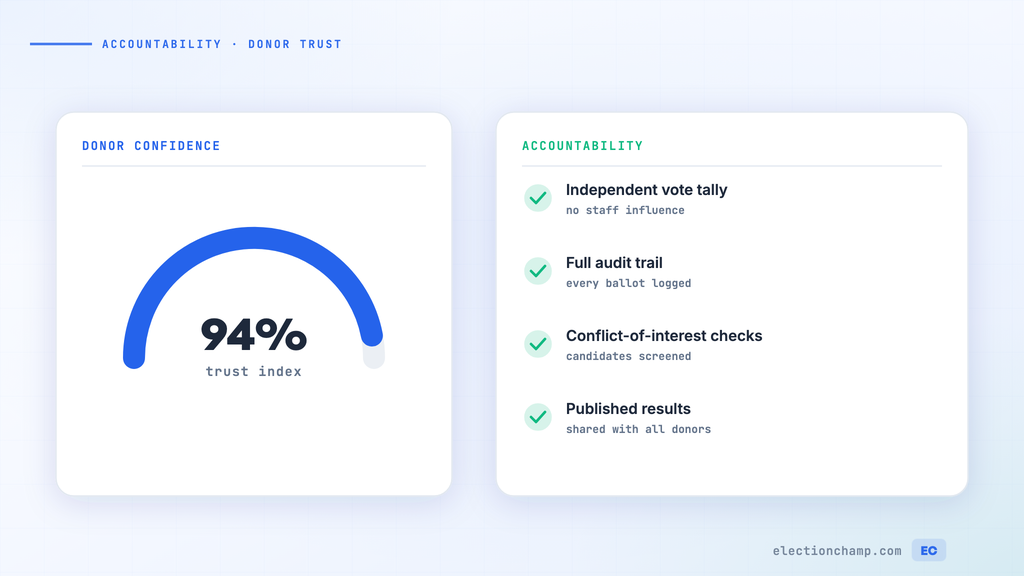
Donors, grantmakers, and charity watchdog organizations increasingly evaluate governance practices when deciding where to direct funding. Board election processes sit at the center of this evaluation. Organizations with transparent, well-documented election practices signal competence, accountability, and trustworthiness — qualities that directly impact fundraising success.
Charity Navigator, GuideStar (now Candid), and the BBB Wise Giving Alliance all include governance indicators in their ratings. A charity that can demonstrate fair, documented elections strengthens its profile across these platforms.
What Donors and Funders Look For
- Regular board turnover through democratic elections — not self-perpetuating boards that select their own replacements
- Independent directors who weren’t appointed by the CEO or founding family
- Documented election procedures that follow the organization’s bylaws
- Broad member participation in leadership selection (for membership organizations)
- Diversity of board composition reflecting the communities served
- Clear conflict-of-interest policies and transparency in governance
How Poor Election Practices Hurt Fundraising
When a charity’s election process looks informal, closed, or poorly documented, the consequences ripple outward:
- Foundation applications suffer: Major funders ask detailed questions about governance. Vague answers about board selection raise red flags.
- Watchdog ratings drop: Charity Navigator deducts points for governance weaknesses, directly impacting public trust scores.
- Member donations decline: When members feel excluded from leadership selection, they disengage — and stop giving.
- Legal exposure increases: Poor election documentation can create liability if a disgruntled member or former board member files a challenge.
- Institutional knowledge concentrates: Without regular, competitive elections, boards stagnate and become echo chambers.
Transparency at Every Stage
- Publish your election calendar publicly — when nominations open, when voting begins, when results are announced
- Make board qualifications and expectations clear so potential candidates (and voters) understand what’s needed
- Give every candidate equal space to present their qualifications — ElectionChamp’s candidate profiles ensure parity
- Use anonymous voting to prevent social pressure and ensure honest selections
- Share results with all members promptly and completely — ElectionChamp’s one-click results distribution makes this easy
Documentation for Compliance
Maintain a complete governance file for each election cycle:
- Board meeting minutes approving the election timeline and procedures
- Nomination committee report listing all candidates considered
- Proof of member notification (email send confirmations from ElectionChamp)
- Election results (CSV download from ElectionChamp)
- Audit trail (timestamped log of all administrative actions)
- Participation statistics (turnout rate, total eligible voters, total votes cast)
This documentation serves double duty: it satisfies your legal record-keeping obligations and provides ready-made evidence for funder governance inquiries.
Using Election Data in Grant Applications
Many grant applications ask about governance practices. Having concrete election data strengthens your responses:
- “Our board is elected annually by our membership through a secure online ballot. In our most recent election, 67% of eligible members participated.”
- “All board candidates are presented with equal visibility through our online voting platform. Voting is anonymous and results are documented with a full audit trail.”
- “Our election records, including participation data and timestamped audit logs, are retained for 7 years in compliance with our document retention policy.”
These aren’t just governance talking points — they’re evidence of organizational maturity that funders value.
Independent Director Elections
Many governance best-practice frameworks recommend that at least one-third of board members be independent — meaning they have no financial, familial, or professional relationship with the organization’s management. Online elections make it easier to achieve this because:
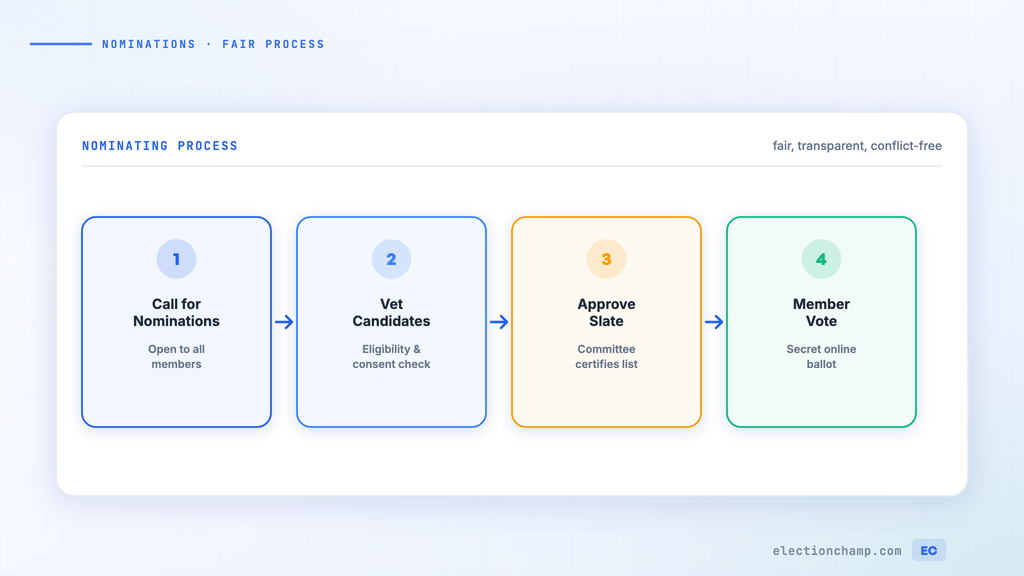
- Broader candidate pools: When any member can nominate or self-nominate online, you access a wider range of potential directors
- Reduced insider advantage: Anonymous voting and randomized ballot order prevent insiders from dominating outcomes
- Documented independence: Election records prove that directors were selected through open, democratic processes
Planning your next vote? Read about nonprofit board voting and board elections, or see pricing: free up to 20 voters, $10 up to 200, then $0.05 per voter.