ElectionChamp
The Hidden Link Between Elections and Funding
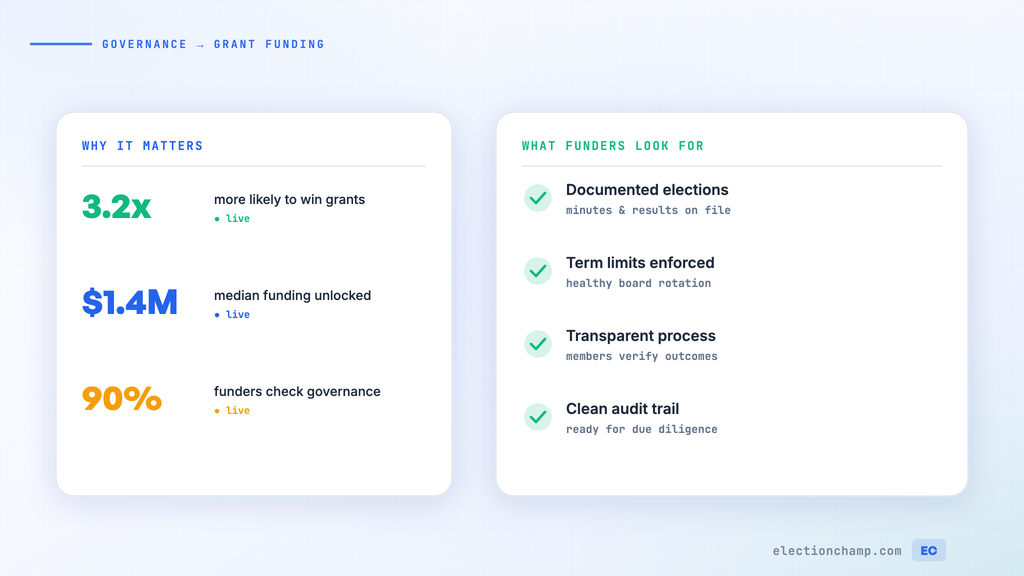
Most nonprofit leaders know that funders evaluate programs, outcomes, and financial management. What many don’t realize is how closely major grantmakers scrutinize governance practices — including how board members are selected. Your election process isn’t just an internal matter. It’s a signal that funders read to assess organizational health, accountability, and long-term sustainability.
This article explores why election quality matters to funders, what they’re looking for, and how modernizing your election process can directly strengthen your grant applications.
Foundation Requirements
Large foundations increasingly include governance questionnaires in their application processes:
- Ford Foundation asks about board composition, selection process, and term limits
- Robert Wood Johnson Foundation evaluates governance structures as part of organizational capacity
- Gates Foundation looks for evidence of strong internal governance and accountability systems
- Community foundations typically require documented board election procedures as a condition of funding
Government Grants
Federal and state government grants have their own governance expectations:
- OMB Uniform Guidance (2 CFR 200) requires nonprofits to have governing boards that provide oversight
- State grant programs often require documentation of board election procedures
- Federal agencies look for evidence that board members are selected through fair, democratic processes rather than self-perpetuation
Charity Watchdog Standards
Organizations like Charity Navigator and the BBB Wise Giving Alliance evaluate governance as part of their public ratings. Their criteria include:
- Regular board rotation through elections (not indefinite terms)
- Independent board members (not all appointed by the CEO or founding family)
- Board meetings with documented attendance and decisions
- Clear policies on conflicts of interest
Five Ways Elections Strengthen Grant Applications
- Demonstrate democratic governance: “Our board is elected annually by our 2,500 members through secure online voting” is far more compelling than “Board members are appointed.”
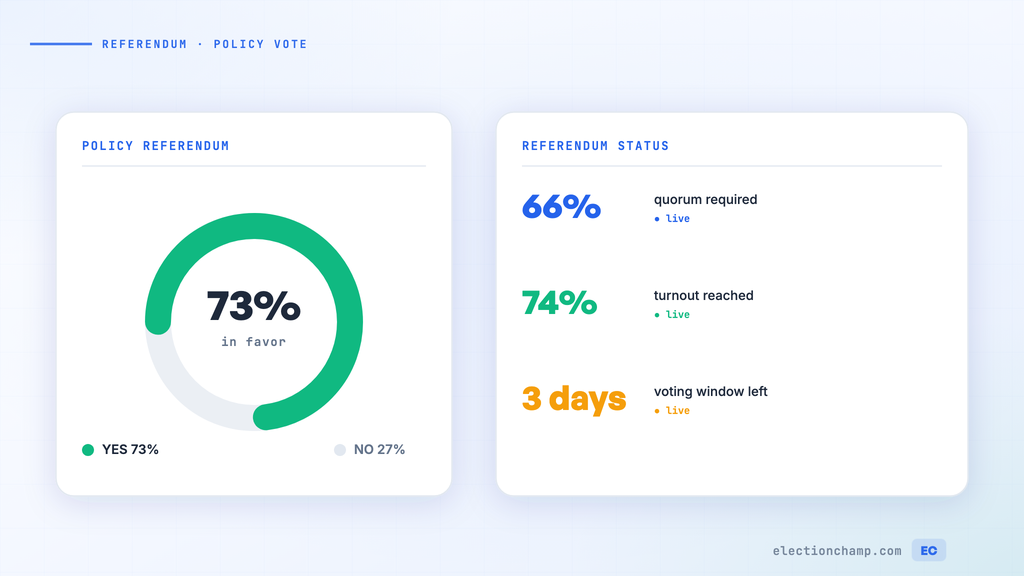
- Prove member engagement: “67% of eligible members participated in our most recent board election” shows an engaged, invested membership base.
- Show accountability: “All election results are documented with timestamped audit trails and archived for 7 years” demonstrates organizational maturity.
- Evidence transparency: “Election results are shared with all members via email within 24 hours of election close” shows you value open governance.
- Highlight board diversity: Fair, open elections with broad participation naturally produce more diverse boards than insider appointment processes.
Building a Governance Narrative for Funders
Don’t just answer governance questions with yes/no responses. Build a narrative that demonstrates your organization’s commitment to strong governance:
Before (Typical Weak Response)
“Board members are elected at our annual meeting.”
After (Strong Response with ElectionChamp Data)
“Our board of directors is elected annually through a secure online voting platform (ElectionChamp) that ensures anonymous balloting, broad accessibility, and full documentation. In our most recent election, 67% of eligible members participated — up from 23% when we used paper ballots. All candidates receive equal presentation through digital profiles, and election results are documented with timestamped audit trails. Our election records are retained for seven years in accordance with our document retention policy.”
Common Governance Red Flags for Funders
Avoid these practices that raise concerns during grant reviews:
- Self-perpetuating boards: Board members selecting their own replacements without member input signals insularity
- No term limits: Indefinite terms concentrate power and prevent fresh perspectives
- Undocumented elections: “We voted at the meeting” with no records looks unprofessional
- Very low participation: Single-digit turnout suggests a disengaged membership
- No contested elections: When every election is uncontested, it may signal a closed process
Action Steps to Strengthen Your Governance Profile
- If you haven’t already, switch to online voting to boost participation and create professional documentation
- Implement term limits if your bylaws don’t already have them
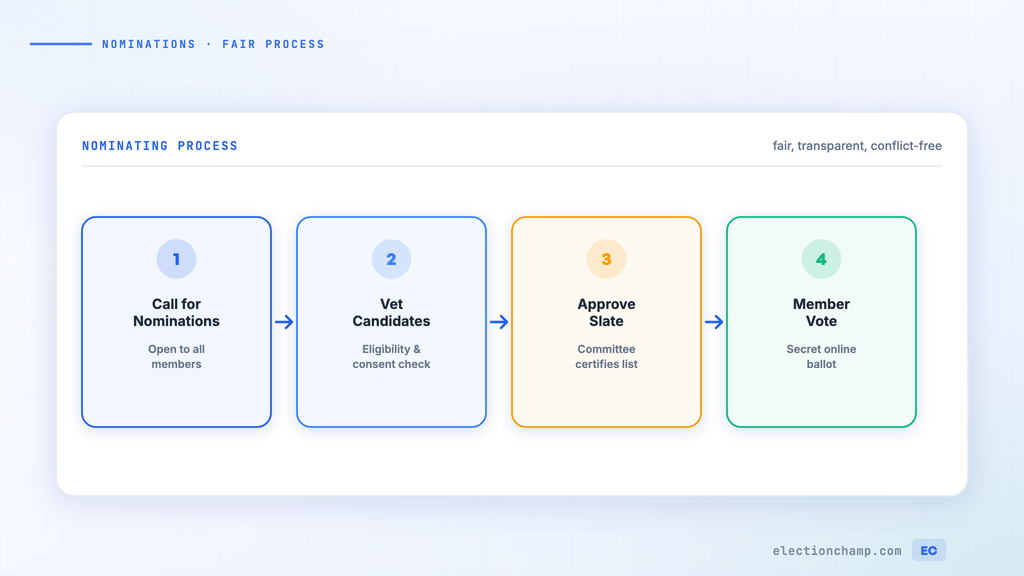
- Open nominations broadly — allow self-nominations and publicize open seats widely
- Archive election records systematically — results, audit trails, participation data
- Include governance metrics in your annual report and on your website
- Reference your election process proactively in grant applications, even when not explicitly asked
Ready to modernize your organizational voting? Start for free at ElectionChamp.com — secure, anonymous, and mobile-friendly voting for every organization.