ElectionChamp
Short answer: Federal credit unions can hold board elections online if they adopt the electronic voting option in Article V of the Federal Credit Union Bylaws. Members vote by electronic device or mail ballot, tellers verify each voter and test the system, and ballots must arrive by midnight 5 days before the annual meeting. State-chartered credit unions follow state law and their own bylaws.
This guide covers who votes, the federal bylaw options, the nomination timeline, how to run the electronic side online, and what it costs.
Who Votes in a Credit Union Election?
Each member gets one vote, no matter how many shares they hold. Under the Federal Credit Union Bylaws (12 CFR Part 701, Appendix A), members cannot vote by proxy, and the board sets a minimum voting age within the limits the bylaws allow.
Members elect the board of directors at or before the annual meeting. Some credit unions also elect a credit committee. Check your bylaws for which seats are on the ballot.
Can a Federal Credit Union Vote Online?
Yes, if the credit union uses the right election option. Article V of the Federal Credit Union Bylaws offers four options:
| Option | How members vote | Nominations |
|---|---|---|
| A1 | In person at the annual meeting | Nominating committee and floor |
| A2 | In person at the annual meeting | Nominating committee and petition |
| A3 | Ballot boxes or voting machines | Nominating committee and petition |
| A4 | Electronic device or mail ballot | Nominating committee and petition |
Under the electronic option, the secretary sends a notice of balloting with each candidate’s name, a short qualifications statement and biographical details. The instructions must tell members without an electronic device that they can vote by returning a mail ballot. Members who chose electronic notices can receive the notice and voting instructions by email.
Tellers verify each voter’s name and account number, test the system’s integrity at regular intervals and tally the vote. Ballots must arrive by midnight, 5 calendar days before the annual meeting, and the chair announces the result at the meeting. If the electronic system fails, the board can switch to mail ballots only and adjust the timeline.
Federal Credit Union Election Timeline
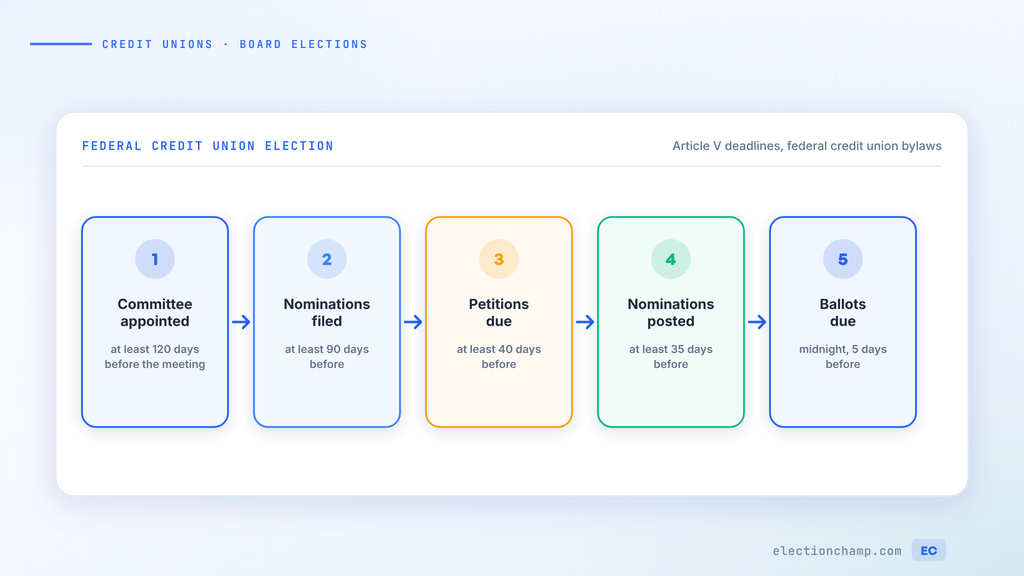
For the petition-based options (A2 to A4), Article V counts every deadline back from the annual meeting:
| Step | Deadline before the annual meeting |
|---|---|
| Chair appoints the nominating committee (at least 3 members) | At least 120 days |
| Committee files its nominations with the secretary | At least 90 days |
| Secretary tells members how to nominate by petition | At least 75 days |
| Petitions are due, with each nominee’s signed consent | At least 40 days |
| Nominations are posted in each office and on the website | At least 35 days |
| Electronic and mail ballots must arrive (option A4) | Midnight, 5 calendar days before |
A petition needs signatures from 1% of members, with a minimum of 20 and a maximum of 500. The nominating committee must put forward at least one candidate for each open seat and confirm each nominee is willing to serve. For how to run that committee well, see our nominating committee guide.
What If There Is Only One Candidate Per Seat?
A ballot is needed when there are more nominees than open seats. When nominations equal the number of seats, the bylaw options let nominees be declared elected without a contested vote, for example by acclamation at the annual meeting. Check the exact wording of the option your credit union adopted.
How to Run the Electronic Vote Online
- Build the ballot. Add a question for the board seats with candidate photos and bios, and a separate question for any other office. Use Total winners to match the number of open seats.
- Load the member list. Upload eligible members with an email address, and a phone number if you want to send text messages. A voter label can carry a member number for your tellers’ records.
- Choose how members get their key. Email and text message reach most members. Add Hand out keys for members who want to vote on a branch device.
- Keep results hidden. Leave “Who can see results while voting is open?” on “No one” until voting closes.
- Close 5 days before the meeting. Set the closing time to match the bylaws deadline, then download the results CSV for the tellers.
- Announce at the annual meeting. The chair announces the result, and you can send the results link to every member.
Each member’s key works once, ballots are anonymous and every administrative action is recorded in an exportable audit log. That record helps the tellers when they report on the election.
Mail Ballots and Double Voting
The electronic option requires a mail ballot for members without a device. ElectionChamp handles the electronic side, and your tellers handle the mail ballots. Under the bylaws’ mail procedure, each sealed ballot stays apart from the member’s identification form until counting.
That gives tellers a clean way to stop double voting. After online voting closes, they check each mail voter’s status on the Voters tab. If a member also voted online, they set aside the sealed mail ballot and apply your bylaws’ rule for duplicates. The same idea works for any hybrid voting setup.
How to Get More Members to Vote
Credit union members rarely think about board elections until someone reminds them. Put the election where members already deal with you:
- Text messages: send the voting link by SMS to members with a mobile number on file.
- Online and mobile banking: add a banner or message with the voting dates.
- Branches: posters and a short line for tellers to mention the election at the counter.
- Statements: include the election dates and candidate list with the statement before voting opens.
- Reminders: send reminders only to members who have not voted yet, up to 5 on a paid election.
Open voting as early as your bylaws allow. Under the electronic option, voting has to close 5 days before the annual meeting, so the meeting itself is too late to drive turnout.
State-Chartered Credit Unions
State-chartered credit unions follow their state’s credit union act and their own bylaws, not the federal bylaw options. State rules on electronic voting, notice, ballots and timing vary. Check with your state regulator and counsel before you change the election method.
What Online Voting Costs a Credit Union
ElectionChamp charges per election, with no subscription and every feature included. Price is based on the number of voters plus any spare keys:
| Eligible members | Price per election |
|---|---|
| Up to 200 | $10 (free up to 20) |
| 1,000 | $50 |
| 5,000 | $250 |
| 20,000 | $1,000 |
Volume pricing is available on request for elections with 1,000 or more voters. Email and text messages carry no per-message fee.
For co-ops and credit unions that also vote on bylaw changes or mergers, see co-op and credit union voting.
Frequently Asked Questions
Can credit union members vote online?
Yes. Federal credit unions can use the electronic voting option in Article V of the Federal Credit Union Bylaws, with a mail ballot for members without a device. State-chartered credit unions follow state law and their bylaws.
Can credit union members vote by proxy?
Not in a federal credit union. The Federal Credit Union Bylaws do not allow proxy voting, and each member has one vote regardless of shares.
When must electronic ballots be received?
Under the electronic option, ballots must reach the tellers by midnight, 5 calendar days before the annual meeting. The chair announces the result at the meeting.
What happens if only one candidate runs for each seat?
A ballot is only needed when nominees outnumber open seats. Otherwise the nominees can be declared elected, for example by acclamation, under the wording of your bylaw option.
Planning your next vote? Read about co-op and credit union voting and board election voting, or see pricing: free up to 20 voters, $10 up to 200, then $0.05 per voter.