ElectionChamp
The Unique Challenge of Graduate Student Governance
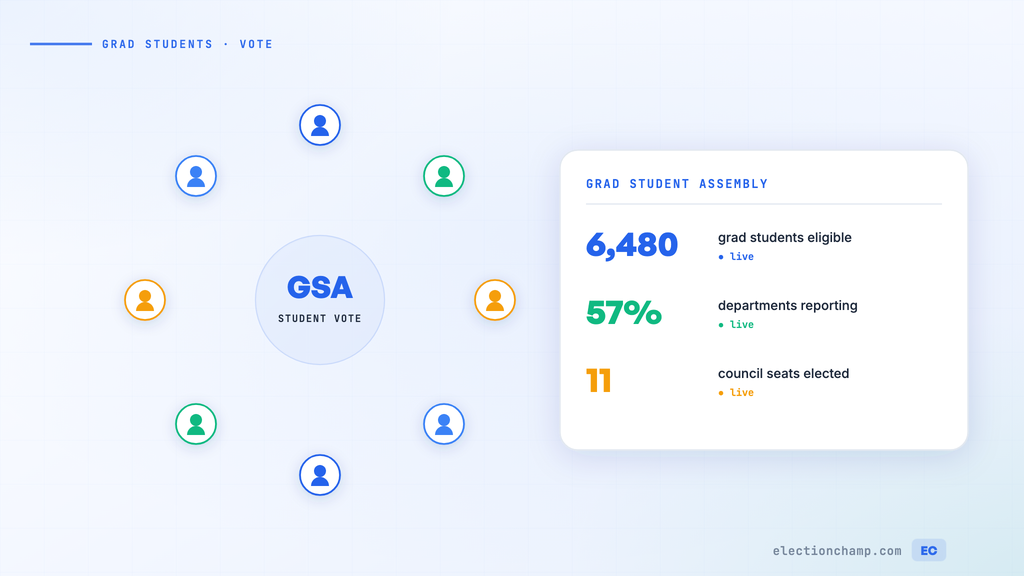
Graduate student associations (GSAs) face governance challenges that undergraduate student governments rarely encounter. Graduate students are older, busier, more dispersed, and more diverse in their schedules and commitments. Many are part-time. Many are international. Many work full-time jobs alongside their studies. Some are campus-based while others are entirely online.
This diversity makes traditional meeting-based voting nearly impossible — and makes online voting not just convenient but essential for legitimate representation.
Common GSA Elections and Votes
|
Vote Type |
Who Votes |
Frequency |
Key Consideration |
|
GSA President / Officers |
All graduate students |
Annual |
Reaching students across all departments |
|
Departmental representatives |
Students within each department |
Annual |
Some departments have 5 students, others 500 |
|
Committee members |
All graduate students or specific groups |
Annual or as needed |
Matching expertise to committee function |
|
Fee referendums |
All graduate students |
As needed |
High stakes — affects every student’s finances |
|
Budget allocation votes |
GSA council / representatives |
Annual or per term |
Distributing limited resources fairly |
|
Policy resolutions |
All graduate students or council |
As needed |
Parking, health insurance, TA pay, campus policies |
Reaching Every Graduate Student
The fundamental challenge: how do you get a vote from someone who’s in the lab at 2 AM, attending classes remotely from another state, or working a clinical rotation at a hospital 30 miles from campus?
- Extended voting windows (10-14 days): Give every student, regardless of schedule, ample time to vote
- Email + SMS notifications: University email for initial notification, SMS reminders for urgency
- Mobile-optimized voting: Students can vote from their phone between classes, during a break, or from home
- No app required: The ballot opens in any browser — critical for students who won’t download another app
Departmental Representation Elections
Most GSAs use a representative model where each department or program elects a representative to the council:
- Create separate elections for each department: “Physics Department GSA Representative Election”
- Import only students enrolled in that department as voters
- Use Plurality voting with Total Winners matching the number of seats allocated to that department
- For very small departments (fewer than 20 students): ElectionChamp’s free tier covers the election entirely
- For large departments: The cost is minimal — $10 for up to 200 students
Fee Referendums
Fee referendums are among the most consequential GSA votes. When proposing a new student fee or changing an existing one, every graduate student is affected:
- Create a clear Yes/No ballot: “Do you approve a $15 per semester Student Activity Fee to fund [specific purposes]?”
- Provide detailed information in the Voter Instructions: what the fee funds, how it compares to peer institutions, and the GSA budget impact
- Set Result Visibility to “After Election Ends” to prevent early results from discouraging participation
- Monitor participation closely — many universities require minimum turnout thresholds for fee referendums to be binding
Engaging International Students
International graduate students make up a significant portion of many programs but often participate at lower rates in governance:
- Provide ballot instructions in clear, simple English — avoid idioms and jargon
- Consider translating key information for programs with large populations of students from specific countries
- Ensure the voting platform works internationally — ElectionChamp is web-based and accessible from any country
- Proactively recruit international student candidates to ensure representation
Engaging Online and Part-Time Students
- Online voting is the only realistic method for students who never set foot on campus
- Send notifications to personal email addresses, not just university accounts — part-time students check personal email more frequently
- Time voting windows to span at least one full weekend when part-time students are most available
- Emphasize that voting takes 2-3 minutes from a phone — minimize the perceived time commitment
Budget Allocation Votes
GSA councils often vote on how to distribute funding to student organizations, events, and programs:
- Create a ballot with each funding request as a separate question: “Approve $500 for the Chemistry Department Symposium? Yes/No”
- Alternatively, use Ranked Choice to prioritize competing requests: rank 10 proposals in order of preference
- Include budget details in the Voter Instructions so council members can make informed decisions
- Download the results CSV and include it in council meeting minutes for transparency
Ready to modernize your organizational voting? Start for free at ElectionChamp.com — secure, anonymous, and mobile-friendly voting for every organization.