ElectionChamp
Listening to Your Community at Scale
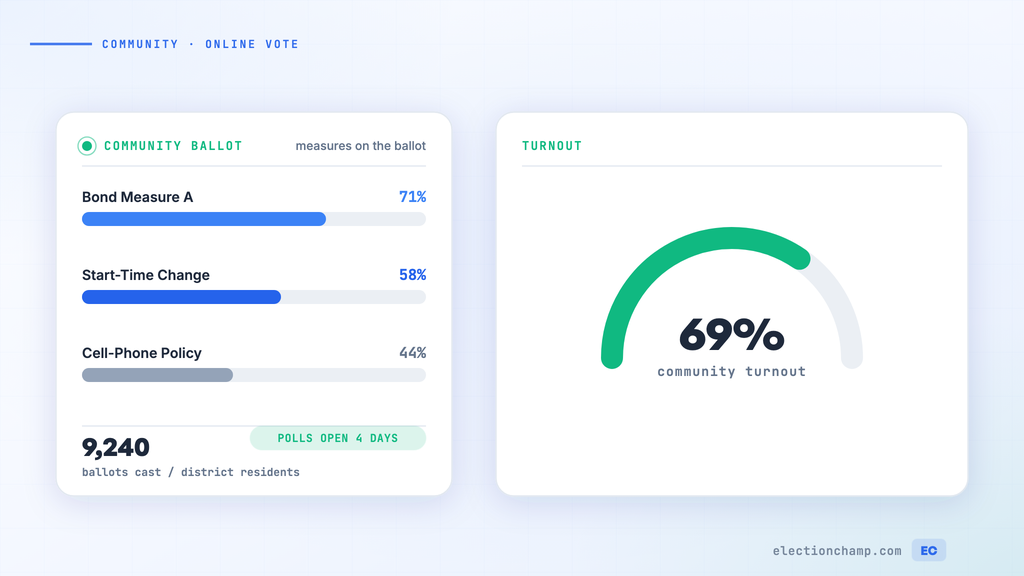
School boards make decisions that affect thousands of families: school boundary changes, calendar modifications, bond measures, facility priorities, curriculum adoptions, and policy updates. These decisions benefit from community input, but gathering that input is challenging. Town halls attract a vocal minority. Paper surveys have low return rates. Comment periods yield unstructured feedback that’s hard to quantify.
Structured online voting gives school boards a way to collect measurable, representative community input on specific questions — turning vague community sentiment into actionable data.
Advisory Votes vs. Binding Votes
|
Type |
Legal Authority |
Purpose |
Example |
|
Binding vote |
Required by law or board policy; result is decisive |
Formal decisions mandated by statute |
Bond measure approval, tax levy renewal |
|
Advisory vote |
Board retains decision-making authority; result informs but doesn’t bind |
Gauging community preference |
School calendar preference, mascot change, facility priorities |
|
Stakeholder survey |
No formal authority; purely informational |
Broad feedback collection |
Satisfaction surveys, program interest gauges |
Most school board community votes are advisory — the board collects input and considers it alongside other factors when making decisions. This is important to communicate clearly: parents and community members should know that their vote matters and will be considered, but the board retains final authority.
What School Boards Can Vote On
- School calendar: Should the district adopt a traditional or year-round calendar? Should spring break align with neighboring districts?
- Facility priorities: Rank these 5 facility improvement projects in order of priority for the community
- Boundary changes: Do you support the proposed school boundary redistricting plan? (Yes/No with supporting documents)
- New program interest: Should the district invest in a new dual-language immersion program? A STEM academy? An arts magnet?
- Policy input: Should the district adopt a later start time for high schools? Should cell phones be permitted in classrooms?
- Bond measure priorities: If a bond measure passes, how should funds be allocated? (Ranked Choice among options)
Setting Up a Community Advisory Vote
- Define the question clearly: Be specific about what you’re asking and what the options are.
- Determine who votes: All parents? All residents in the district? Only parents of students at affected schools? This defines your voter list.
- Build the ballot: Use Yes/No for single proposals, Plurality for choosing among options, or Ranked Choice for prioritizing multiple items.
- Provide context: Attach background documents, financial analyses, or FAQ documents in the Voter Instructions field.
- Set a generous voting window: 10-14 days to accommodate busy family schedules.
- Send notifications via email and SMS: Parents are more likely to respond to text messages than email.
- Share results publicly: Post the results at the next board meeting and on the district website.
Multilingual Support
School districts often serve linguistically diverse communities. Inclusive voting requires accessibility in multiple languages:
- Write ballot questions and voter instructions in all major languages spoken in your community
- Use ElectionChamp’s Voter Instructions field to include translated versions of the question and supporting materials
- Send notification emails in the family’s preferred language if your student information system tracks language preference
- Partner with community organizations and bilingual parent liaisons to promote the vote
Building Trust Through Transparency
Community trust in advisory votes depends on how the board uses the results:
- Share results publicly within 48 hours of the vote closing
- Include participation statistics: how many people voted, what percentage of the community participated
- At the board meeting where the decision is discussed, explicitly reference the advisory vote results
- If the board’s decision differs from the advisory vote result, explain why — this maintains trust even when the board exercises its independent judgment
Reaching Underrepresented Families
The families who are hardest to reach are often the ones most affected by school board decisions:
- Partner with community organizations that serve immigrant, low-income, and minority families
- Distribute Manual Keys through community centers, churches, and food banks
- Set up voting stations at school events (back-to-school nights, parent-teacher conferences) where parents are already present
- Use SMS notifications heavily — text message reach is more equitable than email across socioeconomic groups
Measuring Community Engagement Over Time
|
Metric |
First Vote |
Goal After 1 Year |
How to Track |
|
Participation rate |
15-25% (typical for first advisory vote) |
35-50% |
Total votes / eligible voters |
|
Demographic representation |
Skewed toward engaged families |
More representative of district demographics |
Compare voter demographics to enrollment data |
|
Multilingual participation |
Low if not actively promoted |
Proportional to language demographics |
Track by notification language |
|
Repeat engagement |
N/A |
60%+ of first-time voters participate again |
Compare voter lists across votes |
Ready to modernize your organizational voting? Start for free at ElectionChamp.com — secure, anonymous, and mobile-friendly voting for every organization.