ElectionChamp
Democratic Decision-Making in the Academy
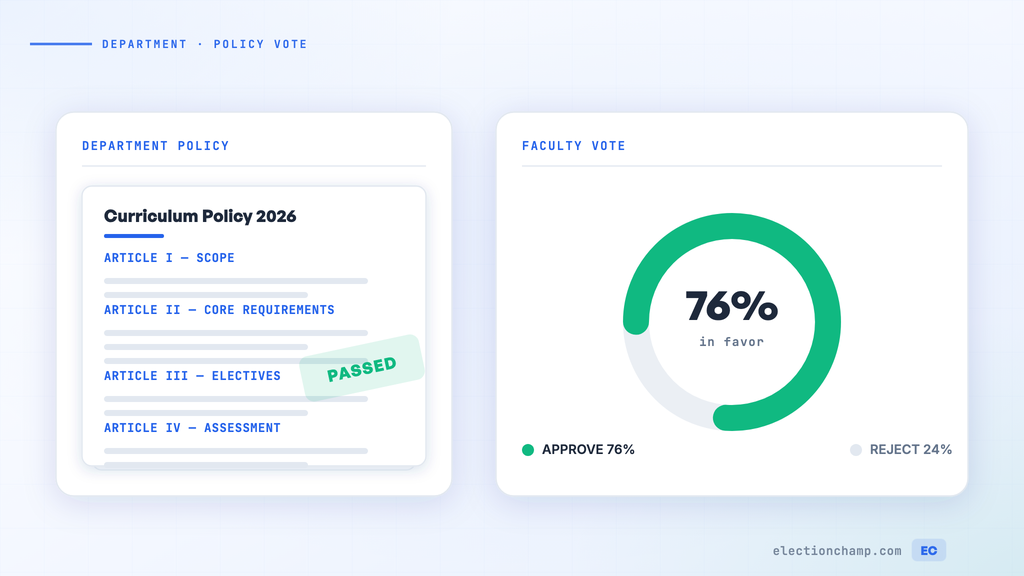
Academic departments are inherently collegial organizations. Faculty members are experts in their fields, and departmental decisions — what to teach, who to hire, how to allocate resources, what policies to adopt — benefit from collective input. Yet coordinating faculty votes through department meetings is increasingly difficult as faculty schedules become more complex and departments span multiple buildings, campuses, or even countries.
Online voting brings the democratic tradition of academic governance into the digital age, making it easier for every faculty member to participate regardless of their schedule or location.
Decisions That Departments Vote On
|
Decision Area |
Example Votes |
Who Votes |
Anonymity |
|
Curriculum |
New course approvals, program revisions, degree requirement changes |
All faculty or curriculum committee |
Usually not needed |
|
Hiring |
Candidate ranking, offer approvals, search committee composition |
Search committee or tenured/tenure-track faculty |
Strongly recommended |
|
Tenure & promotion |
Candidate evaluation, recommendation to dean |
Tenured faculty only |
Required |
|
Resource allocation |
Lab space distribution, equipment purchases, TA assignments |
All faculty |
Recommended |
|
Policy |
Grading policies, attendance rules, teaching load distribution |
All faculty |
Recommended |
|
Leadership |
Department chair selection, committee chairs, program directors |
All faculty or eligible subset |
Required |
|
Strategic planning |
Research focus areas, partnership priorities, growth plans |
All faculty |
Optional |
Why Anonymous Voting Matters in Departments
Academic departments are small communities where everyone knows everyone. This creates unique pressures that make anonymous voting essential for many decisions:
- Power dynamics: Junior faculty may feel pressured to vote with senior colleagues, especially on tenure and hiring decisions
- Retaliation concerns: Faculty who vote against a hire or a curriculum proposal may face social or professional consequences
- Honest assessment: Anonymous voting on hiring candidates produces more honest evaluations than open discussion where conformity pressure operates
- Minority protection: Faculty with dissenting views can express them without being identified and marginalized
ElectionChamp’s architectural anonymity ensures that no one — not the department chair, not the dean, not the IT department — can see how any individual faculty member voted.
Curriculum Votes
Curriculum decisions are the most frequent departmental votes:
- New course proposals: Create a Yes/No vote with the course proposal document attached in Voter Instructions.
- Program revisions: For comprehensive curriculum overhauls, create separate ballot questions for each major change so faculty can approve some while rejecting others.
- Degree requirement changes: These often require supermajority approval — verify your department’s or institution’s threshold.
- Course elimination: Sensitive decisions that benefit from anonymous voting — no faculty member should feel personally targeted.
- Assessment plan approvals: Required by accreditors; documented vote results strengthen your assessment portfolio.
Hiring Committee Votes
Faculty hiring decisions are among the most consequential votes a department makes:
- Candidate ranking: Use Ranked Choice voting to determine the department’s preference order among finalists. This produces a consensus ranking rather than a polarized plurality result.
- Offer approval: After interviews and campus visits, hold a Yes/No vote: “Should we extend an offer to [Candidate]?” Anonymous voting is essential.
- Search committee composition: If the department elects search committee members, use Plurality voting with the number of winners matching available seats.
- Failed search decisions: If no candidate is satisfactory, vote on whether to extend the search, restart, or close the position.
Department Chair Elections
Selecting a department chair is the most significant leadership decision a department makes:
- Many departments elect their chair from among tenured faculty; others have the dean appoint with faculty input
- Use Plurality voting if there are multiple candidates, or Yes/No if there’s a single nominee (a confidence vote)
- Always use anonymous voting — chair elections involve interpersonal dynamics that require ballot secrecy
- Set a voting window of 5-7 days to accommodate faculty schedules
- Share results with the dean’s office as required by institutional policy
Documentation for Accreditation
Accreditation bodies examine whether academic programs have faculty governance processes that are documented and effective:
- ElectionChamp results CSV provides evidence that curriculum changes were formally approved by faculty vote
- Participation rates demonstrate the level of faculty engagement in governance
- Audit trails document that votes were conducted fairly
- Include these records in your accreditation self-study and keep them accessible for site visit teams
Practical Tips for Department Administrators
- For departments with fewer than 20 faculty: ElectionChamp is completely free — there’s no reason not to use it for every departmental vote
- Create a department voting calendar at the start of each academic year: schedule known votes (chair election, curriculum review, committee elections) in advance
- Establish a standard voting window (e.g., 5 business days) so faculty know what to expect
- Archive all vote results in your department’s shared drive alongside meeting minutes
- Use ElectionChamp’s one-click results distribution to email results to all faculty immediately after each vote
Ready to modernize your organizational voting? Start for free at ElectionChamp.com — secure, anonymous, and mobile-friendly voting for every organization.