ElectionChamp
Short answer: Election observers watch the process so members can trust the result. They check who was eligible, how ballots were received, and how votes were counted, without seeing how anyone voted. To audit an online election, reconcile the voter roll, match turnout to ballots cast, check the result totals, and review the admin action log. Then sign off and archive the records.
What Do Election Observers Do?
An observer watches. They do not run the election, touch ballots, or talk to voters while they vote. The U.S. Election Assistance Commission puts it plainly: an observer’s role is “to observe and monitor the election, without violating voter privacy or disrupting the election” (EAC observer guide).
In clubs, associations, unions, and HOAs, the people involved usually fall into four groups.
| Role | Who appoints them | What they do |
|---|---|---|
| Candidate observer | Each candidate | Watches setup, voting, and the count on behalf of one candidate |
| Independent election observer | The board or election committee | Neutral witness with no stake in the outcome |
| Election committee or tellers | Bylaws or the board | Run the process and report the result |
| Auditor | The board, often after the vote | Reviews records and confirms the totals |
Observers vs Inspectors of Elections
An inspector of elections runs the election. An observer only watches it. Some laws require one or both.
- California HOAs must use one or three inspectors of elections. Their duties include determining voting entitlements, receiving ballots, counting votes, and determining results. They must act “impartially, in good faith” (Civil Code 5110).
- U.S. private sector unions covered by the LMRDA must let each candidate have an observer at the polls and at the counting of ballots. In mail ballot elections, that extends to preparing, receiving, opening, and counting ballots (29 CFR 452.107).
Most clubs and nonprofits have no statutory rule. Your bylaws or election policy decide. If they are silent, adopt a written observer policy by board resolution before nominations open.
How to Set Up Observers for an Online Election
Online, there is no ballot box to guard. Observers watch the voter list, the settings, and the log instead.
- Write the rules first. State who may observe, how many per candidate, and what they may see. Send the rules to every candidate at the same time.
- Appoint observers before launch. Name them in the election notice if you can.
- Walk observers through the setup. Show the final voter list, the ballot, the voting method, and the open and close times before you launch. Have them initial a checklist.
- Agree on what they see during voting. Turnout and who has voted is fair to share. How anyone voted is never available.
- Invite them to the close. Screen-share the results the moment voting ends, then share the result file and walk through the admin log together.
In ElectionChamp, the ballot and voter list lock at launch, so the setup observers approved is the setup voters get. Ballots are anonymous, and administrators can see whether someone voted, never what they voted for. Voter masking hides the status of the 5 most recent voters while voting is open. That stops anyone watching the dashboard from tying a just-cast ballot to a person by timing. See how secure online voting works for the full model.
What an Election Audit Trail Should Contain
An audit trail lets someone who was not there reconstruct what happened. Keep these items together.
- The final voter list as launched, with any spare keys issued to latecomers
- The election notice and every reminder, with send dates
- The ballot exactly as voters saw it, including the voting method and “select up to” rules
- Open and close times, and whether the election closed automatically or early
- A timestamped log of every administrative action
- The final results file
- Observer and committee sign-offs
The admin log matters most in a dispute. ElectionChamp keeps a timestamped log of dashboard views, voter list access, result views, and early close. A clean log shows nobody looked at results early or changed the roll mid-vote.
How to Audit Election Results
Run these checks soon after the close, with at least one observer present. Each compares two numbers that should agree.
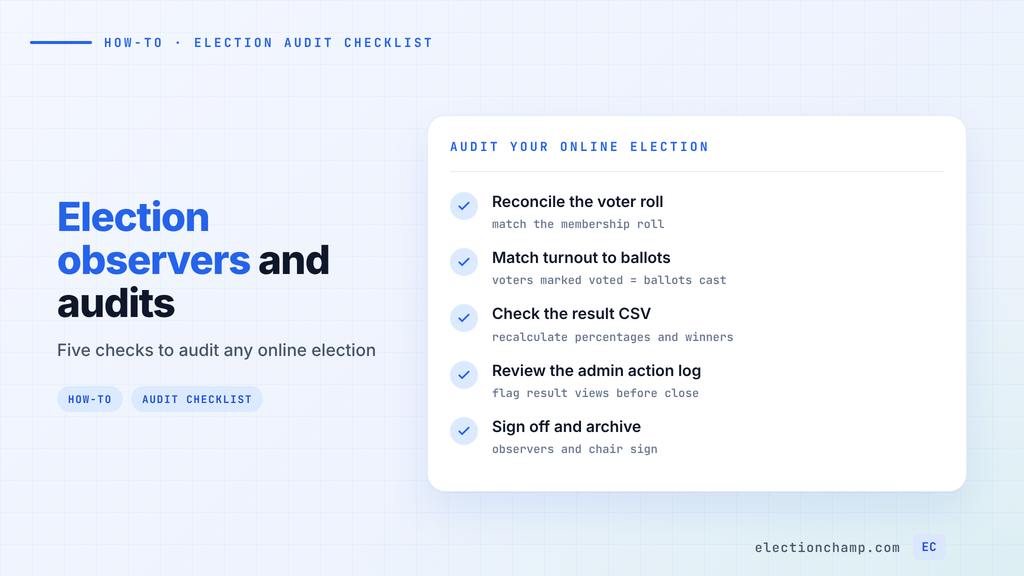
1. Reconcile the Voter Roll
Compare the launched voter list against your membership roll as of the record date in your bylaws. Every eligible member should appear once. Nobody ineligible should appear at all. Account for every spare key: who received it and why.
2. Match Turnout to Ballots Cast
Count the voters marked as having voted. That number should equal ballots cast. On a single-choice question, candidate votes plus abstentions should also equal ballots cast.
Multi-seat races work differently. In a “select up to 3” race, total votes can reach three times the ballots cast, never more.
3. Check the Result File
Download the results CSV and recalculate the percentages yourself. Confirm the winners match your bylaws, including any required majority or tie rules. ElectionChamp’s CSV lists every question, candidate, count, percentage, and winner.
4. Review the Admin Action Log
Read the log from creation to close. Flag any result views before close, voter list access after launch, or an early close that nobody authorized. Each flag needs a written explanation.
5. Sign Off and Archive
Observers and the committee chair sign a one-page audit statement. File it with the records, then announce the result.
Worked Example
Here is an illustrative audit for a 140-member association electing one president and three directors.
| Check | Numbers | Result |
|---|---|---|
| Voter roll vs membership roll | 140 on both, no spare keys | Pass |
| Voters marked voted vs ballots cast | 96 and 96 | Pass |
| President: votes plus abstentions | 51 + 41 + 4 = 96 | Pass |
| Directors: select up to 3 | 261 votes, limit 288 (96 x 3) | Pass |
| Admin log | No result views before close | Pass |
Election Audit Checklist
- Observer rules sent to all candidates on the same day
- Observers named before launch
- Voter list matches the membership roll as of the record date
- Every spare key accounted for
- Voters marked voted equals ballots cast
- Per-question totals fit the ballot rules
- Percentages and winners recalculated by hand
- Admin log reviewed, with any flags explained in writing
- Audit statement signed by observers and the chair
- Records archived with the retention date noted
Recount Procedures for Online and Hybrid Elections
A hand recount of paper ballots looks for human counting errors. Online votes are tallied by software, so the same ballots produce the same totals. An online recount re-checks the inputs instead: the voter list, the turnout reconciliation, and the method rules.
Set the recount rule in advance. A good policy states who may request one, the deadline, and who pays.
California sets a floor for HOAs. On written request, the inspector must make the ballots and the electronic tally sheet available for review. Any recount must preserve the confidentiality of the vote (Civil Code 5125).
In a hybrid election, recount the paper portion by hand with observers present. Then add it to the online totals. For ranked choice or STV races, review the point totals or rounds with observers so they can follow how each winner was found.
If a recount becomes a formal challenge, our guide to handling HOA election disputes covers the next steps.
How Long to Keep Election Records
Retention depends on your organization type and governing documents.
- LMRDA unions: electronic votes and all other election records must be kept for one year (OLMS compliance tip).
- California HOAs: the inspector keeps custody until the challenge window closes, then transfers it to the association (Civil Code 5125). A member has one year from the results notice to sue (Civil Code 5145).
- Everyone else: follow your bylaws. If they are silent, keeping the full package for the term of the officers elected is a sensible default. Confirm with your bylaws and counsel.
Store the voter list, results CSV, admin log, notices, and signed audit statement in one folder. ElectionChamp keeps a full audit trail for every election, so the log is ready when your auditor asks.
Frequently Asked Questions
What is an independent election observer?
An independent election observer is a neutral person with no stake in the outcome who watches the election and confirms the rules were followed. In organizational elections, the board or election committee usually appoints them. They are not candidates, and they do not run the count.
Can election observers see how people voted?
No. Observers can see who is eligible, turnout, and how the count is done. A secret ballot means nobody, including observers and administrators, can link a vote to a voter.
How do you audit election results?
Reconcile the voter list against the membership roll, confirm that voters marked voted equals ballots cast, recalculate the result totals and winners, and review the admin action log. Then have observers and the chair sign an audit statement and archive the records.
Can you request a recount in an online election?
Yes, if your bylaws or election rules allow it. Software tallies the same ballots the same way, so an online recount usually re-checks the voter list, the turnout reconciliation, and the method rules. Paper ballots in a hybrid election are recounted by hand.
Planning your next vote? Read about secure online voting and audit trail, or see pricing: free up to 20 voters, $10 up to 200, then $0.05 per voter.