ElectionChamp
Why Fair Voting Matters for Awards and Scholarships
Scholarship and award decisions affect real people’s lives and careers. A student who receives a scholarship may be able to attend their dream school. A professional who wins an industry award gains recognition that opens doors. When the selection process is opaque, inconsistent, or influenced by bias, deserving candidates are overlooked and the organization’s credibility suffers.
Using a structured, documented voting process ensures that every committee member’s assessment carries equal weight, decisions are defensible, and the organization maintains its reputation for fairness.
Choosing the Right Voting Method
For most scholarship and award committees, Ranked Choice voting works best because it identifies the candidate with the broadest committee support rather than just the most polarizing first-choice pick.
Setting Up a Committee Vote
- Create the election: Name it clearly (e.g., “2026 Johnson Scholarship Selection — Review Committee Vote”)
- Set a short voting window: Committee votes typically need only 3-5 days since the voter pool is small
- Configure security: leave “Who can see results while voting is open?” on “No one” until voting closes so early results don’t influence remaining voters
- Build the ballot: Add each finalist as a candidate with their application summary, qualifications, or relevant portfolio
- Set the voting method: Choose Ranked Choice for consensus-building or Plurality for straightforward selection
- Import the committee: Add each committee member’s email address — this is your entire voter list
- Launch: Committee members receive their ballot link and vote independently
Anchoring Bias
When committee members discuss candidates before voting, the first opinion stated tends to anchor the group’s thinking. Online voting eliminates this by having each member vote independently before seeing anyone else’s assessment.
Halo Effect
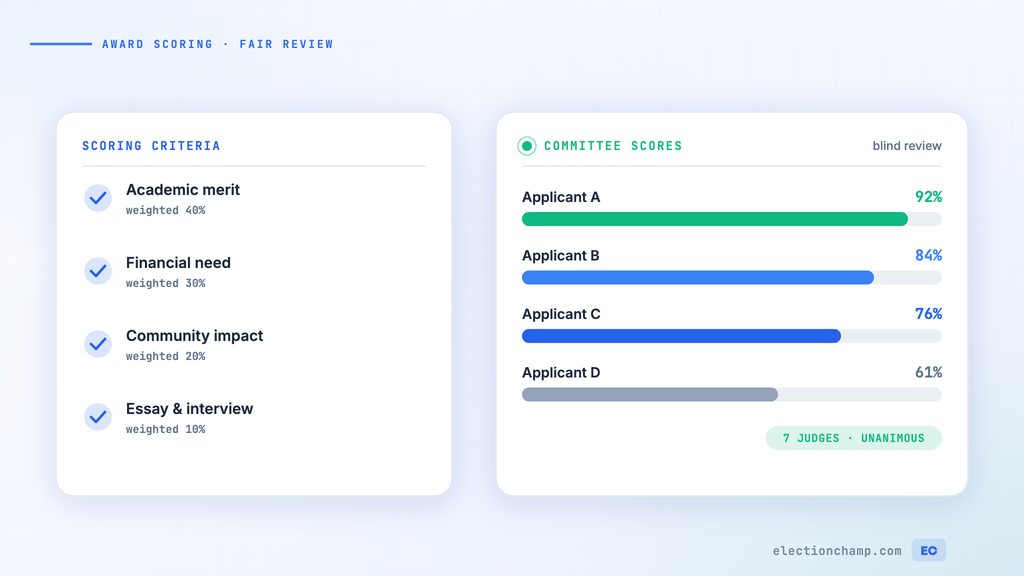
A strong performance in one criterion (e.g., GPA) can create a halo that biases evaluation of other criteria. If you need multi-criteria assessment, create separate ballot questions for each criterion:
- Question 1: Academic Achievement (rank candidates)
- Question 2: Leadership & Community Service (rank candidates)
- Question 3: Financial Need (rank candidates)
- Question 4: Overall Recommendation (rank candidates)
This forces committee members to evaluate each dimension separately, reducing halo effects.
Recency Bias
Enable Random Order on the ballot so candidates appear in a different sequence for each committee member. This prevents the first or last candidate listed from receiving disproportionate attention.
Handling Conflicts of Interest
Award committees often include people who know the candidates personally. Manage this transparently:
- Before voting, ask each committee member to disclose any relationships with candidates
- Members with conflicts should recuse themselves from voting on those specific candidates
- If using ElectionChamp, you can create separate ballots for committee members with conflicts (excluding the conflicted candidate from their ballot)
- Document all conflict disclosures and recusals for your records
Handling Ties
Ties are more common in small committee votes. Prepare for them:
- Define your tiebreaking procedure before voting begins — include it in the committee charter or election announcement
- Common tiebreakers: committee chair casts deciding vote, additional ranked-choice round among tied candidates, or split the award if possible
- ElectionChamp will show exact vote counts and rankings so ties are immediately visible
Documenting Decisions
Thorough documentation protects your organization:
- Download the ElectionChamp results CSV as your official voting record
- Save the audit trail showing when each committee member voted
- Record the selection criteria used and how they were communicated to the committee
- Note any conflict-of-interest disclosures and recusals
- Include the committee’s decision in your board meeting minutes or organizational records
Multi-Round Selection Processes
For competitive scholarships or prestigious awards with many applicants, a multi-round process works well:
- Round 1 — Nominations: Use ElectionChamp’s Nomination ballot type. Committee members write in the names of applicants they believe should advance to the shortlist.
- Round 2 — Narrowing: Create a Plurality ballot with the shortlisted candidates. Each committee member votes for their top 5-10 (depending on how many finalists you want).
- Round 3 — Final Selection: Use Ranked Choice voting among the finalists to identify the winner with the broadest committee support.
Each round is a separate election in ElectionChamp, taking about 5 minutes to set up.
Planning your next vote? Read about nonprofit board voting and board elections, or see pricing: free up to 20 voters, $10 up to 200, then $0.05 per voter.