ElectionChamp
Trust Is the Foundation of Union Strength
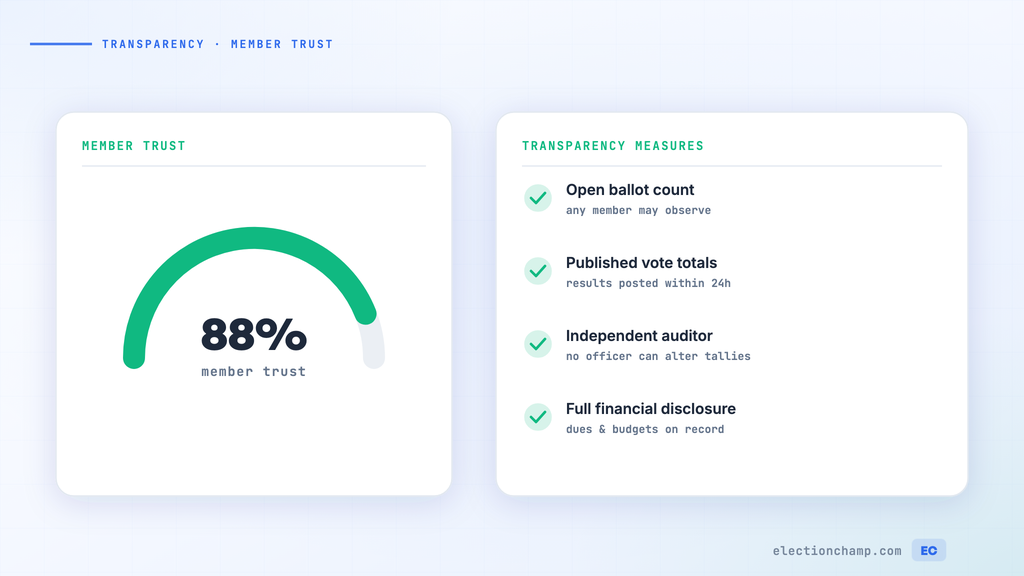
A union’s power comes from its members. When members trust their leadership and the processes that put those leaders in place, the union speaks with a unified voice. When trust erodes — whether due to perceived favoritism, opaque processes, or contested results — the union fragments, grievances go unresolved, and collective bargaining leverage weakens.
Election transparency is not just a legal requirement under the LMRDA; it’s a strategic investment in organizational strength. Unions with transparent, well-documented election processes experience higher participation, fewer protests, smoother leadership transitions, and stronger member engagement across all activities.
The Trust Deficit: Where It Comes From
Member distrust of election processes often stems from identifiable causes:
- Closed processes: Nominations controlled by insiders, slate-making without member input, or barriers to running for office
- Information gaps: Members don’t understand how votes are counted, who oversees the process, or how results are verified
- Historical grievances: Past elections that were perceived as unfair create lasting skepticism, even when current leadership is acting in good faith
- Lack of competition: Uncontested elections year after year signal either a healthy consensus or a discouraged opposition — members often assume the latter
- Opaque counting: Paper ballot counting behind closed doors, even when done honestly, invites suspicion
Pillar 1: Open and Documented Processes
- Publish your election timeline, procedures, and rules well in advance — at least 60 days before the election
- Make nomination procedures clear: who can run, how to get on the ballot, and what the deadlines are
- Document every committee decision and make minutes available to members upon request
- Use a standardized election manual that the Election Committee follows consistently from election to election
Pillar 2: Technology That Proves Itself
Online voting platforms like ElectionChamp provide built-in transparency features that paper ballots cannot match:
- Unique voter keys: Each member receives a single-use, cryptographically generated key — no ambiguity about who can vote or whether anyone voted twice
- Automatic anonymization: The system architecturally separates voter identity from ballot selections — not even administrators can see how anyone voted
- Real-time audit trail: Every administrative action (dashboard views, voter list access, result views) is logged with timestamps
- Automated counting: Results are calculated mathematically — no human counting errors or subjective interpretations
- Downloadable records: Results CSV, audit logs, and participation data can be archived and shared with any oversight body
Pillar 3: Independent Oversight
- Appoint an Election Committee composed of members who are not running for office
- Invite candidate observers to review the process — share the ElectionChamp dashboard or audit trail
- Consider engaging a neutral third party (another local, a regional body, or a professional election administrator) to oversee contested or high-stakes elections
- OLMS offers technical assistance for unions that want guidance on best practices — take advantage of it proactively rather than waiting for a complaint
Pillar 4: Member Education
- Explain how the voting system works before the election — host a demo session or distribute a simple FAQ
- Address common concerns directly: “Can anyone see how I voted?” (No — here’s why.) “Can someone vote twice?” (No — here’s how the system prevents it.)
- After the election, share not just the results but the process metrics: total participation, how notifications were delivered, the audit trail summary
- Invite questions and feedback after every election — treat it as an opportunity to improve, not as criticism
Pillar 5: Continuous Improvement
- After each election, conduct a brief review: What worked? What caused confusion? What would we do differently?
- Track participation rates over time — a steady increase indicates growing trust
- Benchmark your participation against similar locals or industry averages
- Make process improvements visible to members: “Based on your feedback, we’ve extended the voting window and added SMS reminders”
Transparency as a Protest Shield
The most practical benefit of transparency is protest prevention. DOL election protests are expensive, time-consuming, and damaging to union solidarity. When elections are transparent and well-documented:
- Members who lose have less basis for challenge because the process was fair and visible
- The audit trail provides objective evidence that procedures were followed
- OLMS investigations (if they occur) are resolved quickly when records are complete
- The membership’s confidence in the result prevents the kind of internal fracturing that undermines bargaining power
Building Trust Over Multiple Election Cycles
|
Election Cycle |
Trust-Building Actions |
Expected Outcome |
|
Year 1 (Transition) |
Switch to online voting; publish procedures; invite observers; hold info sessions |
Some skepticism; moderate participation increase; establish baseline metrics |
|
Year 2 (Reinforcement) |
Share Year 1 metrics; implement feedback improvements; expand communication |
Growing confidence; higher participation; fewer complaints |
|
Year 3+ (Institutionalization) |
Transparent process is now “how we do things”; new members learn the system; focus on continuous refinement |
High trust; strong participation; election processes strengthen rather than divide the union |
Planning your next vote? Read about union voting software and contract ratification votes, or see pricing: free up to 20 voters, $10 up to 200, then $0.05 per voter.