ElectionChamp
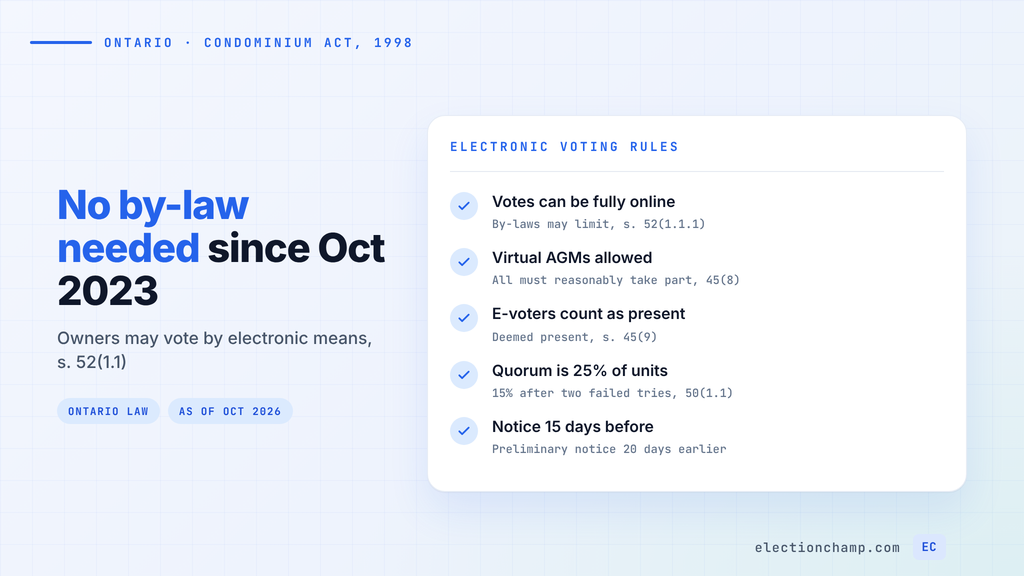
Short answer: Since October 1, 2023, the Ontario Condominium Act, 1998 lets owners vote by telephonic or electronic means without a special by-law. Under section 52(1.1), a show of hands or recorded vote can be held entirely online, in person, or in any mix. Owners’ meetings can be fully virtual or hybrid under section 45(6). Your by-laws can still limit or set conditions on both.
The change came from Schedule 7 of the Less Red Tape, Stronger Economy Act, 2023 (Bill 91), which made the pandemic-era rules permanent. This guide sets out each rule with its section number, then a setup checklist. Confirm every step against your declaration, by-laws, and counsel before your next AGM.
What the Ontario Condo Act Allows for Electronic Voting
Bill 91 added a definition of “telephonic or electronic means” to section 1(1) of the Act. It covers any means that uses the telephone or other electronic or technological means to transmit information or data. Online voting platforms, email ballots, phone votes, and fax all fit, according to the Condominium Authority of Ontario (CAO) electronic meeting guide.
The table summarizes the rules that matter for an electronic vote. Section references are to the Condominium Act, 1998 on e-Laws and O. Reg. 48/01.
| Topic | What the Act says | Section |
|---|---|---|
| Electronic voting | Subject to the by-laws, a show of hands or recorded vote may be held entirely by telephonic or electronic means, in person, or a combination | s. 52(1.1) |
| By-law limits on voting | By-laws may limit the methods used and set requirements for an electronic vote | s. 52(1.1.1) |
| Virtual and hybrid meetings | Subject to the by-laws, an owners’ meeting may be held entirely by telephonic or electronic means, in person, or a combination | s. 45(6) and (7) |
| Participation | The method must let everyone entitled to attend reasonably participate | s. 45(8) |
| Remote voters | A person who votes or attends electronically is deemed present at the meeting | s. 45(9) |
| Quorum | Owners of 25% of units present; 15% after two failed attempts at certain meetings, unless by-laws say otherwise | s. 50(1) and (1.1) |
| Electronic notice | Notice may go to an owner’s electronic communication address unless a by-law prevents it | s. 47(4)(c) and (6) |
| Virtual meeting notice | A fully electronic meeting’s notice need not name a place | s. 47(7.1) |
| Vote records | Corporation records include proxies, ballots, and any record of votes cast electronically before or at the meeting | s. 55(1), para. 10 |
Sources: Bill 91, Schedule 7 (sections 1, 45, 47, 52, and 55 as amended, in force October 1, 2023) and the CAO Owners’ Meeting Guide for the quorum figures.
Do You Still Need a By-Law for Electronic Voting?
No. Before October 1, 2023, the permanent rules required a by-law to vote electronically, and temporary pandemic rules filled the gap until September 30, 2023. Bill 91 repealed part of section 52(1)(b) and added section 52(1.1). Electronic voting is now the default.
The words “subject to the by-laws” still carry weight. Section 52(1.1.1) lets a by-law limit the methods a corporation may use and set requirements for an electronic vote. Section 45(7) does the same for meetings. The CAO’s owners’ meetings page puts it plainly: virtual and hybrid meetings are allowed “unless your corporation’s by-law limits or prohibits them.”
Pull your by-laws before you plan the vote. Many corporations passed electronic voting by-laws before 2023. If yours sets conditions, such as owner consent, a registration process, or an approved list of methods, those conditions still apply. The CAO lists these as by-law topics, as best practice or, for mailed ballots, as a requirement:
- Advance voting procedures, so early votes are handled the same way each year.
- A proxy deadline before the meeting (the CAO suggests at least 7 days).
- Hybrid meeting procedures that stop an owner from voting twice.
- Mailed ballots, which the CAO says require a by-law that allows them.
Amending a by-law is its own owner vote. Our guide to condo association elections and compliance covers the governance side in more depth.
Ontario Condo Virtual Meetings and Hybrid AGMs
Section 45(6) allows an owners’ meeting to be held entirely by telephonic or electronic means, entirely in person, or as a hybrid. The test is section 45(8): the method must let every person entitled to attend reasonably participate.
Under the CAO guide, owners must be able to see or hear the business and vote if they have the right to. Section 45(3) lets owners raise any matter relevant to the corporation’s affairs at an AGM, so the platform has to let owners speak and ask questions. The CAO also recommends getting consent before recording a meeting.
Hybrid meetings add one risk: double voting. An owner who voted online in advance might also try to vote in the room. The CAO recommends tracking who voted in advance so no one votes twice or changes a vote. Our guide to adding online voting to your AGM walks through hybrid logistics step by step.
How Quorum Counts Electronic Votes
Quorum for most owners’ meetings is owners of 25% of the units present, under section 50(1). Some meetings get a lower threshold: an AGM, a turn-over meeting, or a meeting to elect directors or appoint an auditor. The CAO guide says quorum for these drops to 15% after two failed attempts, under section 50(1.1), unless the by-laws say otherwise. The reduction does not apply to owner-requisitioned meetings.
Electronic participation counts. Section 45(9) deems a person who attends or votes electronically, before or at the meeting, to be present. The CAO guide confirms quorum counts owners present in person, by proxy, or through telephonic or electronic attendance or voting.
Advance votes have a limit. The CAO guide says early votes count toward quorum only for the items voted on and set out in the meeting agenda. An owner who voted early on the director election is not present for a motion added at the meeting.
Arrears can also matter. A CCI Toronto article from June 2026 notes that under section 50(2), owners in arrears are not entitled to vote and may not count toward quorum. Check the exact conditions with your manager and counsel before you finalize the voter list.
Notice and Proxy Rules for Electronic Meetings
Notice Requirements
The CAO meeting notices page sets out two notices, both on mandatory forms:
- A preliminary notice, sent at least 20 days before the notice of meeting. It states the purpose of the meeting and, where directors are being elected, invites candidates to tell the board in writing.
- A notice of meeting, sent in writing at least 15 days before the meeting.
For an electronic or hybrid meeting, the notice must say how to attend by phone or electronically. Under section 47(7.1), a fully electronic meeting’s notice need not name a place. For an AGM, the CAO guide notes the approved financial statements and auditor’s report must be attached.
Notices can go by email under section 47(4)(c) when the owner’s address is in the record of owners and mortgagees, no by-law under section 47(6) prevents it, and the owner has not opted out. Ask owners to confirm their email addresses well before the preliminary notice goes out.
Proxies Alongside Electronic Voting
Owners keep the right to vote by proxy, and the CAO guide says organizers must set up a process for it. To appoint a proxy, the owner must use the proxy form on the CAO website. A proxy need not be an owner, and the appointment must be in writing under the hand of the owner or the owner’s attorney, under sections 52(3) and 52(4).
Validating proxies during a virtual meeting slows everything down. Set a deadline before the meeting, ideally in a by-law, and reconcile proxies against the electronic voter list. Each unit should end up with one route to vote: online, in person, or by proxy.
Keeping Records of Electronic Votes
Bill 91 amended paragraph 10 of section 55(1). The corporation’s records now include proxies, ballots, and “any record of votes cast through telephonic or electronic means before or at the meeting.” Minutes are still required for an electronic meeting and are kept under section 55(1).
On retention, the CCI Toronto article cites section 13.2 of O. Reg. 48/01: proxies and ballots must be kept for at least 90 days after the meeting, and longer if the corporation receives written notice of actual or contemplated litigation about them. Confirm the current wording on e-Laws and with counsel, and set your retention date before the vote.
The CAO guide adds that an e-voting system “must have the ability to record and retain all information required to be kept by the condo corporation.” In practice, pick a system that lets you export who voted, the results, and a log of what administrators did, and store all of it with your corporate records.
Ontario Condo Electronic Voting Checklist
- Read your declaration and by-laws for any limits under sections 45(7) or 52(1.1.1).
- Choose the meeting format (virtual, hybrid, or in person) and confirm everyone can reasonably participate.
- Confirm owner email addresses and opt-outs before the preliminary notice.
- Send the preliminary notice at least 20 days before the notice of meeting.
- Send the notice of meeting at least 15 days before the meeting, with attendance and voting instructions.
- Set a proxy deadline and require the CAO proxy form.
- Build the voter list with one entry per unit and remove units voting by proxy or in person.
- Track quorum across online, in-person, and proxy votes, counting each unit once.
- Export results and the audit log, and store them with the minutes, proxies, and ballots.
ElectionChamp handles the recorded vote part of this list. Each unit gets a single-use 16-character voter key by email, SMS, or printed card, so no unit can vote twice. Ballots are anonymous: administrators see whether a unit voted, never how. Printed keys cover owners voting in the room at a hybrid AGM, tracked in the same election. Results arrive the moment voting closes, and you can download them as CSV and export the timestamped audit log for your records. See how it works for condo and HOA online voting.
Pricing is per election. A 150-unit corporation fits in the US$10 tier (up to 200 voters), and a 400-unit corporation pays US$0.05 per voter, or US$20. Elections with up to 20 voters are free. We do not provide legal advice, so confirm the process with your by-laws and counsel.
Frequently Asked Questions
Can Ontario condo owners vote electronically?
Yes. Since October 1, 2023, section 52(1.1) of the Condominium Act, 1998 allows a show of hands or recorded vote to be held entirely by electronic means, in person, or a mix. This is subject to the corporation’s by-laws.
Does an Ontario condo need a by-law for electronic voting?
No new by-law is needed. Electronic voting is permitted unless a by-law limits it. Under section 52(1.1.1), by-laws can limit voting methods and set requirements, so check any existing electronic voting by-law. The CAO says mailed ballots still require a by-law.
Can an Ontario condo AGM be held virtually?
Yes. Section 45(6) allows an owners’ meeting to be held entirely by telephonic or electronic means, in person, or as a hybrid, subject to the by-laws. Under section 45(8), the method must let everyone entitled to attend reasonably participate.
Do electronic votes count toward quorum in an Ontario condo?
Yes. Section 45(9) deems an owner who attends or votes electronically to be present. The CAO says advance votes count toward quorum only for items voted on and set out in the meeting agenda. Quorum is generally owners of 25% of the units.
Planning your next vote? Read about condo and HOA online voting and board elections, or see pricing: free up to 20 voters, US$10 up to 200, then US$0.05 per voter.