ElectionChamp
Short answer: an HOA proxy is a signed, written authorization that lets another person vote for a homeowner who cannot attend. Most states allow proxies unless the governing documents prohibit them. A directed proxy, which spells out how to vote, is safer than a general proxy. Online voting removes most of the need for proxies because owners can vote directly from any device.
This guide explains what proxy voting is, when it is appropriate, the legal framework governing its use, the risks involved, and how online voting is making proxies increasingly unnecessary.
What Is Proxy Voting?
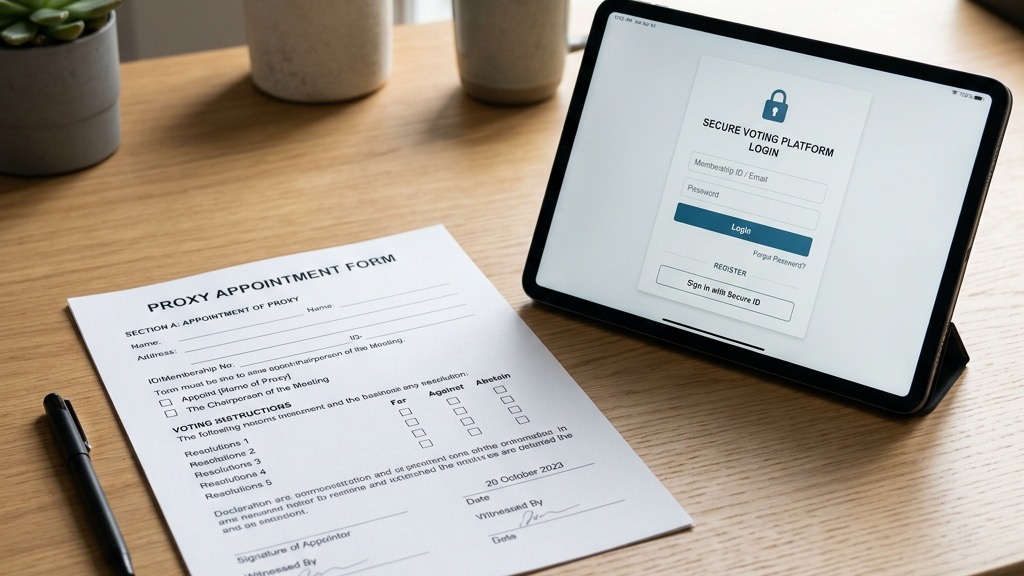
A proxy is a written authorization from one homeowner (the grantor) to another person (the proxy holder) to vote on their behalf at an HOA meeting or election. The proxy holder casts votes as directed by the grantor, or in the case of a general proxy, uses their own judgment.
Proxies exist because traditional HOA voting required physical presence at a meeting. If a homeowner traveled, worked during meeting hours, or simply could not attend, they had no way to participate without assigning a proxy.
Types of HOA Proxies
| Proxy Type | How It Works | When to Use |
|---|---|---|
|
General Proxy |
Authorizes the holder to vote on any matter using their own judgment |
When the grantor trusts the holder to make good decisions on all items |
|
Limited/Directed Proxy |
Specifies exactly how the holder must vote on specific items |
When the grantor wants control over their vote on a particular issue |
|
Quorum Proxy |
Counts toward meeting quorum but does not cast any votes |
When the HOA just needs to meet the attendance threshold |
Most governance experts recommend limited or directed proxies over general proxies because they ensure the homeowner’s actual preferences are recorded.
State Laws on HOA Proxy Voting
Proxy voting rules vary significantly by state. Here is an overview of how key states handle HOA proxies:
| State | Proxies Allowed? | Key Rules |
|---|---|---|
|
California |
Only if the bylaws permit or require them |
The proxy holder must be a member, and a proxy cannot replace the ballot. Voting instructions go on a separate, detachable page, and the proxy holder casts a secret ballot. Revocable until the inspector of elections receives the ballot. Valid 11 months unless the proxy says otherwise, 3 years at most (Civil Code §5130, Corporations Code §7613). |
|
Florida |
Yes |
Must be filed with the secretary, valid only for the specific meeting. Limited proxies required for certain votes. |
|
Texas |
Yes, unless bylaws prohibit |
Must be signed, dated, and specify the meeting. Revocable at any time. |
|
Colorado |
Yes, with limitations |
CCIOA requires proxies be in writing. Bylaws can restrict or prohibit proxies. |
|
New York |
Yes |
Must comply with Not-for-Profit Corporation Law. Proxy valid for 11 months unless otherwise stated. |
|
Illinois |
Varies by declaration |
Common Interest Community Association Act allows proxies unless bylaws prohibit them. |
|
Arizona |
Yes |
Must be in writing, signed, and delivered to the association before the meeting. |
This table is a summary, not legal advice. State statutes change and your declaration or bylaws can add limits, so confirm the rules with your governing documents and counsel before an election.
The Risks of Proxy Voting
While proxies serve a purpose, they come with significant risks that every HOA board should understand:
Proxy Harvesting
This is the practice of one individual or faction collecting a large number of general proxies to concentrate voting power. A single person showing up with 30 proxies can effectively control the outcome of an election. This is legal in many jurisdictions but undermines the democratic principles of community governance.
Fraud and Forgery
Paper proxy forms can be forged, signatures can be contested, and there is often no reliable way to verify that a proxy was actually authorized by the homeowner. Proxy disputes are among the most common triggers for HOA election lawsuits.
Voter Disconnection
When homeowners assign general proxies, they are essentially giving up their voice on issues they may not fully understand. The proxy holder’s vote may not reflect what the homeowner would have chosen if they had participated directly.
Administrative Burden
Managing proxies requires tracking which proxies have been submitted, whether they have been revoked, whether the proxy holder is present at the meeting, and whether the proxy is valid under state law. For large communities, this can be a significant operational challenge.
How Online Voting Reduces Proxy Dependence
The primary reason homeowners use proxies is that they cannot attend a physical meeting. Online voting eliminates this barrier entirely:
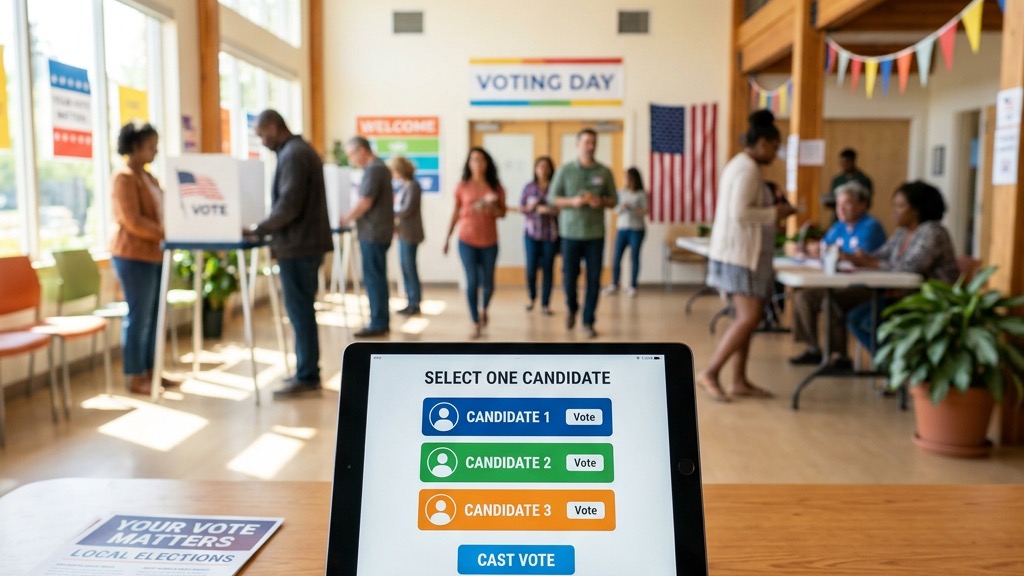
- Homeowners vote directly from their phone, tablet, or computer at any time during the voting window
- No need to attend a meeting, find a proxy holder, or fill out a proxy form
- Each homeowner casts their own vote using their unique, single-use voter key
- Votes are anonymous, authenticated, and recorded with a full audit trail
- No proxy harvesting, no forgery risk, no administrative burden
When owners can vote online during the whole voting window, the main reason to sign over a proxy goes away. Each owner casts their own ballot with a single-use voter key, and the board gets a full audit trail. See how this works on our HOA online voting page.
When Proxies Are Still Necessary
Even with online voting, there are situations where proxies may still be needed:
- Real-time meeting votes on motions from the floor that were not part of the pre-distributed ballot
- Homeowners without any internet access or digital literacy (though this is increasingly rare)
- Legal requirements in some jurisdictions that mandate proxy availability for certain vote types
In these cases, ElectionChamp’s printed key feature allows you to run a hybrid election where some homeowners vote online and others use printed ballots distributed in person. The system tracks all votes in one place, preventing double voting.
What an HOA Proxy Form Should Include
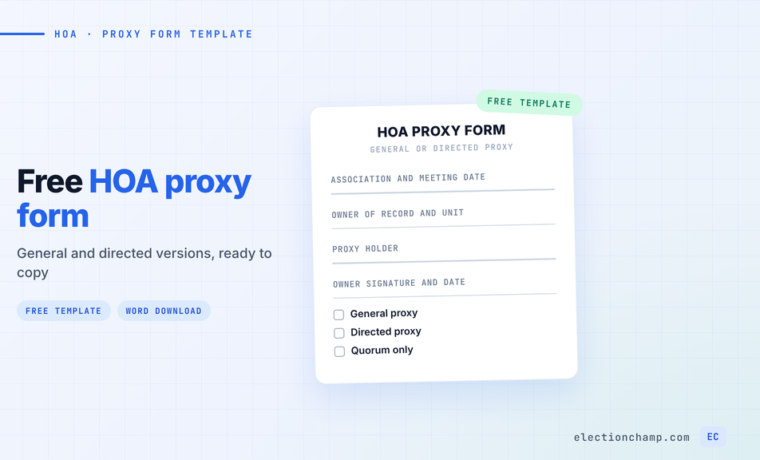
A proxy form that holds up to scrutiny usually includes these fields:
- Association name and the meeting or election the proxy covers, with its date
- Owner name, unit or lot number, and contact details
- Proxy holder name, or a default holder such as the board secretary
- Type of proxy: general, directed, or quorum only
- Voting instructions for each item, if directed
- Owner signature and date of signing
- Expiration date and a statement that the owner can revoke it
- Where and by when the completed form must be delivered
Check your state statute for required wording. Some states require voting instructions on a separate page so a secret ballot stays secret.
Are HOA Proxy Votes Confidential?
Only partly. The proxy holder sees the owner’s instructions on a directed proxy, and the association usually keeps the signed forms as election records. In states with secret-ballot rules, the instructions are often kept on a separate page from the signature so the vote cannot be matched to the owner. Online ballots avoid the problem: on ElectionChamp, ballots are anonymous and administrators cannot trace a vote to a voter. Read more about how ballot anonymity works.
Best Practices If You Must Use Proxies
If your HOA still uses proxies for some elections, follow these best practices to minimize risk:
- Use directed (limited) proxies rather than general proxies whenever possible
- Require proxies to be submitted in writing before the meeting, not handed in at the door
- Set a clear expiration date on all proxy forms
- Maintain a proxy log that records submission dates, grantor names, and proxy holders
- Allow homeowners to revoke proxies at any time before the vote
- Have the election committee verify proxy validity before counting
Frequently Asked Questions
Can an HOA prohibit proxy voting?
In most states, yes. The declaration or bylaws can restrict or prohibit proxies unless a state statute requires them for certain votes. In California, an association may use proxies only if its bylaws permit or require them. Confirm with your governing documents and counsel.
How long is an HOA proxy valid?
It depends on the state and the form. Many proxies cover a single meeting and its adjournments. In California, a proxy expires 11 months after its date unless it says otherwise, and no proxy can last more than 3 years.
Can an HOA proxy be revoked?
Generally yes. An owner can revoke a proxy before it is used, usually in writing or by voting in person. In California, the owner can revoke it until the inspector of elections receives the ballot.
Do proxies count toward quorum?
Usually yes. A valid proxy counts the owner as present for quorum, and a quorum-only proxy exists for that purpose alone.
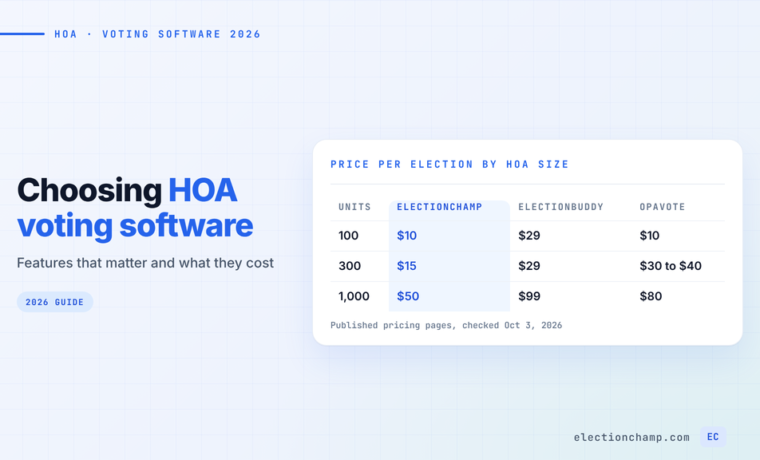
Running an HOA election soon? ElectionChamp is free for up to 20 voters and $10 for up to 200, with every feature included. See pricing or set up your election.