ElectionChamp

Short answer: most HOAs can vote online if state law and their governing documents allow electronic voting. Check both, pick a platform with anonymous ballots and an audit trail, load your owner list, and give owners a voting window of one to two weeks. This guide covers the legal checks, the setup timeline, and how to reach quorum.
Why HOAs Are Moving Online
Homeowner associations are among the fastest-growing adopters of online voting. The reason is simple: traditional paper-based HOA elections are expensive, time-consuming, and plagued by low participation. Boards spend weeks printing ballots, mailing them, collecting responses, and counting votes manually. After all that effort, participation rates often hover between 10 and 25 percent.
Online voting addresses every one of these pain points. It reduces costs by eliminating printing and postage. It saves time by automating ballot delivery and vote counting. And most importantly, it dramatically increases participation by making it effortless for homeowners to vote from anywhere, on any device, at any time during the voting window.
Legal Considerations: Can Your HOA Vote Online?
Before implementing online voting, your board must answer two questions: Does your state allow it? And do your governing documents permit it?
State Law
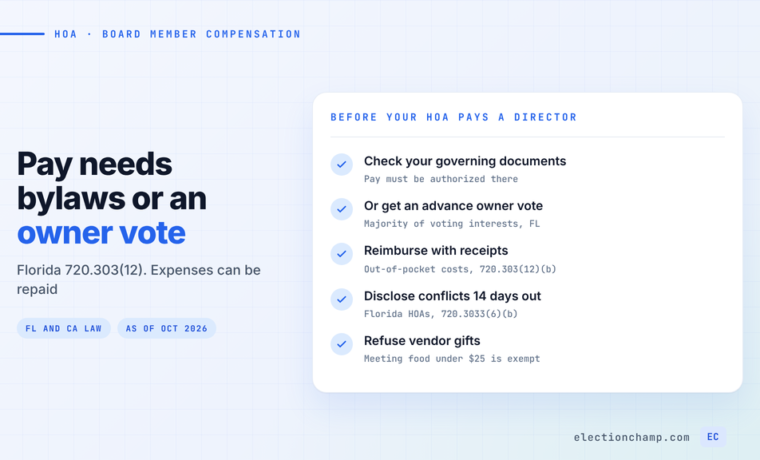
A growing number of states explicitly authorize electronic voting for HOAs and condominium associations. California’s AB 2159, which took effect January 1, 2025, is one of the most comprehensive, explicitly allowing HOAs to conduct elections electronically under the Davis-Stirling Act. Florida’s Statutes 720 and 718 address electronic voting for HOAs and condos respectively. Many other states either explicitly permit electronic voting or do not prohibit it, leaving the decision to the association’s governing documents.
Important: This is general information, not legal advice. Consult with your association’s attorney for guidance specific to your state and governing documents.
Governing Documents
Even if your state allows electronic voting, your CC&Rs, bylaws, or operating rules may contain language that restricts voting to specific methods. Common restrictions include requiring ballots to be “mailed” or requiring votes to be cast “in person” at a meeting. If your governing documents contain such restrictions, you will likely need to amend them before adopting online voting.
Types of HOA Votes You Can Conduct Online
Online voting is not just for annual board elections. HOAs regularly need member input on a wide range of decisions:
- Board of Directors elections: The most common use case. Elect new board members or fill vacancies.
- Bylaw amendments: Propose changes to your governing documents and let members vote Yes or No.
- Special assessments: Seek member approval for large expenditures or assessments beyond the regular budget.
- Budget ratification: Some states require member approval of the annual budget.
- Rule changes: Poll members on proposed rule modifications before the board adopts them.
- Recalls: Conduct recall votes to remove board members if required by your governing documents.
- Community surveys: Gather member input on amenities, priorities, or community improvements.
Step-by-Step: Running Your First HOA Online Election
Phase 1: Pre-Election Planning (4–6 Weeks Before)
Review your governing documents for election procedures, quorum requirements, and voting method restrictions. Confirm your state allows electronic voting. If amendments are needed, begin that process well in advance. Establish a nominating committee and open the nomination period per your bylaws.
Phase 2: Platform Setup (2–3 Weeks Before)
Create your election on ElectionChamp, from scratch or from the Annual HOA template. On the Start step, enter your HOA’s name, add the association logo, and set when voting opens and closes. Most HOAs use 7 to 14 days. On the Ballot step, add the positions to be filled, candidate names, photos, and biographical statements. If your election includes bylaw amendments or special assessments, add those as separate ballot questions.
Phase 3: Voter List Preparation (1–2 Weeks Before)
Your voter list should include every eligible homeowner. Export this from your property management software or compile it from your membership records. For each voter, include their name and email address (and phone number, with the country code, if you want to send text messages). Paste or upload the list on ElectionChamp’s Voters step, review for duplicates and errors, and set 5 to 10 spare keys for latecomers.
Phase 4: Notification and Voting (Election Period)
Customize the notification email with your HOA’s branding and voice. Include clear instructions and the voting deadline. Launch the election. Monitor the dashboard for participation in real time. Send reminder notifications to voters who have not yet voted — typically at the midpoint and 24 hours before close.
Phase 5: Results and Documentation (After Close)
Review results on the dashboard. Download the CSV for your official records. Send results to all voters using the one-click results distribution feature. Present results at the next board meeting and include them in the meeting minutes. Archive the audit trail for compliance.
Achieving Quorum for HOA Elections
Quorum is the minimum number of voters (or voting weight) required for an election to be valid. It is the single most common challenge in HOA elections. Online voting addresses this challenge by removing barriers to participation, but you still need a deliberate strategy.
- Start with online: Open the online voting window well before any in-person meeting. Let homeowners vote at their convenience for a week or more.
- Send reminders: Use “Send Reminder” on ElectionChamp’s dashboard to send the invitation again to everyone who has not yet voted.
- Offer hybrid: For homeowners who want to vote at the meeting, prepare printed keys for in-person distribution.
- Monitor in real time: Watch the participation dashboard and send additional outreach if you are approaching the deadline without quorum.
- Educate members: Many homeowners do not understand what quorum is or why their vote matters. Include a brief explanation in your notification: “We need at least 51% of homeowners to vote for this election to count. Your vote matters!”
Cost Comparison: Paper vs. Online HOA Elections
|
Cost Category |
Paper Ballots (200 Units) |
Online Voting (200 Voters) |
|
Ballot printing |
$150–$300 |
$0 |
|
Postage (outbound + return) |
$250–$400 |
$0 |
|
Envelope preparation |
$50–$100 (labor) |
$0 |
|
Manual counting |
$100–$200 (labor) |
$0 (automatic) |
|
Venue rental (if needed) |
$200–$500 |
$0 |
|
Platform fee |
$0 |
$10 flat fee |
|
Total estimated cost |
$750–$1,500 |
$10 |
The savings are dramatic and scale even more favorably for larger associations. An HOA with 500+ units might spend $2,000–$5,000 on a paper election. The same election on ElectionChamp would cost $25.
Security and Anonymity for HOA Elections
HOA elections often involve contentious decisions — board recalls, special assessments, or controversial rule changes. Voters need to know their choices are private and the process is tamper-proof.
ElectionChamp provides AES-256 encryption for all data, unique one-time-use voter keys, complete ballot anonymity (administrators cannot see who voted for what), a full audit trail of every administrative action, and voter masking that hides the status of the last five voters to prevent timing-based identification.
Ready to run your HOA election online? See how HOA online voting software handles board elections and budget votes, review ballot security, or check pricing: free up to 20 voters, $10 up to 200.