ElectionChamp
Understanding How Ranked Choice Votes Are Counted
Ranked choice voting asks voters to rank candidates in order of preference rather than picking just one. But how are those rankings actually turned into a winner? The counting process depends on which RCV method you’re using — and understanding the math helps you verify results and explain them to your voters.
This guide covers the two most common RCV methods: Borda Count (used by ElectionChamp’s Ranked Choice option) and Instant Runoff Voting (IRV), with step-by-step examples you can follow and verify.
Method 1: Borda Count
In a Borda Count, each ranking position is assigned points. The candidate with the most total points wins. This method rewards broad consensus — a candidate who is everyone’s second choice may win over a candidate who is half the voters’ first choice and half the voters’ last choice.
How Points Are Assigned
With N candidates, a 1st-place ranking gets N points, 2nd place gets N-1 points, and so on down to 1 point for last place.
|
Ranking |
Points (5 candidates) |
Points (4 candidates) |
Points (3 candidates) |
|
1st place |
5 points |
4 points |
3 points |
|
2nd place |
4 points |
3 points |
2 points |
|
3rd place |
3 points |
2 points |
1 point |
|
4th place |
2 points |
1 point |
— |
|
5th place |
1 point |
— |
— |
Worked Example: Borda Count
Election: 3 candidates (Alice, Bob, Carol), 10 voters, each ranks all 3 candidates.
|
Voter Group |
# of Voters |
1st Choice |
2nd Choice |
3rd Choice |
|
Group A |
4 voters |
Alice |
Bob |
Carol |
|
Group B |
3 voters |
Bob |
Carol |
Alice |
|
Group C |
3 voters |
Carol |
Alice |
Bob |
Points calculation (3 candidates: 1st = 3 pts, 2nd = 2 pts, 3rd = 1 pt):
|
Candidate |
1st Place Points |
2nd Place Points |
3rd Place Points |
Total |
|
Alice |
4 × 3 = 12 |
3 × 2 = 6 |
3 × 1 = 3 |
21 points |
|
Bob |
3 × 3 = 9 |
4 × 2 = 8 |
3 × 1 = 3 |
20 points |
|
Carol |
3 × 3 = 9 |
3 × 2 = 6 |
4 × 1 = 4 |
19 points |
Result: Alice wins with 21 points, even though she didn’t have the most first-place votes by a huge margin. Alice won because she was a strong second choice for Group C, giving her broad support across the electorate.
Method 2: Instant Runoff Voting (IRV)
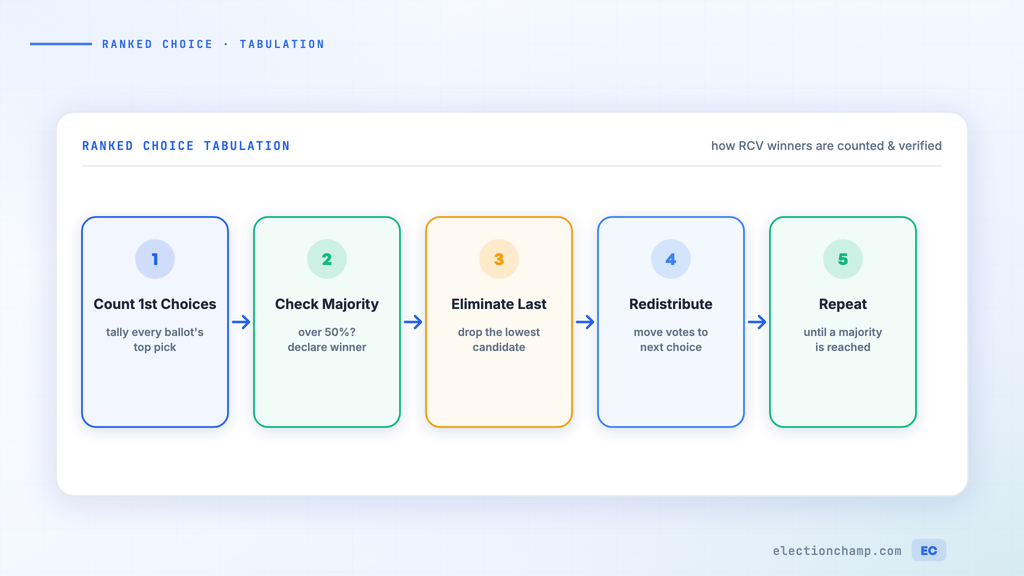
IRV eliminates the candidate with the fewest first-place votes in each round, redistributing their votes to the next-ranked candidate on each ballot, until one candidate achieves a majority.
Worked Example: IRV
Same election: 3 candidates, 10 voters.
Round 1: Count first-place votes.
- Alice: 4 votes | Bob: 3 votes | Carol: 3 votes
- No candidate has a majority (>5). Eliminate the candidate with fewest votes. Bob and Carol are tied at 3; tiebreaker eliminates Carol (or per your rules).
Round 2: Carol is eliminated. Her 3 voters’ ballots transfer to their next choice (Alice).
- Alice: 4 + 3 = 7 votes | Bob: 3 votes
- Alice achieves a majority (7 out of 10) and wins.
Note: Under IRV, Alice wins with a majority after Carol is eliminated. Under Borda Count, Alice also wins — but by a narrower margin based on overall point totals. The methods can produce different winners in more complex elections.
Verifying Results: A DIY Spreadsheet Approach
You can verify Borda Count results using any spreadsheet (Excel, Google Sheets):
- Create columns for each candidate.
- For each voter (or voter group), enter the points assigned to each candidate based on their ranking.
- Sum each candidate’s column. The highest total wins.
- Cross-check against the results from your voting platform.
For large elections, the manual approach becomes impractical — which is exactly why platforms like ElectionChamp automate the counting. But for small elections or when you need to demonstrate the math to stakeholders, a spreadsheet verification builds confidence.
When to Use Ranked Choice vs. Plurality
|
Scenario |
Best Method |
Why |
|
Single winner, 2 candidates |
Plurality |
Ranked choice adds no value with only 2 options |
|
Single winner, 3+ candidates |
Ranked Choice |
Ensures the winner has broad support, not just the largest faction |
|
Multiple winners |
STV or Plurality with multiple winners |
STV gives proportional representation; Plurality is simpler |
|
Board election, 1 seat |
Ranked Choice |
Finds the consensus candidate across the whole electorate |
|
Yes/No question |
Plurality |
Binary choices don’t benefit from ranking |
Why Automated Counting Matters
For elections with more than a handful of voters, manual RCV counting is error-prone and time-consuming:
- A Borda Count with 200 voters and 5 candidates involves 1,000 individual point assignments to sum
- IRV with complex ballots can require dozens of elimination rounds
- Human counting errors in RCV are more common than in simple plurality because the math is more complex
- ElectionChamp calculates results automatically and instantly — no manual counting, no errors, no delays
Ready to modernize your organizational voting? Start for free at ElectionChamp.com — secure, anonymous, and mobile-friendly voting for every organization.