ElectionChamp
Democratic Governance Is in the Co-op DNA
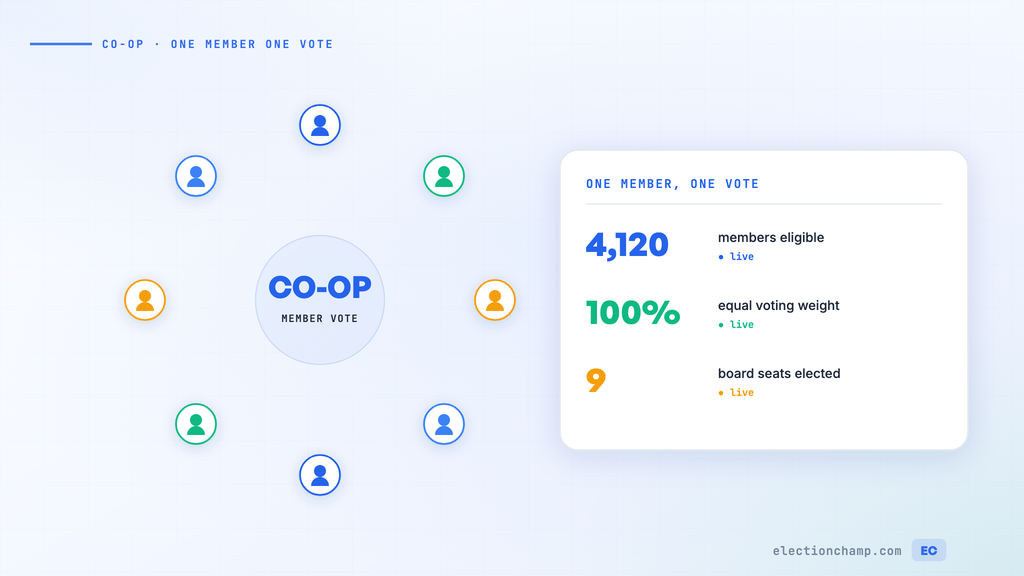
Cooperatives are built on democratic principles. The International Cooperative Alliance’s second principle — Democratic Member Control — states that cooperatives are democratic organizations controlled by their members, who actively participate in setting policies and making decisions. In cooperatives, members have equal voting rights: one member, one vote.
This principle makes election integrity not just a best practice but a foundational requirement. Every member’s vote must carry equal weight, the process must be transparent, and participation must be accessible to all. Online voting helps cooperatives fulfill these principles at scale.
Types of Cooperatives and Their Election Needs
|
Co-op Type |
Common Elections |
Regulatory Oversight |
|
Credit Unions |
Board of Directors, Supervisory Committee, Credit Committee |
NCUA (federal), state credit union regulators |
|
Housing Co-ops |
Board of Directors, committee chairs, policy votes |
State cooperative housing laws, HUD (if federally assisted) |
|
Worker Co-ops |
Board of Directors, officer elections, policy decisions, compensation votes |
State cooperative statutes, potentially NLRB if unionized |
|
Agricultural Co-ops |
Board of Directors, commodity pool votes, marketing agreements |
USDA, state agricultural cooperative acts, Capper-Volstead Act |
|
Consumer Co-ops |
Board of Directors, bylaw amendments, major policy decisions |
State cooperative statutes |
|
Electric / Utility Co-ops |
Board of Directors (by district), rate decisions, capital credit allocations |
State public utility commissions, RUS (USDA) |
The One-Member-One-Vote Principle
Unlike corporations where voting power is tied to share ownership, cooperatives give every member exactly one vote regardless of patronage level, account balance, or tenure. This principle is both the strength and the challenge of co-op elections:
- Strength: Every member has equal say, creating genuine democratic governance
- Strength: Decisions reflect the will of the membership, not just large stakeholders
- Challenge: With equal votes, participation becomes critical — low turnout means a small group speaks for everyone
- Challenge: Members with different usage levels may have different motivations to participate
ElectionChamp enforces one-member-one-vote automatically. Each member receives exactly one unique voting key that works exactly once — no duplicate voting is possible, and no member can vote more than once.
Credit Union Elections
Credit union elections are among the most regulated cooperative elections:
NCUA Requirements
- Board elections must follow the Federal Credit Union Act and NCUA regulations (12 CFR Part 701)
- A Nominating Committee must be appointed at least 90 days before the annual meeting
- Nominations from the floor must be permitted at the annual meeting (or via petition)
- Secret ballot is required for contested elections
- Election results must be announced at or immediately after the annual meeting
- Records must be retained for at least 3 years
Online Voting for Credit Unions
NCUA has issued guidance permitting electronic voting for credit unions, subject to certain safeguards:
- The credit union’s bylaws must authorize electronic voting
- Each member must be uniquely authenticated
- Voting must be confidential (secret ballot)
- The system must prevent duplicate voting
- Results must be auditable
- Members without electronic access must have an alternative voting method
ElectionChamp meets all of these requirements: unique voter keys for authentication, anonymous ballots, one-time-use keys preventing duplicates, full audit trails, and printed keys for members who need a non-digital option.
Housing Cooperative Elections
Housing co-ops elect boards that manage properties, set maintenance fees, approve budgets, and make decisions that directly affect residents’ daily lives. Key considerations:
- Eligibility: Only shareholders (unit owners/occupants) typically vote — verify against your share register
- Proxy management: Many housing co-ops allow proxies; online voting can reduce proxy dependence by making direct participation easier
- Quorum: Housing co-op bylaws often require 25-50% participation. Online voting dramatically improves quorum achievement.
- Transfer approvals: Some co-ops vote on new member admissions — create a separate Yes/No ballot for each applicant
Worker Cooperative Elections
Worker co-ops have unique election characteristics:
- All worker-members typically have voting rights — no separate shareholder class
- Officers and board members are elected from among the workforce
- Policy decisions (wages, hours, work rules) may require membership votes
- Hiring and termination decisions may involve votes in some structures
- Financial decisions (profit distribution, capital investments) often require membership approval
For worker co-ops, mobile voting is especially valuable because members can vote during breaks or between shifts without needing to attend a separate meeting.
Integrating Online Voting with Annual Meetings
Most cooperatives hold an annual meeting where elections traditionally take place. Online voting enhances rather than replaces this tradition:
- Open online voting 7-14 days before the annual meeting — capture votes from members who can’t attend
- During the meeting, present the live participation dashboard — show how many members have already voted
- Allow floor nominations if required by bylaws — add any new candidates and extend voting if needed
- Distribute printed keys at the meeting for members who haven’t voted online
- Close voting at the end of the meeting (or shortly after) and announce results
This hybrid approach satisfies regulatory requirements for annual meeting elections while maximizing participation.
Regulatory Compliance Across Co-op Types
|
Requirement |
Credit Unions |
Housing Co-ops |
Worker Co-ops |
Ag Co-ops |
|
Nominating Committee |
Required (90 days prior) |
Per bylaws |
Per bylaws |
Per bylaws |
|
Floor Nominations |
Required |
Per bylaws |
Common |
Per bylaws |
|
Secret Ballot |
Required (contested) |
Required (most states) |
Recommended |
Per bylaws |
|
Quorum |
Per bylaws (often 15%) |
Per bylaws (often 25-50%) |
Per bylaws |
Per bylaws |
|
Record Retention |
3+ years (NCUA) |
Per state law |
Per state law |
Per state/federal law |
|
Electronic Voting |
Permitted with safeguards |
Per state law + bylaws |
Per bylaws |
Per bylaws |
Best Practices for Co-op Elections
- Verify your bylaws permit electronic voting before launching — amend if necessary
- Maintain a clean membership roster — only eligible, current members should receive ballots
- Provide multiple participation channels: online, SMS, and printed keys for in-person
- Communicate early and often — co-op members are stakeholders, not just voters
- Archive everything: results CSV, audit trail, participation statistics
Strengthening the Cooperative Difference
Strong election participation reinforces the cooperative difference — the democratic governance that sets co-ops apart from conventional businesses. When members actively participate in choosing their leaders and shaping policy, they feel ownership over the organization’s direction. That engagement translates into stronger member loyalty, better retention, and a co-op that genuinely reflects its members’ needs.
- Track and publish turnout rates — celebrate improvements year over year
- Compare your participation to industry benchmarks and share results with members
- Use election participation as a metric in your annual report and cooperative identity communications
Planning your next vote? Read about co-op and credit union voting and board elections, or see pricing: free up to 20 voters, $10 up to 200, then $0.05 per voter.