ElectionChamp
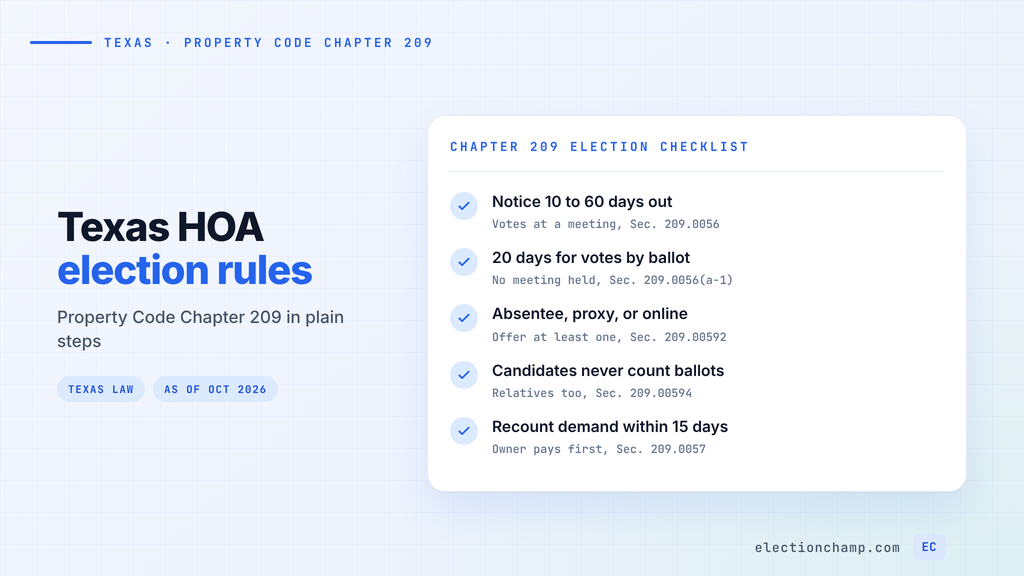
Short answer: Texas HOA election rules come mainly from Property Code Chapter 209. Give owners written notice 10 to 60 days before a vote at a meeting, or at least 20 days before the ballot deadline for a vote without one. Offer at least one of absentee ballot, proxy, or electronic ballot. Board election votes must be written and signed, and electronic ballots count as both. Candidates cannot count ballots, and owners have 15 days to demand a recount.
This guide walks through each election section of the Texas Residential Property Owners Protection Act as published on the Texas Legislature site, including the 2025 changes. It ends with a checklist. Your declaration and bylaws add their own rules, so confirm every step with your documents and counsel.
Which Texas HOAs Chapter 209 Covers
Section 209.003 applies the chapter to residential subdivisions whose declaration lets the association collect assessments on all or most of the property. Membership must also be mandatory for all or most owners. The name does not matter: “homeowners association,” “community association,” and similar labels are all covered.
Three groups sit outside some or all of these rules:
- Condominiums. Chapter 209 does not apply to condos, which follow Chapter 82.
- Public Information Act associations. Those subject to Government Code Chapter 552 are excluded from the notice, recount, and voting method sections.
- Older mixed-use master associations. Those that existed before 1974 and cannot fine owners are exempt from the core election sections.
Texas HOA Election Notice Requirements
Section 209.0056 sets two notice windows, depending on whether owners vote at a meeting. The section overrides any contrary rule in your dedicatory instruments.
| Type of vote | Notice deadline | Who gets notice |
|---|---|---|
| Election or vote at an owners’ meeting | No earlier than the 60th day and no later than the 10th day before the vote | Each owner entitled to vote |
| Election or vote not taken at a meeting | At least 20 days before the last day a ballot can be submitted | All owners entitled to vote on the matter |
| Electronic ballot posted on a website | Notice of the posting is required; no separate deadline is stated | Each owner, with instructions for accessing the posting (209.00592(e)) |
| Board candidate call, more than 100 lots | At least 10 days before ballots go out; owners get at least 10 days to respond | Each owner, by mail or by posting plus email (209.00593) |
Since September 1, 2025, Section 209.0056(d) also says an owners’ meeting “may be held by any method of communication, including electronic and telephonic means as provided by Section 6.002, Business Organizations Code.”
Texas HOA Voting Rules: Absentee, Proxy, and Electronic Ballots
Section 209.00592 allows votes in person or by proxy at a meeting, by absentee ballot, by electronic ballot, or by a delegated method in your documents. Unless your documents say otherwise, one method is enough. Owners must be offered at least one of absentee ballot, proxy, or electronic ballot.
What Changed in 2025
Before Senate Bill 2629, the minimum was absentee ballot or proxy. The bill added electronic ballot to that list, effective September 1, 2025, according to the Texas HOA Law 2025 legislative update. An association can now meet the minimum with electronic ballots alone, if its documents allow it.
What Counts as an Electronic Ballot in Texas
Under Section 209.00592(d), an electronic ballot must meet three conditions:
- It is given by email, fax, or posting on an Internet website.
- The identity of the owner submitting it can be confirmed.
- The owner may receive a receipt of the electronic transmission and a receipt of the ballot.
Section 209.0058(b) makes electronic votes count as written and signed ballots. Board elections, assessment increases, document amendments, and board removals all require written, signed votes, except in uncontested races.
Absentee Ballot Warning Language
An absentee ballot solicitation must include the ballot, delivery instructions, and this exact statement from Section 209.00592(c):
“By casting your vote via absentee ballot you will forgo the opportunity to consider and vote on any action from the floor on these proposals, if a meeting is held. This means that if there are amendments to these proposals your votes will not be counted on the final vote on these measures. If you desire to retain this ability, please attend any meeting in person. You may submit an absentee ballot and later choose to attend any meeting in person, in which case any in-person vote will prevail.”
How Absentee and Electronic Ballots Affect Quorum
Section 209.00592(b) sets three counting rules. An absentee or electronic ballot counts toward quorum only for the items on that ballot. It is not counted if the owner attends and votes in person. It is also not counted on a motion amended at the meeting to differ from the ballot language. Floor nominations in a board election are not treated as amendments.
Chapter 209 sets no default quorum for owners’ meetings and prescribes no proxy form. Both come from your bylaws and other governing law.
Texas HOA Board Election Rules
Section 209.00593 says any board member whose term has expired must be elected by the owners, regardless of what your documents say. The board may fill a vacancy for the rest of the term. An appointment that violates the section is void. The section does not apply during the development period.
Associations with more than 100 lots have extra steps. At least 10 days before ballots go out, the association must send a notice soliciting candidates. The deadline to respond cannot be earlier than the 10th day after that notice. Every eligible candidate who asked in time must appear on the ballot.
Two related rules:
- Voting rights. Section 209.0059 voids any dedicatory instrument provision that would disqualify an owner from voting in a board election or on a matter about the owner’s rights or responsibilities.
- Annual meeting. Section 209.014 requires an annual meeting. If the board ignores an owner’s demand for 30 days, three or more owners can form an election committee to hold the board election.
For the full run of tasks from nominations to results, see how to run an HOA board election from start to finish.
Ballot Secrecy, Counting, and Recounts
Section 209.00594 controls who touches the ballots. A candidate, a person who is the subject of the vote, or anyone related to them within the third degree by consanguinity or affinity cannot tabulate the ballots or be given access to them. Anyone else may tabulate. Only the tabulator, or a recount tabulator, may access the ballots cast. Neither may reveal how anyone voted.
Section 209.0058(d) lets the association adopt secret ballot rules. The rules must prevent overvoting and count every eligible vote. In a board election, each candidate may name one person to observe the count. The observer may not see who cast any ballot, and a disruptive observer may be removed.
A court can still order ballots released (Section 209.00594(d)), as the Texas Supreme Court did with protective measures in In re Keenan.
Recounts Under Section 209.0057
Any owner may demand a recount within 15 days after the later of the meeting where the vote was held or the announcement of results. The demand must be in writing, by verified mail, USPS signature confirmation, or hand delivery. The steps in Section 209.0057:
- The association estimates the cost and invoices the owner within 20 days of the demand.
- The owner pays within 30 days, or the demand is treated as withdrawn.
- The association hires a qualified tabulator: a current or former county judge, county elections administrator, justice of the peace, or county voter registrar, or a person both sides agree on. The tabulator cannot be a member or a relative of a board member within the third degree.
- The recount is completed within 30 days. If it changes the result, the association reimburses the owner.
Our guide on handling HOA election disputes covers what to keep.
Running a Texas HOA Electronic Vote
The statute describes outcomes and leaves the tool to you. Match each requirement to a feature you can show an owner who asks.
| Chapter 209 requirement | What to look for in a voting tool |
|---|---|
| Confirm the owner’s identity (209.00592(d)) | A unique credential per owner sent to the contact details on file |
| Receipt of transmission and ballot (209.00592(d)) | A confirmation the owner receives after voting; ask the vendor how it works |
| One vote per eligible member (209.0058(d)) | Single-use credentials and a voter list locked at launch |
| Recount on demand (209.0057) | Exportable results and a log of administrative actions |
In ElectionChamp, each owner gets a single-use 16-character voter key by email link, SMS link, or printed key. The key deactivates once the ballot is submitted, so no one votes twice. Ballots are anonymous: administrators see whether an owner voted, never how. A timestamped audit trail logs every administrative action and can be exported, and results download as CSV when voting closes.
Do not make a candidate or a relative the election administrator. If owners vote per lot, use whole-number weighted voting. Our HOA online voting page shows the full setup. Ask us how voter confirmations work before you rely on them for the receipt requirement.
Texas HOA Election Compliance Checklist
Review this list with your manager or counsel before notice goes out.
- Confirm Chapter 209 applies (209.003) and that you are not a condo under Chapter 82.
- Read your declaration, bylaws, and any election policy for quorum, proxy, and secret ballot rules.
- Choose voting methods. Offer at least one of absentee ballot, proxy, or electronic ballot (209.00592(a-1)).
- If you have more than 100 lots, send the candidate call at least 10 days before ballots go out, and list every timely candidate (209.00593).
- Send notice 10 to 60 days before a meeting vote, or at least 20 days before the ballot deadline for a vote without a meeting (209.0056).
- Include the exact absentee warning statement on absentee ballots (209.00592(c)).
- For electronic ballots, confirm owner identity and provide transmission and ballot receipts (209.00592(d)).
- Appoint a tabulator who is not a candidate or a relative of one (209.00594).
- Let each board candidate name one observer for the count (209.0058(d)).
- Announce results, keep records, and send a cost invoice within 20 days of any recount demand (209.0057).
This guide summarizes the statute for planning. It is not legal advice, so confirm with your governing documents and counsel.
Frequently Asked Questions
Can a Texas HOA hold elections online?
Yes, if the vote meets Section 209.00592. An electronic ballot can be given by email, fax, or a website posting, the owner’s identity must be confirmable, and the owner must be able to get a receipt. Since September 1, 2025, an electronic ballot can be the one voting method the association must offer. Confirm with your dedicatory instruments and counsel.
How much notice is required for a Texas HOA election?
For a vote at an owners’ meeting, Section 209.0056 requires written notice no earlier than the 60th day and no later than the 10th day before the vote. For a vote without a meeting, notice must go out at least 20 days before the last day a ballot can be submitted.
Can a candidate count ballots in a Texas HOA election?
No. Under Section 209.00594, a candidate, the subject of a vote, or a relative within the third degree cannot tabulate or access the ballots. In a board election, each candidate may name one person to observe the count, and that observer may not see who cast any ballot.
Can a Texas HOA stop delinquent owners from voting?
Section 209.0059 voids any provision in a dedicatory instrument that would disqualify an owner from voting in a board election or on a matter about the owner’s rights or responsibilities. Associations subject to Government Code Chapter 552 are excluded from that section, so confirm your situation with counsel.
Planning your next vote? Read about HOA online voting and board elections, or see pricing: free up to 20 voters, $10 up to 200, then $0.05 per voter.