ElectionChamp
Why Church Elections Require Special Care
Elections in churches, synagogues, mosques, and other religious organizations carry a weight that goes beyond typical organizational governance. Leadership selection in faith communities is deeply personal — it involves trust, spiritual discernment, and the collective vision of a congregation. Disputes over election fairness can fracture communities in ways that take years to heal.
This is precisely why a professional, transparent, and confidential election process matters so much. When members trust that their vote counts equally and that the process is fair, the outcome carries legitimacy — even for those whose preferred candidate didn’t win.
Navigating Congregational Sensitivities
Religious elections differ from corporate or association elections in several important ways:
Confidentiality Is Sacred
In many congregations, members are deeply uncomfortable with the idea that anyone could know how they voted. This is especially true in smaller communities where relationships are close and opinions on candidates can be intense.
ElectionChamp addresses this completely: ballots are anonymous by design. Administrators can see whether a member has voted, but can never see what they voted for. This isn’t a setting that can be overridden — it’s built into the architecture of the platform.
Unity Over Competition
Unlike corporate elections where healthy competition is expected, church elections often emphasize unity and consensus. To support this:
- Frame the election as discernment, not competition — the ballot is a tool for the congregation to identify whom God is calling to serve
- Give all candidates equal presentation — same photo format, same space for statements
- Avoid campaign-style language in communications — focus on prayerful consideration
- Consider using Ranked Choice voting for consensus-building — it surfaces candidates with the broadest support
Inclusivity Across Generations
Congregations often span a wide age range, from teenagers to seniors in their 90s. Your election process needs to accommodate everyone:
- Online voting for members comfortable with technology — most can vote from their phone in 2 minutes
- Printed keys for members without email — print voter codes and distribute them after services
- Clear, simple instructions in large font — include in the bulletin or a one-page handout
- Designate tech-savvy volunteers as “voting helpers” after services to assist members who need it
Before You Begin
- Review your church constitution and bylaws for election requirements — many denominations have specific procedures
- Check if your denomination has rules about electronic voting — most permit it, but some require specific safeguards
- Determine who is eligible to vote — typically “members in good standing” as defined by your bylaws
- Set up a nominating committee well in advance (60-90 days before the election)
Ballot Configuration Tips
- Use clear, respectful language for position titles (e.g., “Elder Board — 3 Year Term” rather than just “Position 1”)
- Include candidate photos and brief biographies — voters should know who they’re voting for
- Enable the Abstain option — some members may feel led to abstain on specific questions
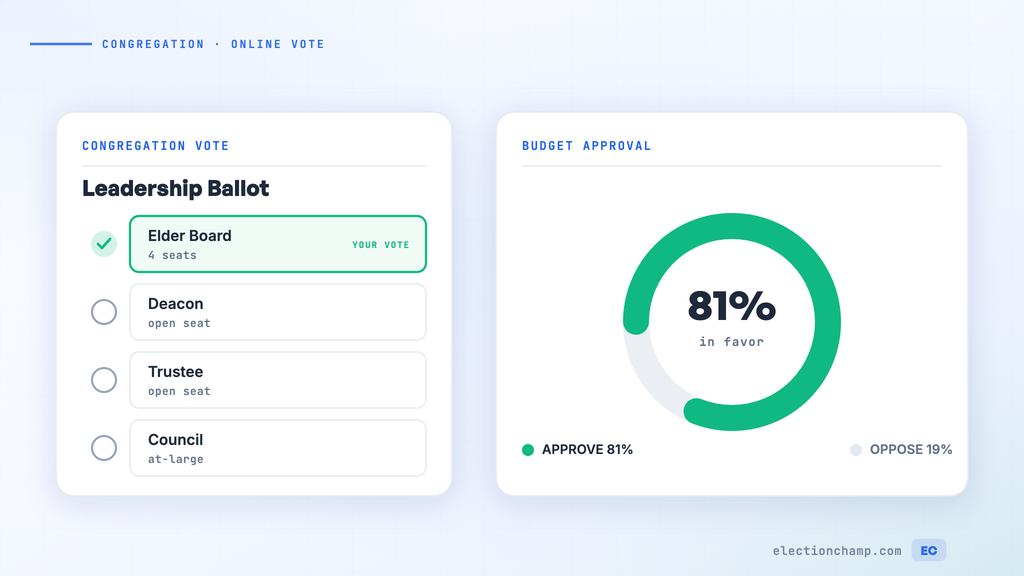
- For congregational votes (budgets, building projects), use a Yes/No question and share the budget or plan with members before voting opens
Hybrid Voting for Church Elections
Many churches find that a hybrid approach works best, combining online voting with an in-person voting opportunity:
- Open online voting 7-10 days before a designated Sunday
- On that Sunday, set up a voting table in the fellowship hall with printed keys for members who prefer to vote in person
- Assign volunteers to help members vote on their phones or enter printed keys at the voting page
- Keep online voting open for 2-3 more days after Sunday to capture any remaining votes
- Close the election and announce results at the following service or via email
Members who cannot attend on Sunday still get a full week to vote.
How to Elect Church Elders
Many congregations choose elders, deacons or a church council by member vote. Others appoint them through the pastor, the session or a regional body. Your constitution decides which model applies, so start there.
Where members vote, the process usually runs in four steps:
- Confirm the rules. Check the constitution or bylaws for who may serve, term length, how many seats are open, and the vote needed to elect (a plurality, a majority, or a higher threshold).
- Collect nominations. A nominating committee proposes candidates, members suggest names, or both. In ElectionChamp, a nomination question lets members type in names, and the results show a count for each name.
- Confirm consent and qualifications. The committee or council checks that each nominee is willing and qualified before names go on the ballot.
- Hold the vote. List the nominees with a short bio and photo, set the number of seats, and use “select up to” so members cannot pick more names than there are seats. Results show each candidate’s total, and the audit log records every administrative action.
Some traditions affirm a slate rather than choose between candidates. A yes/no question for each nominee, or for the full slate, handles that. If your rules require a set share of yes votes, state the threshold on the ballot and check the totals against it.
Denomination rules differ widely. Confirm the process with your constitution and, where relevant, your denomination’s governing documents.
After the Election
- Announce results with gratitude and grace — thank all candidates for their willingness to serve
- Publicly welcome newly elected leaders
- File election results with your church records as required by your bylaws or denomination
- Download and archive the ElectionChamp audit trail and results CSV
- Begin onboarding new leaders promptly — orientation, training, and transition
Protecting Election Integrity in Close-Knit Communities
In small congregations where everyone knows each other, election integrity requires extra attention:
- Never discuss individual voting patterns — even casually mentioning “I noticed so-and-so voted early” can create discomfort
- Use ElectionChamp’s voter masking feature, which hides the last 5 voters’ status to prevent timing-based identification
- Ensure the election administrator doesn’t publicly share participation statistics that could identify individuals in very small groups
- Emphasize in all communications that voting is completely anonymous and private
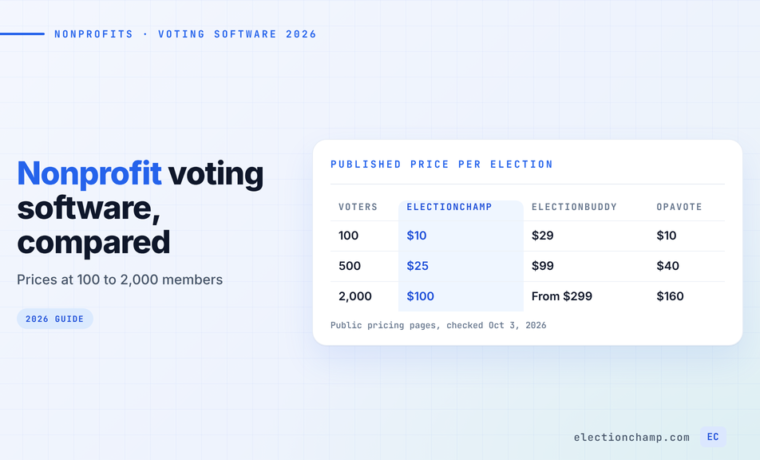
Planning your next vote? Read about online voting for churches and budget approvals, or see pricing: free up to 20 voters, $10 up to 200, then $0.05 per voter.