ElectionChamp

Short answer: To run a club election online, start with your bylaws: who can vote, which seats are open, and how much notice members get. Then build a clean member list, take nominations for two to three weeks, and set up a ballot with bios and an abstain option. Send each member a single-use voting link, open voting for about a week, remind non-voters, and share results the moment voting closes.
Most clubs run one election a year, usually with a new volunteer in charge. This guide gives that volunteer a sequence to follow, a timeline to copy, and the decisions to settle before anyone sees a ballot.
Check Your Club Bylaws Before You Set a Date
Your constitution or bylaws decide most of the process. Read them first, and write down the answers before you announce anything.
- Open positions and terms. Which officer and committee seats are up this year, and for how long.
- Who can vote. Usually members in good standing, often meaning dues paid by a cutoff date.
- Notice period. Some constitutions require 21 days of written notice before an AGM. TidyHQ’s AGM guide uses that as its baseline.
- Nomination rules. Whether nominations need a nominator and seconder, and when they close.
- Voting method. Whether the vote must be by ballot, and whether a voting method is named.
- Quorum and ties. How many members must take part, and what happens on a tie.
- Electronic voting. Whether online voting is allowed, required at a meeting, or not mentioned.
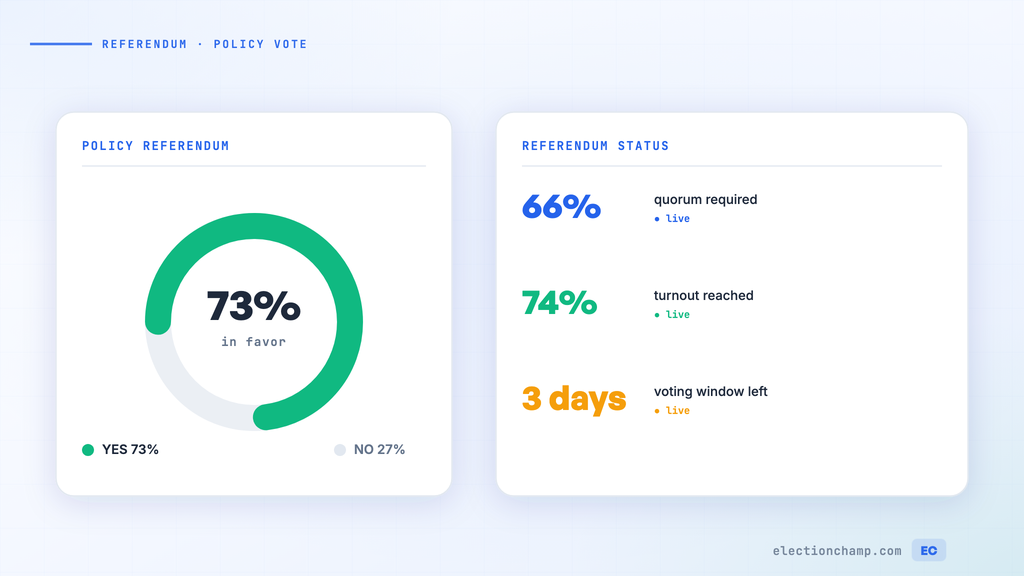
If your bylaws are silent or require a show of hands, many clubs amend them first. A short member vote can do this; see how other groups handle bylaw and policy votes. Rules vary by club and jurisdiction, so confirm with your bylaws and counsel when the stakes are high.
Sports clubs have extra layers, like league affiliation and whether parents or players vote. Our guide to sports league and club elections covers those.
Decide Who Can Vote in Your Club Election
The member list causes more disputes than the ballot. Pick a cutoff date for membership and publish it with the election notice. Anyone who renews after that date waits for next year, unless your bylaws say otherwise.
Export the list from wherever you track dues and clean it before you upload it:
- One row per voter, with a working email address or mobile number.
- Remove duplicates, lapsed members, and shared inboxes that would merge two voters.
- Decide how family or household memberships vote. If a family membership gets two votes, you can give that row a weight of 2 instead of creating fake voters.
- Keep a few blank voter slots for members who renew late but qualify. In ElectionChamp these are spare keys, and they count toward capacity.
Have a second committee member check the list against your dues records. Do it before launch, because the voter list locks once the election starts.
How to Run Club Committee Election Nominations
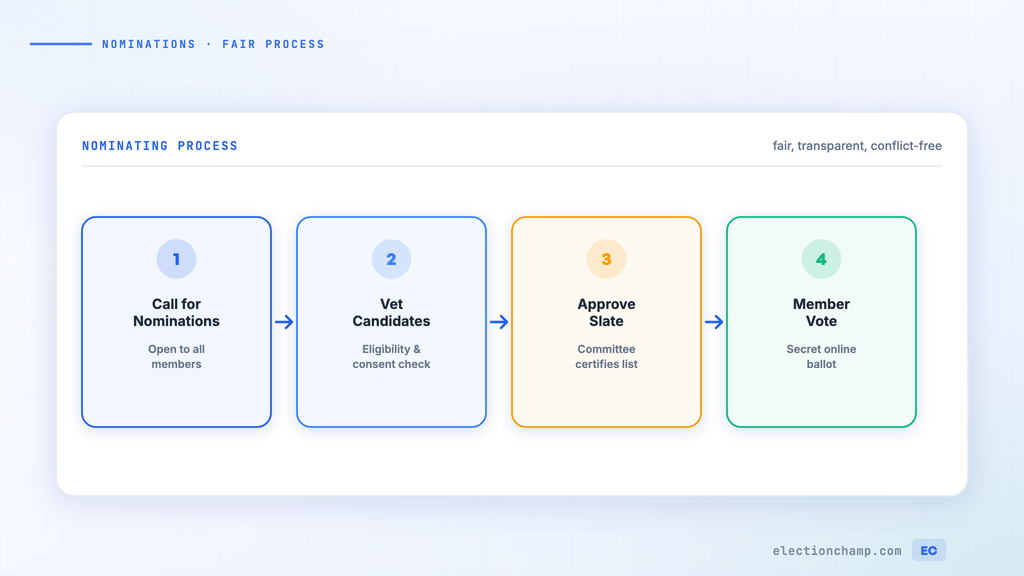
Open nominations about six weeks before the vote and close them about three weeks out. That leaves time to chase empty seats and collect candidate material. Toastmasters, for example, requires its nominating committee to announce its slate at least two weeks before the election.
A simple online form works for nominations. Ask each candidate for:
- Name and the position they are running for.
- Nominator and seconder, if your bylaws require them.
- A statement of 100 words or fewer.
- A photo, optional but useful in larger clubs.
Expect some seats with one candidate. Under Robert’s Rules, the chair can declare an unopposed nominee elected, unless the bylaws require a ballot vote. In that case the ballot must still be taken, as explained on the official Robert’s Rules Q&A forum. For a fairer nominating process, see the nominating committee’s guide.
Set Up the Ballot: Bios, Abstain, and Multi-Seat Races
Give each position its own question, in the order your bylaws list them. Then match the question type to the seat.
Single Officer Seats
President, treasurer, and secretary are usually plurality votes with one winner. Add each candidate’s photo and statement so members can compare them without leaving the ballot. Turn on random candidate order if you want to avoid the advantage of being listed first.
General Committee Seats
If five candidates run for three committee seats, use a multi-winner question. Set “select up to 3” and three total winners. For proportional results in larger clubs, STV fills multiple seats so that different groups of members are represented. To use STV, collect ranked ballots in ElectionChamp. When voting closes, run the exported ranked results through our free STV Excel calculator.
Abstain, Nominations, and Motions
Turn on “Allow Abstain” so members can skip a race without spoiling the ballot. Abstentions then show separately in the results. ElectionChamp ballots have no write-in field. If your bylaws allow floor nominations, run a nomination question first so members can type in names. Then list those nominees on the ballot. Motions such as approving last year’s minutes or a dues change can sit on the same ballot as yes, no, or abstain questions.
Before launch, test the ballot on a phone with two committee members. In ElectionChamp, setup and testing are free, and the ballot locks once you launch.
Pick a Voting Window and Plan Reminders
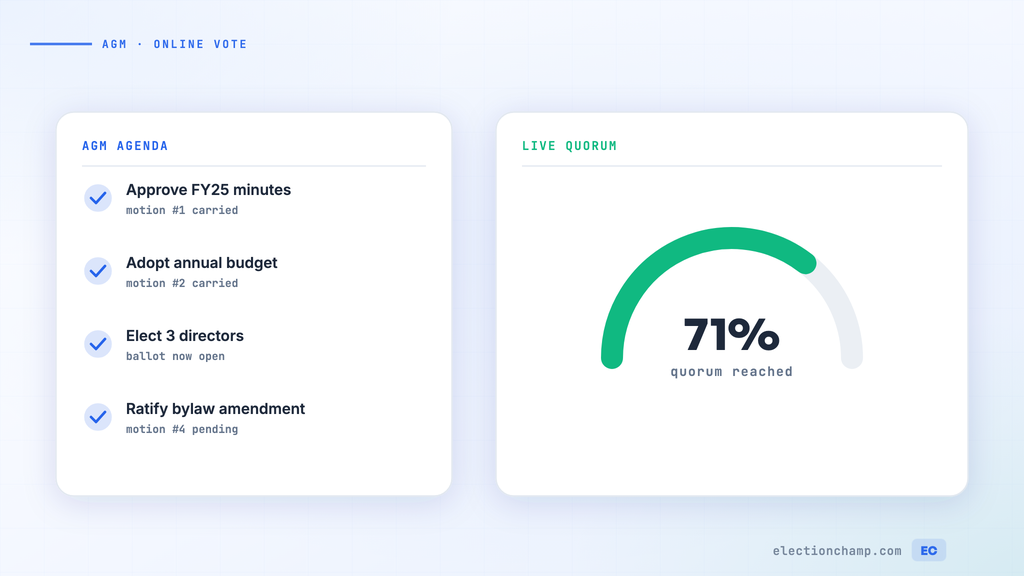
About a week of voting covers members who only check email on weekends. If your election happens at an AGM, open online voting a week before and close it at the meeting. Members at the meeting can vote with printed keys, which they scan with a phone camera. That hybrid setup keeps everyone in one count.
Plan reminders before launch. Send the invitation from a name members recognize, like the club president. Then send reminders only to people who have not voted yet. On ElectionChamp, free elections include 1 reminder and paid elections include up to 5. Use SMS for members who ignore email.
A Simple Club Election Timeline
Adjust the weeks to your bylaws’ notice period. This version works for a club that votes online and announces results at its AGM.
| When | Task | Owner |
|---|---|---|
| 8 weeks before | Check bylaws, confirm open seats, set the voting dates | President or secretary |
| 6 weeks before | Announce the election, publish the membership cutoff, open nominations | Secretary |
| 4 weeks before | Send formal notice if your bylaws require it, export the member list | Secretary |
| 3 weeks before | Close nominations, collect statements and photos | Election officer |
| 2 weeks before | Build and test the ballot, publish the candidate list | Election officer |
| 1 week before | Launch voting and send voter links | Election officer |
| 2 days before close | Send a reminder to members who have not voted | Election officer |
| Close or AGM | Announce results and email them to all members | President |
| Within 2 weeks after | Hold the handover meeting | Outgoing and incoming committee |
Name an election officer who is not running. That person builds the ballot, answers voter questions, and announces the count.
Announce Results and Hand Over to the New Committee
Decide who sees results, and when, before voting opens. Choosing “no one until close” keeps early results from swaying late voters. When voting closes, the count is instant. Download the CSV for your minutes and email a results link to every member in one step. For ties, follow your bylaws. Toastmasters notes that under Robert’s Rules, members vote again until one candidate has a majority.
Ballots stay anonymous. Administrators can see who voted, never how they voted. If a result is challenged, the audit trail shows every administrative action with a timestamp.
Then run a short handover meeting. Cover these items:
- Bank signatories and online banking access.
- Passwords for the website, email, and social media accounts.
- Insurance, venue bookings, and league or federation registrations.
- Member records and the shared drive.
- Open commitments, such as suppliers, sponsors, and grant reports.
Record the new committee in your minutes. If your club files with a state agency or governing body, update its records too. If your club is a formal association with chapters or a large membership, our page on association voting software covers managed elections and larger votes.
Frequently Asked Questions
Can a club election be held online?
Usually, yes, if your constitution or bylaws allow it or do not require an in-person vote. Some bylaws require voting at a meeting. In that case you can amend them or run a hybrid vote that closes at the meeting. Confirm with your bylaws and counsel.
What happens if only one person runs for a club position?
Under Robert’s Rules, the chair can declare the only nominee elected, unless the bylaws require a ballot vote. If they do, the ballot is still taken, and members may write in another name if write-ins are allowed.
How long should club election voting stay open?
About a week works for most clubs because it includes a weekend. If the election is tied to an AGM, open voting a week before and close it at the meeting.
How much does it cost to run a club election online?
Prices vary by platform. ElectionChamp is free up to 20 voters, $10 flat up to 200 voters, and $0.05 per voter above 200, paid per election with no subscription. A 300-member club pays $15.
Planning your next vote? Read about association voting software and bylaw and policy votes, or see pricing: free up to 20 voters, $10 up to 200, then $0.05 per voter.