ElectionChamp
Fair Selection Requires Fair Process
Honor society admissions, academic awards, scholarship selections, and teaching excellence recognitions all depend on committee votes. These decisions affect people’s careers, opportunities, and reputations. When the process is opaque or inconsistent, it invites accusations of favoritism, bias, and unfairness.
Structured online voting brings transparency, documentation, and consistency to selection processes — protecting both the candidates and the committee members making the decisions.
Types of Academic Selection Votes
|
Selection Type |
Voters |
Stakes |
Anonymity |
|
Honor society admission |
Chapter members or selection committee |
High — affects student credentials |
Required |
|
Teaching awards |
Students, faculty committee, or both |
High — career recognition |
Essential for student voters |
|
Research awards |
Peer review panel or committee |
Very high — funding and prestige implications |
Required |
|
Scholarship selection |
Selection committee |
High — financial impact on recipients |
Recommended |
|
Distinguished alumni |
Alumni board or committee |
Medium — organizational recognition |
Recommended |
|
Department honors |
Faculty committee |
Medium — academic recognition |
Recommended |
Honor Society Selection Process
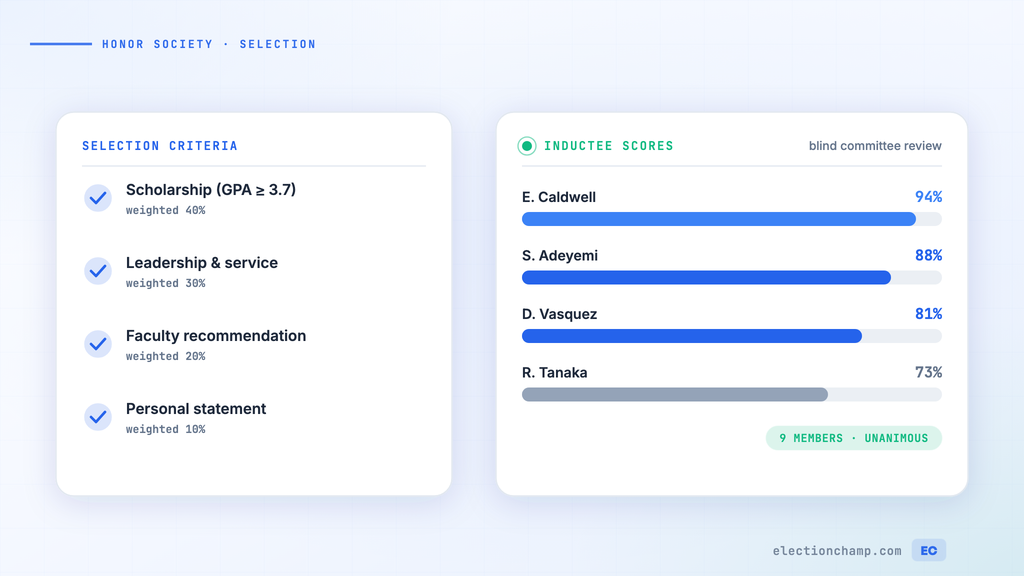
Honor societies (Phi Beta Kappa, Sigma Xi, discipline-specific societies) have specific admission standards. The voting process typically involves:
- Candidate screening: Verify that nominees meet minimum requirements (GPA, credit hours, other criteria) before presenting them to the committee.
- Prepare candidate materials: Compile transcripts, personal statements, letters of recommendation, and any other required documentation.
- Distribute materials to the selection committee: Provide adequate time (at least 1 week) for review before the vote.
- Set up the ballot: Create a Yes/No question for each candidate: “Should [Candidate Name] be admitted to [Honor Society]?” Use anonymous voting.
- Define the threshold: Many honor societies require a supermajority (two-thirds) or unanimous approval for admission.
- Conduct the vote: 5-7 day voting window. Anonymous ballots via ElectionChamp.
- Document the results: Download the results CSV and audit trail. File with the chapter’s records.
Blind Review Voting
For research awards and some scholarship selections, blind review — where committee members evaluate candidates without knowing their identity — reduces bias:
- Assign each candidate a number or code rather than using names on the ballot
- Provide application materials with identifying information redacted
- Committee members evaluate based on the work and qualifications, not the person
- After votes are tallied, reveal the identities and announce results
ElectionChamp supports this by allowing you to list candidates by code rather than name on the ballot. The committee chair maintains the key linking codes to identities.
Scoring vs. Ranking vs. Voting
Different selection processes call for different methods:
|
Method |
How It Works |
Best For |
ElectionChamp Implementation |
|
Simple vote (Yes/No) |
Each committee member votes to approve or reject each candidate |
Honor society admissions, award nominations |
Yes/No Plurality question per candidate |
|
Ranking |
Committee members rank candidates from best to worst |
Scholarship selection where you must choose a specific number from many applicants |
Ranked Choice voting |
|
Plurality selection |
Each committee member selects their top choice(s) |
Teaching awards, best paper awards |
Plurality with appropriate selection limit |
|
Multi-round voting |
Eliminate lowest candidates in successive rounds |
Competitive fellowship selections |
Multiple elections: first round narrows the field, second round selects winners |
Documentation and Accountability
Academic selection processes are subject to scrutiny — from candidates, from administrators, and sometimes from external bodies. Thorough documentation protects the committee:
- Maintain written selection criteria that are published before the process begins
- Document every step: who was nominated, who was screened, who was presented to the committee
- Preserve ElectionChamp results and audit trails as the official record of the committee’s vote
- If a candidate appeals, the documentation demonstrates that the process was fair, consistent, and properly conducted
Conflict of Interest Management
Selection committees frequently face conflicts of interest — a committee member’s student is a candidate, or a committee member is close colleagues with a nominee:
- Establish conflict of interest policies before the selection process begins
- Members with conflicts should recuse themselves from voting on the affected candidate
- In ElectionChamp, create a voter list that excludes recused members for the relevant questions, or instruct recused members to use the Abstain option
- Document any recusals in the committee minutes
Multi-Category Awards
Annual award ceremonies with multiple categories are easy to manage as a single election:
- Create one election with each award category as a separate ballot question
- Committee members vote on all categories in one session
- Results are calculated independently for each category
- Download the comprehensive results report and present at the awards ceremony
Best Practices for Selection Committees
- Always use anonymous voting — committee members should never feel pressured to vote a certain way
- Set the voting window to close before the announcement event — don’t announce results immediately after the vote to allow time for administrative review
- Keep participation records: note which committee members voted (not how they voted) for quorum verification
- Review your selection process annually: Is it producing diverse, high-quality selections? Are committee members satisfied with the process?
- Consider rotating committee membership to bring fresh perspectives and prevent entrenchment
Ready to modernize your organizational voting? Start for free at ElectionChamp.com — secure, anonymous, and mobile-friendly voting for every organization.