ElectionChamp
Party Democracy in the Digital Age
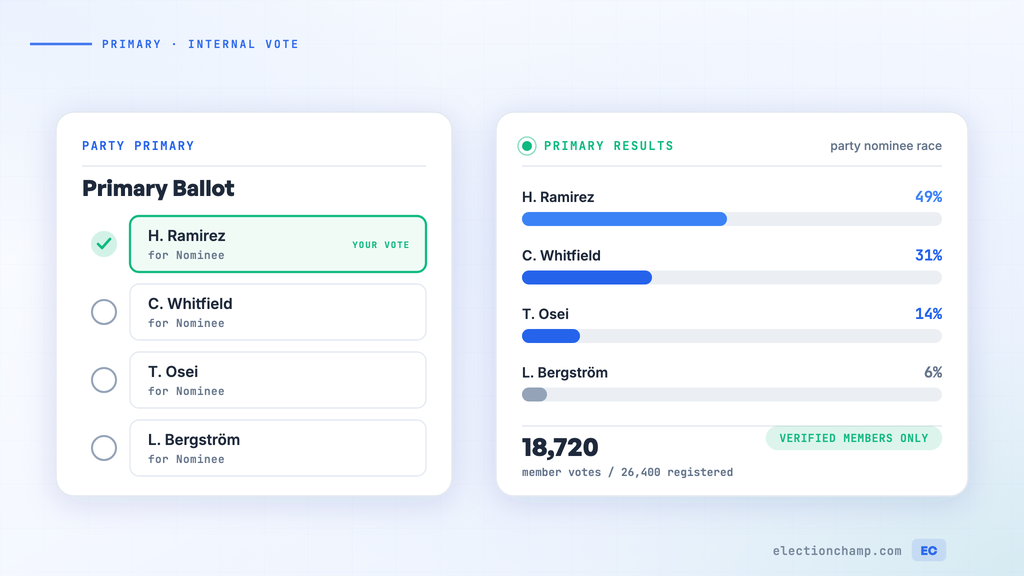
Political parties are democratic organizations that depend on member participation to choose leaders, select delegates, adopt platforms, and make policy decisions. Yet internal party elections often suffer from the same low-participation problems as other organizational votes — compounded by geographic dispersion, volunteer-dependent infrastructure, and tight timelines.
Online voting brings accessibility, security, and efficiency to party governance without sacrificing the democratic principles that parties exist to uphold.
Types of Internal Party Elections
|
Election Type |
Who Votes |
Frequency |
Method |
|
State/county party chair |
Precinct committee members or delegates |
Every 2-4 years |
Plurality or Ranked Choice |
|
Party officers (VP, Secretary, Treasurer) |
Committee members or delegates |
Every 2-4 years |
Plurality |
|
Precinct committee members |
Registered party members in each precinct |
Every 2-4 years |
Plurality |
|
Convention delegates |
Party members or primary voters |
Presidential cycle or annual |
Proportional or Plurality |
|
Platform planks |
Convention delegates or members |
Annual or per convention |
Yes/No per plank |
|
Endorsements |
Central committee or party members |
Per election cycle |
Plurality or advisory vote |
|
Bylaw amendments |
Convention delegates or committee |
Annual or as needed |
Yes/No (supermajority) |
Party Chair and Officer Elections
Party leadership elections are the most consequential internal votes:
- Determine the electorate: State party rules define who votes — typically precinct committee members, state committee members, or convention delegates.
- Open nominations per party bylaws: Many parties allow nominations from the floor at a meeting, supplemented by petition.
- Create the ballot: Separate questions for each officer position. Use Plurality voting for contested races.
- Add candidate information: Party officer candidates should provide position statements explaining their vision for the party.
- Set the voting window: If the election is tied to a convention, voting may occur during a specific session. If conducted remotely, a 5-7 day window is appropriate.
- Certify results: Party elections often require formal certification by a credentials committee or elections officer.
Delegate Selection
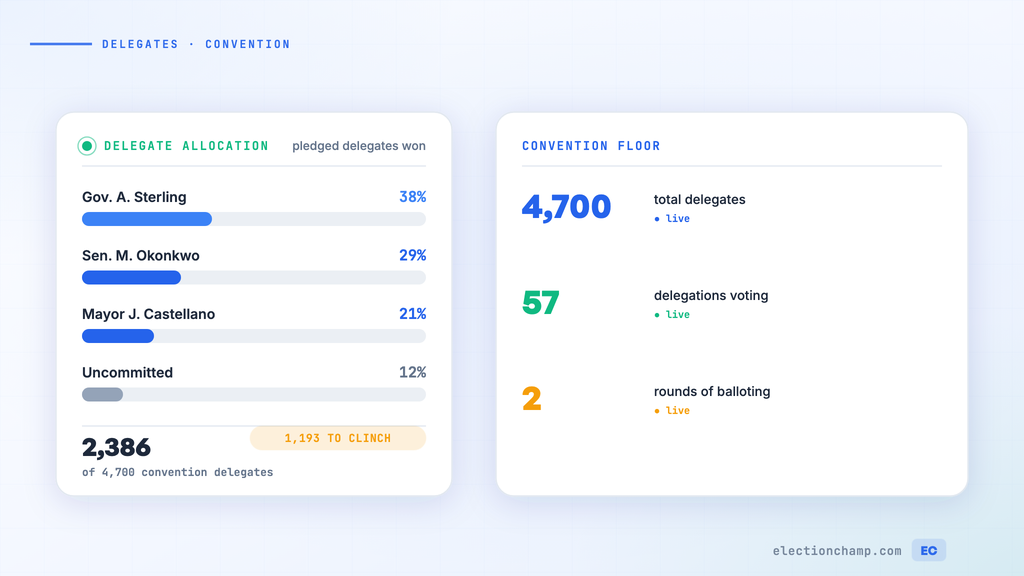
Delegate selection for national and state conventions is one of the most complex internal party processes:
- Rules vary significantly between parties and between states — always start with your party’s current delegate selection plan
- Proportional allocation: Many delegate elections use proportional representation. If Candidate A gets 60% and Candidate B gets 40%, delegates are allocated accordingly.
- ElectionChamp can facilitate the voting component, with results then used to calculate proportional delegate allocation per party rules
- For direct delegate elections (voting for individual delegates), use Plurality voting with the number of winners matching available delegate slots
Platform Votes
Party platforms express the organization’s positions on policy issues. Platform votes at conventions or through membership balloting work well online:
- Create a separate ballot question for each proposed platform plank or amendment
- Include the full text of each proposal in the Voter Instructions field
- Use Yes/No voting for each plank — members can support some positions while opposing others
- For competing platform planks on the same issue, use Plurality voting to choose between alternative positions
Security Requirements for Party Elections
Political party elections attract more scrutiny and more attempted interference than typical organizational votes:
- Voter authentication: Only registered party members or authorized delegates should be able to vote. ElectionChamp’s unique voter keys ensure only those on the imported list can participate.
- Ballot secrecy: Members must be able to vote their conscience without party leaders knowing how they voted. ElectionChamp’s anonymous ballots protect this.
- One person, one vote: Single-use voter keys prevent any member from voting twice.
- Result integrity: Automated counting eliminates human counting errors or manipulation. Full audit trails document the process.
- Record retention: Keep all election records per party bylaws and any applicable state election codes.
Hybrid Convention Voting
Many party conventions combine in-person and remote participation:
- In-person delegates: Distribute printed keys at the convention registration desk
- Remote delegates: Send ballot links via email and SMS before the convention session
- Real-time voting: Open the ballot during the convention session, allow 10-15 minutes for voting, then close and announce results
- Display the participation dashboard on the convention screen so delegates can watch turnout in real time
Compliance with Party Rules and State Law
|
Consideration |
Details |
Action |
|
Party bylaws |
Internal rules governing elections, nominations, and governance |
Review before every election; follow procedures exactly |
|
State party rules |
State-level party rules may add requirements beyond local bylaws |
Check state party committee guidance |
|
State election code |
Some states regulate internal party elections |
Consult legal counsel for applicable requirements |
|
FEC regulations |
Federal law may apply to certain party activities |
Ensure election processes don’t trigger FEC reporting issues |
|
Open/closed elections |
Some party elections are open to all members; others are restricted to committee members |
Clearly define and enforce eligibility |
Engaging Party Members in Governance
- Use regular online voting to keep members engaged between elections: policy surveys, endorsement advisory votes, and priority-setting exercises
- Track and publish participation rates — party members who vote in internal elections are more likely to volunteer, donate, and vote in general elections
- Use election participation as a metric for party health alongside membership numbers and fundraising
Planning your next vote? Read about online voting for government and audit trail and compliance, or see pricing: free up to 20 voters, $10 up to 200, then $0.05 per voter.