ElectionChamp
AI Meets Democracy
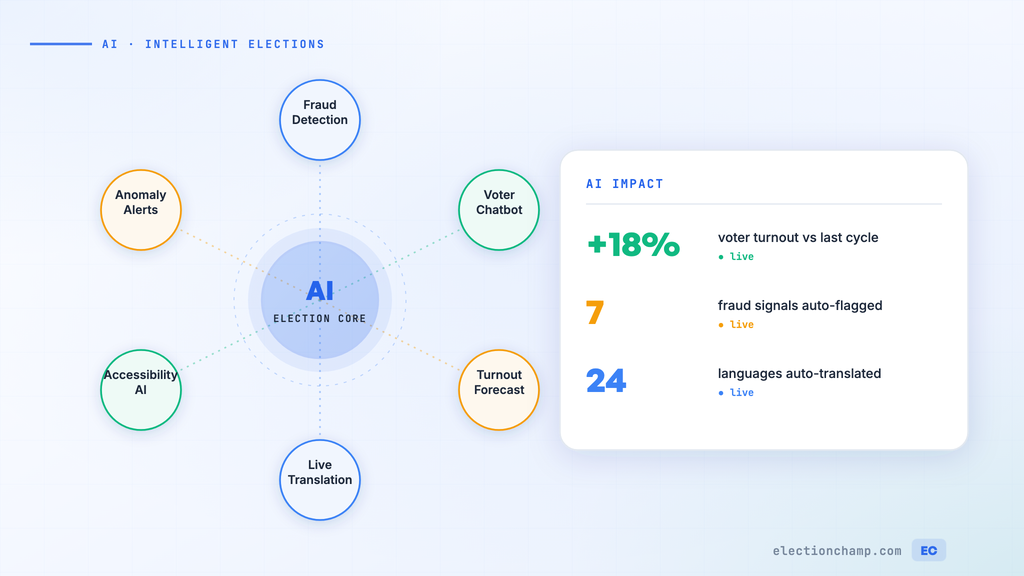
Artificial intelligence is transforming virtually every industry, and online voting is no exception. While the core of voting — one person making a choice in secret — must remain fundamentally human, AI is enhancing every layer around that core: how elections are set up, how voters are supported, how integrity is maintained, and how results are analyzed.
This isn’t about AI making decisions for people. It’s about AI making it easier for people to make decisions — and for administrators to run fair, efficient elections.
Current AI Applications in Online Voting
|
Application |
What It Does |
Benefit |
|
AI-Assisted Ballot Design |
Generates ballot structures from natural language descriptions |
Reduces setup time from hours to minutes |
|
Smart Notifications |
Optimizes send times and reminder frequency based on response patterns |
Improves voter turnout |
|
Natural Language Processing |
Makes ballots and instructions accessible in plain language |
Reduces voter confusion and invalid votes |
|
Anomaly Detection |
Identifies unusual voting patterns that may indicate irregularities |
Strengthens election integrity |
|
Accessibility Enhancement |
Adapts ballot presentation for different abilities and devices |
Ensures inclusive participation |
|
Predictive Participation |
Forecasts turnout and identifies at-risk voter segments |
Enables targeted outreach |
AI-Assisted Ballot Design
One of the most practical AI applications today is helping administrators create well-structured ballots quickly:
- Describe your election in plain language: “We need to elect a president and 3 board members, plus vote on a bylaw amendment about electronic voting”
- The AI generates a complete ballot structure: appropriate voting methods for each question, suggested voter instructions, and recommended settings
- The administrator reviews, edits, and customizes — the AI handles the first draft, the human ensures accuracy
- ElectionChamp’s election templates take a simpler route today: the ballot, settings and invitation come filled in for common votes, and you change anything before you launch
Intelligent Voter Communication
AI is improving how organizations communicate with voters before and during elections:
- Optimal timing: AI analyzes historical open rates and voting patterns to determine the best time to send reminders to each voter segment
- Message personalization: AI can adapt reminder language based on the voter’s engagement history — a first-time voter gets a different message than a regular participant
- Channel selection: AI recommends whether to send email, SMS, or both based on which channel each voter is most likely to respond to
Fraud Detection and Integrity
While ElectionChamp’s unique voter keys already prevent duplicate voting, AI adds additional integrity layers:
- Pattern analysis: AI can detect unusual patterns such as a large number of votes submitted in a very short time window from similar characteristics
- Behavioral analysis: Identifying submission patterns that deviate significantly from normal voting behavior
- Audit enhancement: AI can flag audit trail entries that warrant human review
Important: AI fraud detection supplements but never replaces the fundamental security architecture. Unique voter keys, anonymous ballots, and one-time-use authentication remain the primary defenses.
Accessibility Improvements
AI is making voting more accessible for people with diverse needs:
- Screen reader optimization: AI can ensure ballot content is properly structured for assistive technologies
- Language simplification: AI can generate plain-language versions of complex ballot questions and legal text
- Device adaptation: AI-driven responsive design ensures the ballot works optimally on any device and screen size
Ethical Considerations
AI in elections raises important ethical questions that responsible platforms must address:
- Transparency: Voters and administrators should know when AI is involved in the process and what role it plays.
- Bias prevention: AI systems must be designed to avoid introducing bias into ballot design, voter communication, or result analysis.
- Human oversight: AI should assist, not replace, human decision-making. The administrator always has final authority over ballot content, voter lists, and election settings.
- Privacy: AI analysis must not compromise voter anonymity or reveal individual voting patterns.
- Accountability: When AI makes recommendations (ballot design, send times, etc.), the human administrator remains responsible for the final decision.
What’s Coming Next
- Conversational voter support: AI chatbots that can answer voter questions about the election process in real-time, in multiple languages
- Predictive turnout modeling: AI that forecasts participation rates days before the election closes, enabling proactive outreach
- Automated compliance checking: AI that reviews election setups against regulatory requirements (LMRDA, state HOA laws, etc.) and flags potential compliance gaps
- Post-election analysis: AI-generated insights about voting patterns, participation demographics, and process improvements for the next election cycle
Planning your next vote? Read about secure online voting and audit trail, or see pricing: free up to 20 voters, $10 up to 200, then $0.05 per voter.