ElectionChamp
Online Voting Has Gone Mainstream
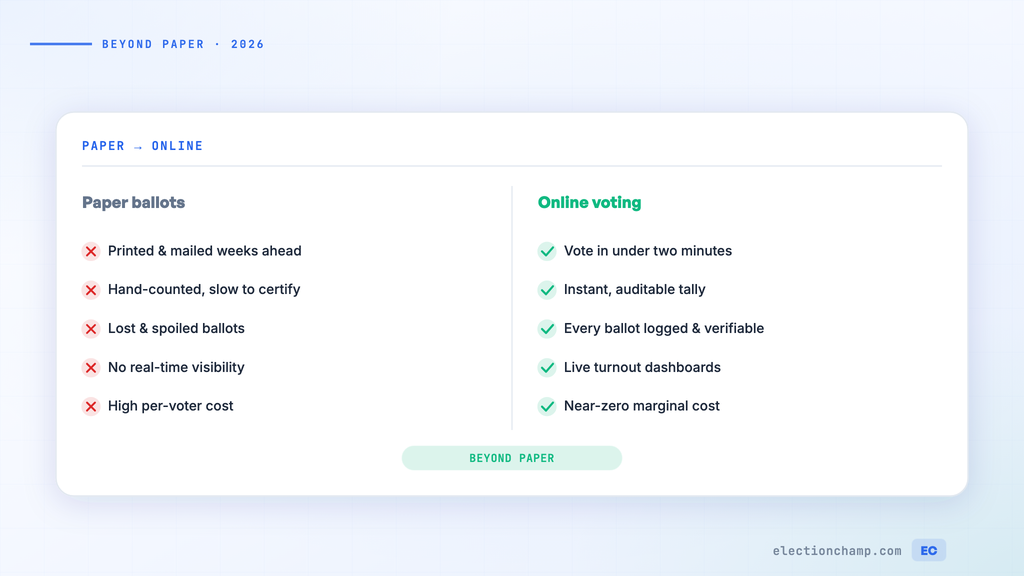
The question is no longer whether organizations should adopt online voting — it’s why they haven’t already. In 2026, online voting has moved from an innovative option to the expected standard for organizational governance. The shift that began accelerating during the pandemic has become permanent, driven by member expectations, cost pressures, and the demonstrable superiority of digital processes over paper.
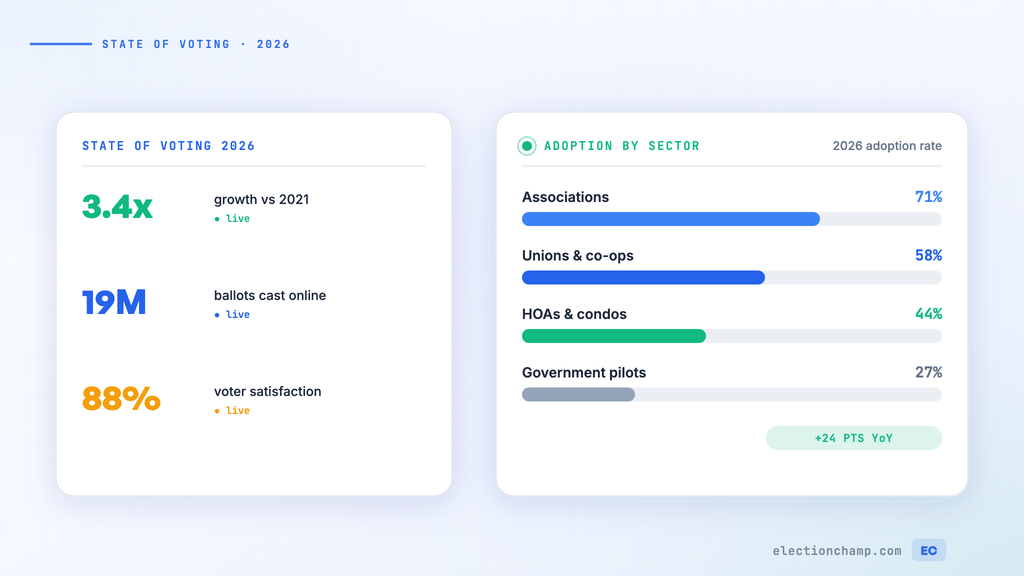
Adoption by Sector
|
Sector |
Estimated Adoption Rate |
Growth Trend |
Primary Driver |
|
HOAs & Condominiums |
45-55% |
Rapid growth |
State legislation enabling e-voting (CA, FL, TX) |
|
Nonprofits & Associations |
50-60% |
Steady growth |
Cost reduction and participation improvement |
|
Professional Associations |
55-65% |
Mature adoption |
Dispersed membership demands digital access |
|
Labor Unions |
35-45% |
Accelerating |
OLMS guidance supporting electronic methods |
|
Cooperatives |
40-50% |
Growing |
Democratic principles + member accessibility |
|
Corporations (private) |
30-40% |
Growing |
Governance efficiency and documentation |
|
Schools & Universities |
55-65% |
Rapid growth |
Student expectations and civic education value |
|
Religious Organizations |
25-35% |
Early growth |
COVID-era adoption becoming permanent |
|
Political Parties |
20-30% |
Early growth |
Member engagement and cost reduction |
1. Mobile-First Voting Is the Standard
The majority of votes in organizational elections are now cast on mobile devices. Organizations that don’t offer mobile-optimized voting are seeing declining participation as members expect to handle governance tasks from their phones just like banking, shopping, and communication.
2. SMS Notifications Are Outperforming Email
- Text message open rates remain around 98%, compared to 25-30% for email
- Organizations using SMS+Email notification see 20-40% higher participation than email-only
- SMS reminders during the voting window are the single most effective turnout driver
3. Hybrid Voting Is the Norm
Pure paper elections are disappearing, but pure online elections aren’t universal either. The dominant model is hybrid: online voting supplemented by manual/in-person options for members who prefer or need them. This approach maximizes participation while respecting diverse member preferences.
4. State Legislation Is Enabling Digital Adoption
- California’s AB 2159 established a clear legal framework for HOA electronic voting
- Florida, Texas, and other states with large HOA markets have updated their statutes to explicitly permit electronic voting
- More states are expected to follow as the legal frameworks prove effective
5. Security Expectations Are Rising
Organizations are no longer satisfied with basic password protection. They expect:
- Unique, cryptographically generated voter keys
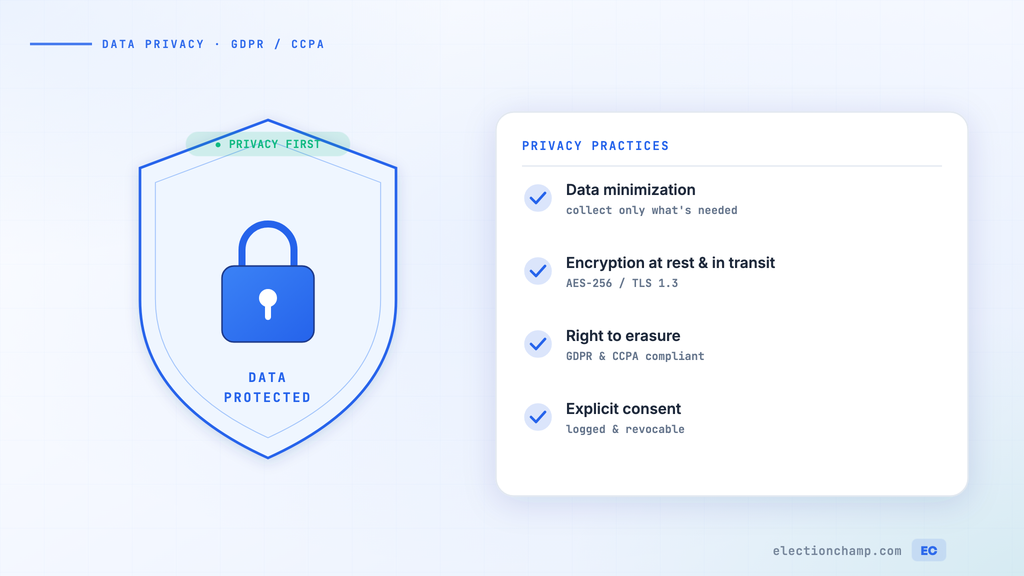
- Architectural ballot anonymization (not just policy-based privacy)
- Complete audit trails that can withstand scrutiny
- One-time-use authentication that physically prevents duplicate voting
6. AI-Assisted Election Setup
Artificial intelligence is beginning to help election administrators set up elections more efficiently, from ballot design suggestions to optimal voting window recommendations to automated voter communication.
What’s Not Working
- Blockchain voting: Despite continued hype, blockchain-based voting systems have not achieved meaningful market adoption. The technology adds complexity and cost without solving problems that existing encryption and authentication already address.
- Video-verified voting: Some platforms experimented with video confirmation of voter identity. These systems raised privacy concerns and created accessibility barriers.
- App-based voting: Requiring voters to download a dedicated app creates friction. Browser-based voting has won the market because it eliminates this barrier.
Predictions for 2027 and Beyond
- Adoption will cross 60% in most sectors: Online voting will be the default method for organizational elections, with paper-only holdouts becoming the exception.
- Regulatory frameworks will mature: More states and countries will adopt explicit legislation governing electronic voting for organizations.
- Integration with governance platforms: Online voting will integrate more deeply with meeting management, document sharing, and governance software.
- Participation rates will become a governance metric: Boards and regulators will increasingly evaluate organizations on their election participation rates, making turnout a strategic priority.
- Real-time analytics will enable adaptive campaigns: Election administrators will use real-time participation data to adjust communication strategies mid-election.
The Bottom Line
Online voting in 2026 is no longer a technology question — it’s a governance question. Organizations that have adopted it are seeing higher participation, lower costs, better documentation, and stronger democratic legitimacy. Those that haven’t are falling behind member expectations and missing an opportunity to strengthen their governance.
Planning your next vote? Read about how online elections work and the full feature list, or see pricing: free up to 20 voters, $10 up to 200, then $0.05 per voter.