ElectionChamp
The Nominating Committee: Guardians of Democratic Governance
The nominating committee is arguably the most important committee in any organization’s governance structure. By determining who appears on the ballot, the committee shapes the pool of potential leaders. A well-run nominating process produces competitive elections with qualified, diverse candidates. A poorly run one produces rubber-stamp elections where the same insiders cycle through leadership positions.
This guide helps nominating committee members fulfill their responsibility with fairness, transparency, and professionalism.
Understanding Your Role
The nominating committee’s job is to identify and present qualified candidates — not to choose the winners. Key principles:
- You are stewards of the process, not kingmakers. Your job is to ensure voters have good choices, not to predetermine the outcome.
- Transparency builds trust. Members should understand how candidates are identified, evaluated, and selected for the slate.
- Inclusivity broadens the talent pool. Actively seek candidates beyond the usual suspects.
- Documentation protects everyone. Keep records of your criteria, outreach, and decisions.
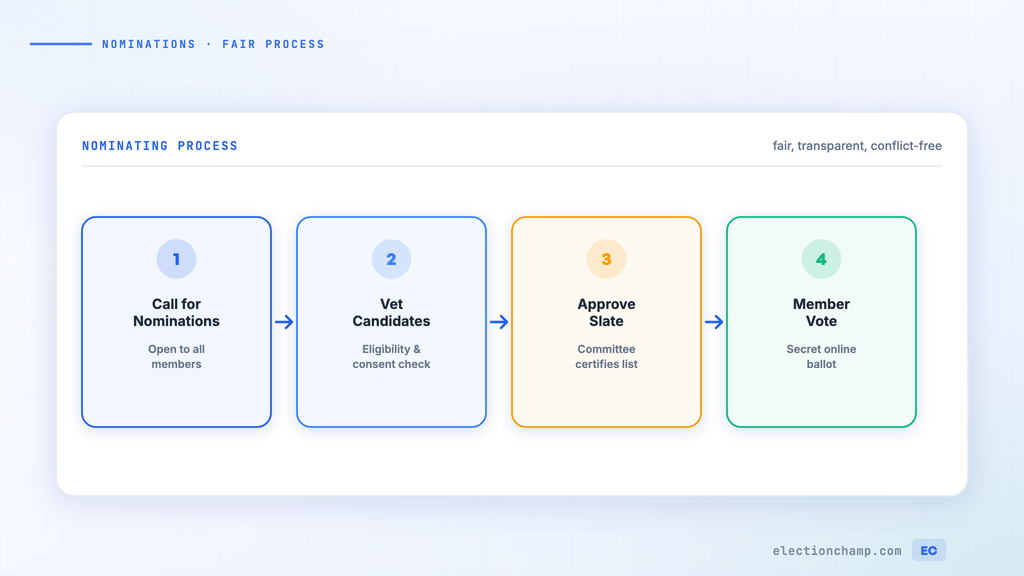
Step-by-Step: Running a Fair Nomination Process
- Review your bylaws: Understand the committee’s formal powers and limitations. Some bylaws specify committee composition, timeline, and procedures.
- Define the criteria: What qualifications, skills, and attributes does the organization need on its board? Consider expertise gaps, diversity needs, and strategic priorities.
- Publish the criteria: Share the board member profile publicly so potential candidates can self-assess and members know what the committee is looking for.
- Open nominations broadly: Accept nominations from committee members, the general membership, and self-nominations. Cast a wide net.
- Conduct outreach: Don’t just wait for nominations to come in. Proactively identify promising members and invite them to consider running.
- Evaluate candidates: Review each nominee against the published criteria. Conduct brief interviews if appropriate.
- Present the slate: Deliver a recommended slate with enough candidates to provide voter choice. Aim for more candidates than open seats.
- Ensure floor/petition nominations: Most bylaws allow additional nominations beyond the committee’s slate. Facilitate this process rather than blocking it.
Developing Selection Criteria
Strong criteria balance multiple dimensions:
Skills and Expertise
- Financial literacy (every board needs at least one member who can read financial statements)
- Legal knowledge (particularly relevant for the organization’s sector)
- Industry or domain expertise (the organization’s mission area)
- Fundraising ability or donor network access
- Technology proficiency (increasingly important for all organizations)
- Strategic planning experience
Diversity Dimensions
- Professional background (avoid boards dominated by a single profession)
- Age and generational representation
- Geographic distribution (for organizations with dispersed membership)
- Race, ethnicity, and gender diversity
- Tenure mix (experienced board members alongside fresh perspectives)
Practical Requirements
- Availability for meetings and committee work
- Willingness to serve the full term
- Absence of conflicts of interest
- Membership in good standing (dues current, participation history)
Recruiting Beyond the Usual Suspects
Many nominating committees default to asking the same people or accepting only those who volunteer. This perpetuates homogeneous boards. To break the cycle:
- Analyze your current board composition: Where are the gaps in skills, perspectives, and demographics?
- Review your membership rolls: Who are the engaged members you haven’t considered for leadership?
- Ask current board members: “Who impresses you at events, in committees, or in professional interactions?”
- Use ElectionChamp’s Nominations ballot type: Run a pre-election where members write in names of people they’d like to see on the board. This crowdsources candidates you might not have considered.
- Personally invite strong candidates: Many people won’t self-nominate but will run if asked directly by someone they respect.
Candidate Statements and Equal Presentation
Every candidate deserves fair, equal presentation to voters. The nominating committee should:
- Provide a standard template for candidate statements (word limit, required sections, formatting guidelines)
- Request a professional photo from each candidate
- Review statements for accuracy but not for content — you’re not editors or censors
- Ensure all candidates’ materials are submitted by the same deadline
- Upload all candidate information to ElectionChamp so voters can review it directly on the ballot by clicking “View Information”
Timeline Template
|
Milestone |
Timing |
Responsible Party |
|
Committee appointed |
90 days before election |
Board / Appointing authority |
|
Criteria published |
80 days before |
Nominating Committee |
|
Nominations open |
75 days before |
Nominating Committee |
|
Active recruitment |
75-45 days before |
Committee members |
|
Nominations close |
45 days before |
Nominating Committee |
|
Candidate interviews (if applicable) |
45-30 days before |
Nominating Committee |
|
Slate presented to board |
30 days before |
Committee Chair |
|
Candidates announced to membership |
28 days before |
Organization staff / comms |
|
Floor/petition nominations deadline |
14 days before |
Per bylaws |
|
Final ballot set |
10 days before |
Election administrator |
|
Voting opens |
Day 0 |
ElectionChamp |
|
Voting closes |
Day 7-14 |
ElectionChamp |
|
Results announced |
Within 24 hours of close |
Board / Organization |
Common Mistakes to Avoid
- Pre-selecting winners: If the committee presents exactly as many candidates as open seats, you’ve removed voter choice. Always aim for more candidates than positions.
- Lack of outreach: Waiting passively for nominations yields a narrow field. Actively recruit.
- Unclear criteria: Without published, objective criteria, the committee appears to be picking favorites.
- Excluding self-nominations: Members should always be able to put themselves forward.
- Blocking floor nominations: Even if the committee has a preferred slate, additional nominations strengthen democratic legitimacy.
- Insufficient diversity: A homogeneous slate signals a closed process and limits the organization’s potential.
Planning your next vote? Read about association voting software and bylaw and policy votes, or see pricing: free up to 20 voters, $10 up to 200, then $0.05 per voter.