ElectionChamp
Short answer: Elected by acclamation means a candidate is declared elected without a ballot because the race is uncontested. It applies once nominations close with no more qualified candidates than open seats. Under Robert’s Rules, the chair simply declares the nominee elected, unless the bylaws require a ballot. HOAs in California, Florida, and Nevada have statutes with their own conditions. If a ballot is required or a step was missed, hold the vote.
What Does Elected by Acclamation Mean?
Elected by acclamation means declared elected without a contest. A Canadian historical dictionary defines “by acclamation” as “(elected) without opposition” (Dictionary of Canadianisms on Historical Principles).
Acclamation entered English in the 1540s as an “act of shouting or applauding in approval,” from the Latin acclamare, “to call to, cry out at” (Online Etymology Dictionary). By 1801 it also meant approval by a unanimous voice vote. In Canada the meaning narrowed to election without opposition, and an unopposed candidate is said to be “acclaimed.”
Related terms include “uncontested election,” “unopposed,” and “declared elected.” Acclimation, which means adjusting to a new climate, is a different word.
When Does Election by Acclamation Apply?
Acclamation applies only when all of these are true:
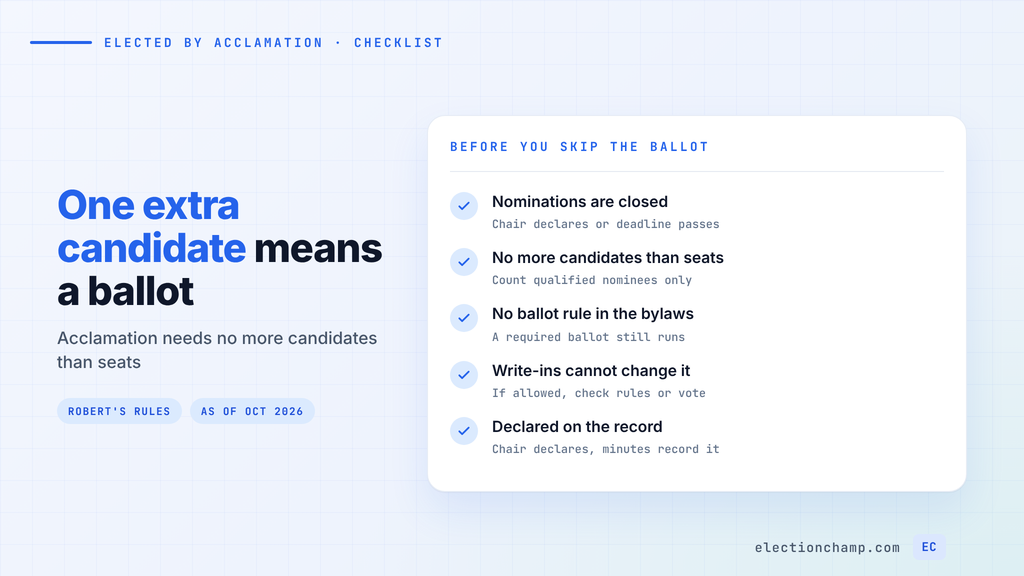
- Nominations are closed. The chair has declared them closed, or your deadline has passed.
- Qualified candidates do not exceed seats. Three for three qualifies. Two for three also qualifies where your rules allow it, leaving one vacancy.
- Nothing requires a ballot. Your bylaws, and any statute that governs you, allow seating without one.
- Write-ins cannot change the count. If write-in votes are allowed, the race may not be truly uncontested.
- Required notices went out on time. HOA statutes add notice steps.
| Situation | Acclamation? | Result |
|---|---|---|
| One nominee for one seat, no ballot rule | Yes | The chair declares the nominee elected |
| Three nominees for three seats | Yes, if your rules allow it | All three are seated |
| Two nominees for three seats | Yes, where allowed | Two are seated and one seat is vacant |
| Four nominees for three seats | No | Hold a vote |
| Bylaws require a ballot vote | No | Ballot even with one candidate |
How Is an Election by Acclamation Declared?
At a meeting, the chair declares it. No vote is taken. A typical script:
“Are there any further nominations for treasurer? [Pause.] Hearing none, nominations are closed. There being only one nominee, the chair declares [Name] elected treasurer.”
For a multi-seat board, name every candidate in the declaration.
Minutes Wording for Election by Acclamation
Record who was nominated and how the chair declared the result:
Nominations for treasurer: [Name], nominated by [Name]. There being no further nominations, nominations were closed. There being only one nominee, the chair declared [Name] elected treasurer by acclamation.
If a board vote seats the candidates, as California requires for HOAs, record the motion with each name and the vote count.
When Nominations Close Before the Meeting
Many organizations close nominations at a deadline instead:
- Confirm your authority. Find the bylaw or statute that allows seating without a ballot.
- Log every nomination. Record receipt, acknowledgment, and the qualification decision with dates.
- Certify the count at close. The election committee or inspector confirms in writing that qualified candidates do not exceed seats.
- Seat the candidates on the record. Make the declaration or board vote your rules require, with names in the minutes.
- Tell the members and keep every record together.
You can collect nominations online with ElectionChamp, where members type nominee names into a nomination question. Build the final ballot early too. Setup and testing are free and you pay only at launch, so a ready ballot costs nothing if the race stays uncontested.
Robert’s Rules on Election by Acclamation
Robert’s Rules of Order Newly Revised covers acclamation in section 46 of the 11th edition. If only one person is nominated and the bylaws do not require a ballot vote, the chair declares the nominee elected. That is “the election by unanimous consent or ‘acclamation'” (Robert’s Rules, 11th edition, section 46 excerpt).
A ballot requirement controls. If your bylaws say elections are by ballot, take the ballot even with one candidate, because acclamation works like a voice vote (Civility; official Robert’s Rules Q&A forum).
Without Robert’s Rules as your parliamentary authority, your bylaws and standing rules decide. See our guide to Robert’s Rules for online voting.
HOA Election by Acclamation: State Rules
HOAs often have one more layer. California requires director elections by secret ballot “notwithstanding any other law or provision of the governing documents” (Civil Code 5100(a)). There, acclamation exists only because a second statute carves out an exception. For contested races, see how online voting for HOAs works.
Where HOA Acclamation Is Allowed by Statute
These statutes were checked in October 2026.
| State and law | When candidates do not exceed seats | Key conditions |
|---|---|---|
| California HOAs, Civil Code 5103 | The board may vote to seat the qualified candidates by acclamation. It is optional. | Full election within the last 3 years, a 90-day initial notice and a reminder notice, nomination acknowledgments within 7 business days, and a board vote at an open meeting |
| Florida HOAs, Statutes 720.306(9)(a) | No election is required. Qualified candidates begin serving, even if the annual meeting lacks a quorum. | Applies only if floor nominations are not required by the statute or the bylaws. In that case write-ins are not permitted. |
| Florida condos, Statutes 718.112(2)(d) | No election is required unless more candidates file notices of intent or are nominated than there are vacancies. | Candidates give written notice of intent at least 40 days before the scheduled election |
| Nevada, NRS 116.31034(5) and (6) | No ballots are prepared. Candidates are deemed elected at the meeting where ballots would have been counted. | The board must decide this before the eligibility notice goes out and disclose the decision in that notice |
| Other states | Varies | Check your state HOA or nonprofit statute, your declaration, and your bylaws |
Older articles cite Civil Code 5100(g), which covered only associations with 6,000 or more units (2020 version). AB 502 replaced it with Section 5103 on January 1, 2022, with no size limit. AB 1764 last amended 5103, effective January 1, 2024.
California Civil Code 5103 Requirements
California’s rule is optional: the association “may, but is not required to” seat qualified candidates by acclamation. The inspector of elections counts candidates as of the nomination deadline set under Civil Code 5115(a). A regular director election must have been held in the last three years, measured from the last ballot due date to the start of voting (5103(a)).
| Step | Timing | Civil Code |
|---|---|---|
| Initial individual notice with the acclamation statement | At least 90 days before nominations close | 5103(b)(1) |
| General notice of the nomination procedure and deadline | At least 30 days before nominations close | 5115(a) |
| Acknowledge each nomination and tell the nominee if they qualify | Within 7 business days of receipt | 5103(c) |
| Reminder notice with the current candidate list | 7 to 30 days before nominations close | 5103(b)(2) |
| Board votes to seat the candidates | Open board meeting with each name on the agenda | 5103(e) |
Individual notice means mail, or email to members who agreed to electronic delivery. A website or bulletin board posting does not satisfy it (Tinnelly Law Group on AB 502). Nominees may be disqualified only on the grounds in Section 5105(b) to (e), and your rules must apply the same requirement to sitting directors (5103(d)).
Section 5100(a)(2) requires an election for each seat at least every four years, and acclamation needs a full election within the last three (5103(a)). One extra qualified candidate means a full secret ballot election under Sections 5115 and 5120. Election operating rules cannot be amended less than 90 days before an election (Civil Code 5105). Our guide on how to run an HOA board election from start to finish covers that path.
Write-Ins and Too Few Candidates in HOA Elections
- Florida HOAs: write-in nominations are not permitted when no election is required and floor nominations are not required (720.306(9)(a)).
- California: election rules “may permit write-in candidates for ballots” (Civil Code 5105(g)). Section 5103 does not mention write-ins.
- Nevada: Section 116.31034 does not address write-ins.
Where write-ins are allowed and the statute is silent, get counsel’s view before seating anyone.
All three states cover “fewer” candidates as well as “equal,” and unfilled seats become vacancies. In California HOAs incorporated as nonprofit mutual benefit corporations, the board may fill vacancies unless the articles or bylaws say otherwise. The members fill a vacancy created by removing a director, unless the documents allow the board to fill it (Corporations Code 7224(a)). If nobody runs, check your bylaws for holdover language, meaning directors serve until a successor is elected.
Acclamation in Clubs, Nonprofits, and Unions
Clubs and Community Groups
Many clubs elect officers at an annual meeting, where the Robert’s Rules procedure fits as written. If your bylaws say officers are elected by ballot, hold one for every office.
Nonprofits and Associations
Member-elected nonprofit boards follow their bylaws and their state’s nonprofit corporation law, so check both for a ballot requirement. Certify the count at the deadline and record the declaration in the minutes. The same records support contested board elections.
Unions
For US local unions covered by the Labor-Management Reporting and Disclosure Act, federal guidance applies. When a nominee is unopposed after a reasonable opportunity for nominations, the union “does not have to include that position on the ballot” (DOL guide to local union officer elections). That holds only if write-in votes are not permitted by the constitution and bylaws, applicable resolutions, or established practice.
If every office is unopposed under those conditions, “no election is necessary.” Federal rules neither require nor prohibit write-ins (29 CFR 452.64), so check your constitution first.
When You Should Still Hold a Vote
Run the ballot when:
- Your bylaws or a statute require one, as California does for HOA directors.
- A notice or nomination step was missed or is in doubt. California members can sue within one year of the results notice or of when the claim arose, whichever is later (Civil Code 5145(a)).
- Write-ins or floor nominations are allowed and your rules are silent on uncontested races.
- A nominee’s eligibility is disputed.
- Trust in the board is low. Skipping the ballot can look like a closed process.
- You are near California’s three-year or four-year limit.
ElectionChamp is free up to 20 voters and $10 flat up to 200. A short ballot costs less than a disputed seat.
Frequently Asked Questions
What does elected by acclamation mean?
It means a candidate is declared elected without a ballot because the race is uncontested. When nominations close, there are no more qualified candidates than open seats. It is allowed only where your bylaws, and any statute that applies, permit it.
Is election by acclamation the same as a unanimous vote?
Under Robert’s Rules, acclamation is an election by unanimous consent. The chair declares the nominee elected and no votes are cast or counted. If your bylaws require a ballot, acclamation is not available.
Does an uncontested election still need a vote?
It depends on your bylaws and any statute that governs you. If the bylaws require a ballot, hold one even with one candidate. California, Florida, and Nevada let uncontested HOA races skip the ballot if their conditions are met. Confirm with your governing documents and counsel.
Can write-in candidates stop an election by acclamation?
They can where write-ins are allowed. Department of Labor guidance lets an unopposed union office skip the ballot only if write-ins are not permitted. Florida HOAs bar write-ins when no election is required and floor nominations are not required. If your rules allow write-ins, get advice or run a short ballot.
Planning your next vote? Read about board elections and nominations, or see pricing: free up to 20 voters, $10 up to 200, then $0.05 per voter.