ElectionChamp
Parliamentary Procedure Meets the Digital Age
Robert’s Rules of Order (RONR) has been the standard for parliamentary procedure in American organizations since 1876. It governs how motions are made, debated, and voted on in everything from small nonprofit boards to large membership assemblies. But Robert’s Rules were written for in-person meetings with voice votes and show-of-hands counting.
As organizations move meetings and voting online, the question becomes: how do Robert’s Rules apply to digital voting? The answer is that the principles translate perfectly — only the mechanics change.
The Motion Process
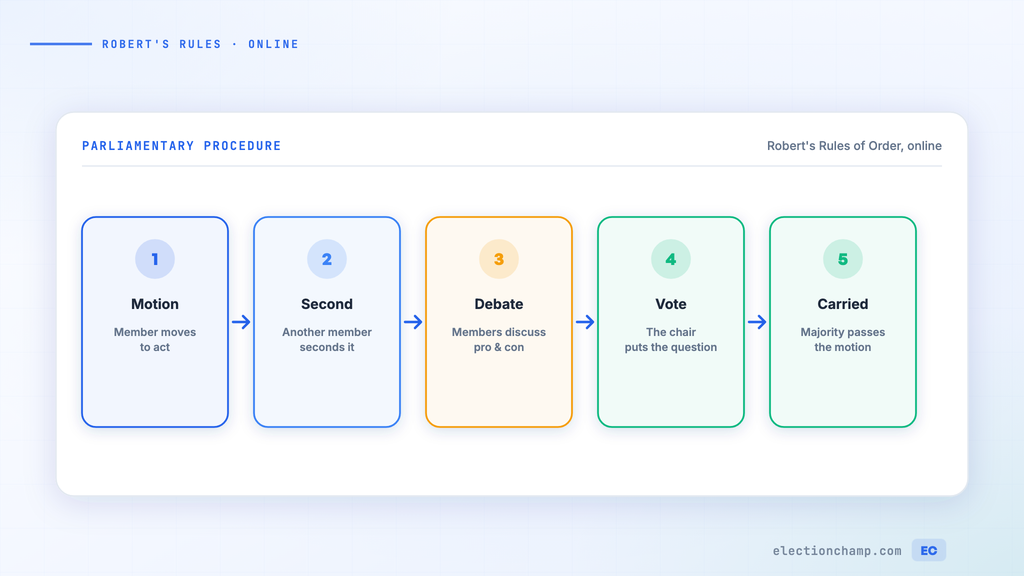
Under Robert’s Rules, formal decisions follow a specific process:
- A member makes a motion: “I move that we approve the 2026 operating budget.”
- Another member seconds the motion: “I second the motion.”
- The chair states the question: “It is moved and seconded that we approve the 2026 operating budget. Is there any discussion?”
- Members debate the motion.
- The chair puts the question to a vote: “All those in favor? All those opposed?”
- The chair announces the result: “The motion carries” or “The motion is lost.”
In an online voting context, steps 1-4 happen during your meeting (virtual or in-person), and step 5 happens through the online ballot. Step 6 is handled by the automated results.
Voting Thresholds Under Robert’s Rules
|
Action |
Vote Required |
What It Means |
ElectionChamp Setup |
|
Ordinary motions |
Majority of votes cast |
More than half of those who vote (excluding abstentions) |
Yes/No Plurality; check if Yes > No |
|
Bylaw amendments |
Two-thirds of votes cast |
At least 66.7% vote Yes |
Yes/No Plurality; verify 66.7% threshold |
|
Suspend the rules |
Two-thirds of votes cast |
At least 66.7% vote Yes |
Yes/No Plurality |
|
Rescind a previous action (with notice) |
Majority of votes cast |
More than half |
Yes/No Plurality |
|
Rescind (without previous notice) |
Two-thirds of votes cast |
At least 66.7% |
Yes/No Plurality |
|
Elections (when more than 2 candidates) |
Majority of votes cast |
A candidate must get more than half to win |
Plurality; hold a second vote if no one has a majority (Ranked Choice uses Borda points and does not ensure a majority) |
Important: Under Robert’s Rules, abstentions are not counted as votes cast. A motion can pass with 10 Yes votes, 8 No votes, and 5 abstentions — because 10 is a majority of the 18 votes cast.
Quorum in Online Voting
Robert’s Rules requires a quorum — a minimum number of members — for valid business. Key considerations for online voting:
- Your bylaws define the quorum requirement (commonly a majority of members, or a specific number/percentage)
- In online voting, quorum is typically measured by participation (number of ballots submitted), not physical attendance
- ElectionChamp’s real-time dashboard shows participation count, letting you monitor quorum achievement throughout the voting period
- If quorum isn’t met by the end of the voting window, the vote’s validity may be challenged — monitor closely and send reminders
- Check your bylaws: some define quorum for online votes differently than for in-person meetings
Elections Under Robert’s Rules
Robert’s Rules provides specific guidance for elections:
- Nominations: Must follow your bylaws. Typically, nominations are accepted from a nominating committee, from the floor, or both.
- Ballot voting: Robert’s Rules requires ballot voting for elections when the bylaws specify it or when the assembly orders it. Online voting satisfies the ballot voting requirement.
- Majority rule: Under RONR, a candidate must receive a majority of votes cast to be elected (not just the most votes). If no candidate achieves a majority, additional rounds of voting are needed.
- Ranked Choice alternative: To avoid multiple rounds, some organizations use instant-runoff voting, which eliminates the lowest candidate and transfers votes until someone has a majority. ElectionChamp’s ranked choice works differently. It counts ranked ballots with Borda points: each rank earns points, first choice the most, and the highest total wins. A points count does not guarantee a majority winner. If your bylaws require instant runoff, export the ranked results as CSV and run the count in a separate tool.
Motions and Resolutions
- Main motions (proposals for the organization to take action) translate directly to Yes/No ballot questions
- Amendments to motions should be voted on before the main motion — if amendments are possible, consider holding the main motion vote after the meeting where amendments are debated
- Subsidiary and privileged motions (postpone, refer to committee, etc.) are handled during the meeting itself, not through online voting
Multiple Motions on One Ballot
- If the assembly has multiple motions to vote on, each can be a separate ballot question in one ElectionChamp election
- Voters see each motion individually and vote Yes or No on each
- Results are calculated separately for each question
- If motions are interdependent (Motion B only applies if Motion A passes), note this in the voter instructions and handle sequencing during the meeting
Script: Transitioning to Online Vote
“The motion has been made, seconded, and debated. We will now conduct the vote using our online voting platform. Each member will receive a ballot link via email and text message. The voting window will be open for [X days] and will close on [date] at [time]. Please submit your ballot within this period. Results will be announced at our next meeting [or via email within 24 hours].”
Script: Announcing Online Vote Results
“The results of the online vote on the motion to [motion text] are as follows: [X] votes in favor, [Y] votes opposed, [Z] abstentions. A total of [N] members voted, which [does/does not] constitute a quorum. The motion [carries/is lost].”
Can we use online voting instead of voice votes at meetings?
Yes, if your bylaws authorize it. Most organizations amend their bylaws to explicitly authorize electronic voting. Even without a bylaw amendment, many organizations interpret their existing voting provisions broadly enough to include digital methods. Consult with your parliamentarian.
Does online voting violate the right to debate?
Not if you handle debate and voting as separate phases. Debate happens during the meeting (in-person or virtual). Voting happens online after debate concludes. Members have had their opportunity to discuss before the vote opens.
Can a member change their vote?
- Under Robert’s Rules, a member may change their vote before the result is announced
- In ElectionChamp, once a ballot is submitted, the voter key is deactivated and the vote cannot be changed — this is an intentional security measure
- This is actually stricter than Robert’s Rules requires, but it enhances election integrity and is generally accepted as best practice for formal elections
Robert’s Rules Quick Reference for Online Elections
|
Element |
Robert’s Rules Requirement |
Online Voting Implementation |
|
Quorum |
As defined by bylaws |
Monitor via ElectionChamp participation dashboard |
|
Secret ballot |
When required by bylaws or ordered by assembly |
All ElectionChamp votes are anonymous by default |
|
Majority vote |
More than half of votes cast |
Review results CSV — Yes votes vs. total votes cast |
|
Two-thirds vote |
At least 66.7% of votes cast |
Calculate from results CSV |
|
Notice |
As required by bylaws |
Send via ElectionChamp + any other required method |
|
Record of vote |
Minutes should record the vote count |
Download results CSV for meeting minutes |
Planning your next vote? Read about association voting software and bylaw and policy votes, or see pricing: free up to 20 voters, $10 up to 200, then $0.05 per voter.