ElectionChamp
Democratic Principles Are Universal
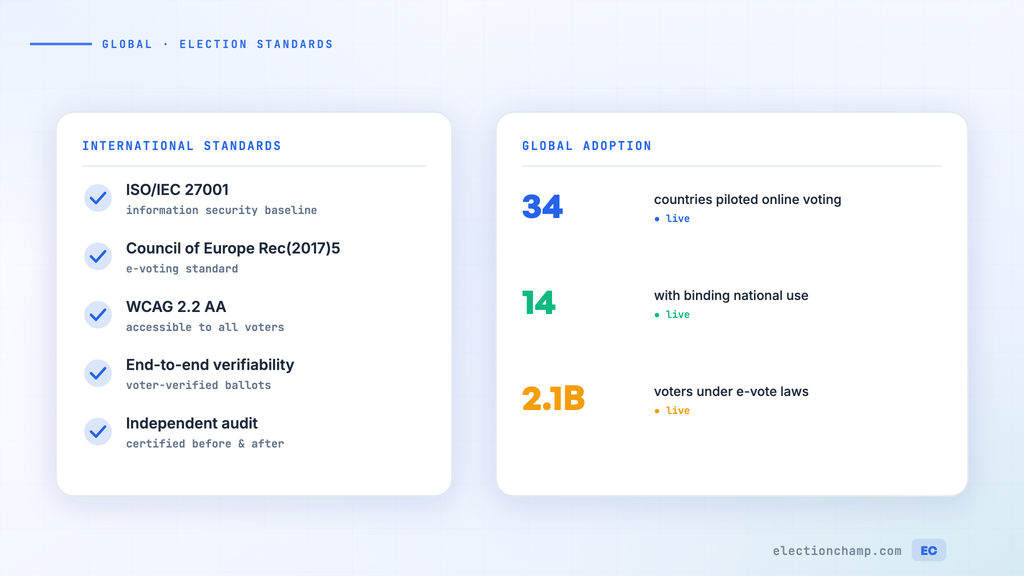
While election laws vary by country, the fundamental principles of democratic voting are recognized internationally: universal and equal suffrage, secret ballot, free expression of the voter’s will, and the integrity of the electoral process. International organizations have developed standards and guidelines for electronic voting that translate these principles into the digital context.
For organizations with international membership — global nonprofits, multinational professional associations, international cooperatives, and cross-border unions — understanding how online voting aligns with these standards ensures that elections are respected and legitimate regardless of where members are located.
Key International Standards Bodies
|
Organization |
Standard/Guideline |
Focus Area |
|
Council of Europe |
Recommendation CM/Rec(2017)5 |
Legal, operational, and technical standards for e-voting in member states |
|
OSCE/ODIHR |
Handbook on the Observation of New Voting Technologies |
Election observation standards including electronic voting |
|
International IDEA |
ICT in Elections Database |
Global database of technology use in elections; best practice guidance |
|
ACE Electoral Knowledge Network |
Encyclopedia on Electoral Management |
Comprehensive reference on election administration including technology |
|
IEEE |
P1622 Standard |
Technical standard for electronic election data interchange |
|
ISO |
ISO/IEC 27001 |
Information security management applicable to voting systems |
Council of Europe E-Voting Standards
The Council of Europe’s 2017 recommendation on e-voting is the most comprehensive international framework. Its key principles:
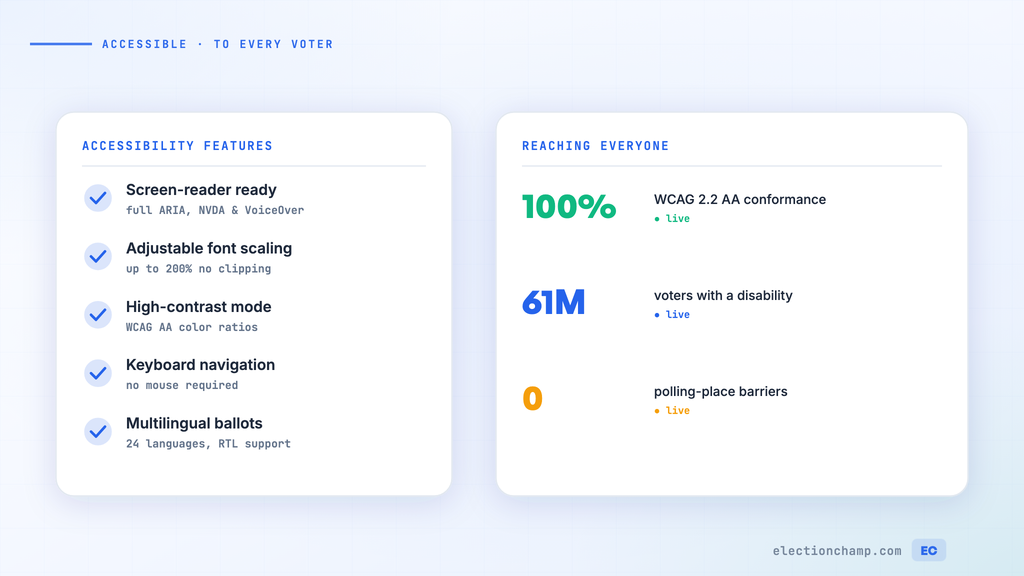
- Universality: E-voting must be available to all voters, with alternative methods for those who cannot use electronic channels
- Equality: Each voter’s vote must carry equal weight in the electronic system
- Freedom: Voters must be able to vote without coercion, and the system must not reveal their choices to others
- Secrecy: The link between the voter’s identity and their vote must be broken and impossible to reconstruct
- Transparency: The e-voting system must be open to examination and verification while maintaining ballot secrecy
- Reliability: The system must function correctly, count votes accurately, and be resistant to failure
How ElectionChamp Meets These Standards
|
Principle |
CoE Requirement |
ElectionChamp Implementation |
|
Universality |
Alternative voting methods available |
Email, SMS, and printed keys for offline voting |
|
Equality |
One vote per person, equal weight |
Unique single-use voter keys; one submission per key |
|
Freedom |
No coercion; voter makes independent choice |
Anonymous voting; mobile access from any private location |
|
Secrecy |
Identity-vote link broken |
Architectural separation of voter identity and ballot data |
|
Transparency |
System open to verification |
Complete audit trail; downloadable results; documented processes |
|
Reliability |
Accurate counting; resistant to failure |
Automated calculation; cloud infrastructure; redundancy |
Cross-Border Election Challenges
Organizations with members across multiple countries face specific challenges:
- Time zones: A single voting window must accommodate members from Asia to the Americas. Extended windows (10-14 days) solve this.
- Language diversity: Ballot materials may need to be available in multiple languages. Use the Voter Instructions field for translations.
- Legal jurisdiction: Different countries have different rules about data privacy, electronic communications, and voting. The organization’s bylaws and country of incorporation typically govern.
- Connectivity: Internet access varies globally. Mobile-optimized voting works in more locations; printed keys provide an offline option.
- Cultural expectations: Voting norms differ across cultures. Clear instructions and support help all members participate confidently.
Data Privacy Across Borders
International elections involve transferring voter data across borders, which triggers privacy regulations:
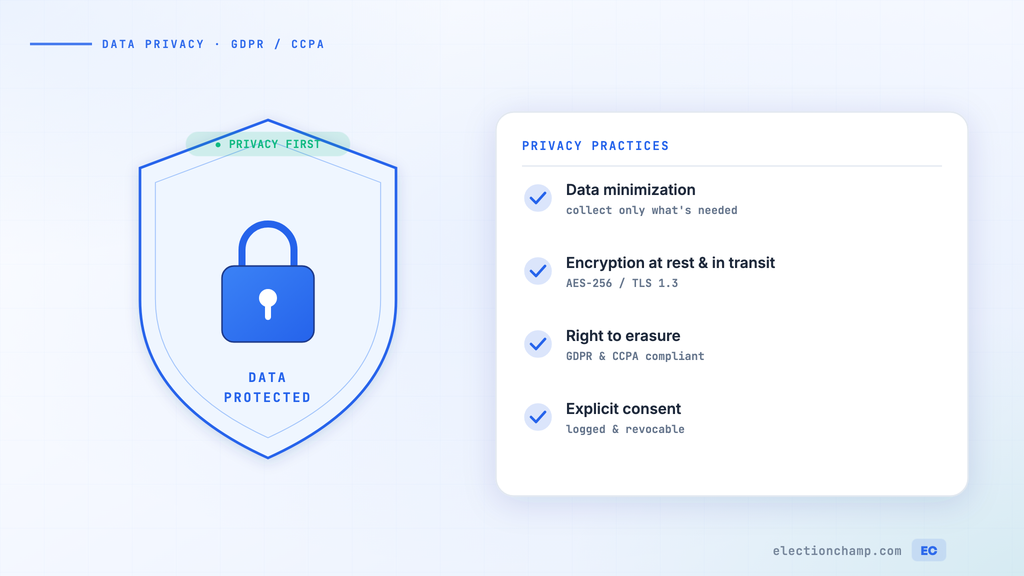
- GDPR (European Union): If any of your members are EU residents, you must comply with GDPR requirements for data processing, consent, and data protection.
- CCPA/CPRA (California): California residents have specific data privacy rights that apply to voter data.
- PIPEDA (Canada): Canadian privacy law governs the collection and use of personal information.
- Other jurisdictions: Brazil (LGPD), Japan (APPI), Australia (Privacy Act), and others may apply depending on your membership.
ElectionChamp’s anonymous ballot architecture inherently supports privacy by design — voter identity and ballot data are architecturally separated, minimizing the personal data associated with actual votes.
Multilingual Election Management
- Identify the languages spoken by your membership and determine which need full ballot translation
- Translate ballot questions, candidate information, and voter instructions into all necessary languages
- Send notification emails in each member’s preferred language if your membership database tracks language preference
- Provide voter support in multiple languages — even a simple FAQ document in key languages reduces confusion
- Test the ballot with native speakers of each language before launch to catch translation errors
Building Legitimacy for International Elections
International elections carry higher stakes for legitimacy because members in different countries may have different expectations:
- Publish your election procedures in advance and make them accessible to all members worldwide
- Consider appointing election observers from different regions to provide independent oversight
- Share results comprehensively: participation rates by region, total votes, and margins — transparency builds trust across borders
- Maintain election records per the most stringent requirement among all applicable jurisdictions
Organizations That Benefit from International Standards Compliance
- Global professional associations (medical, legal, engineering, academic) with members across dozens of countries
- International NGOs and humanitarian organizations with worldwide operations
- Multinational cooperatives and credit unions with cross-border membership
- International labor federations and trade union confederations
- Religious organizations with global governance structures
- Sports federations and international athletic associations
Planning your next vote? Read about online voting for government and audit trail and compliance, or see pricing: free up to 20 voters, $10 up to 200, then $0.05 per voter.