ElectionChamp
Giving People a Direct Say in How Money Is Spent
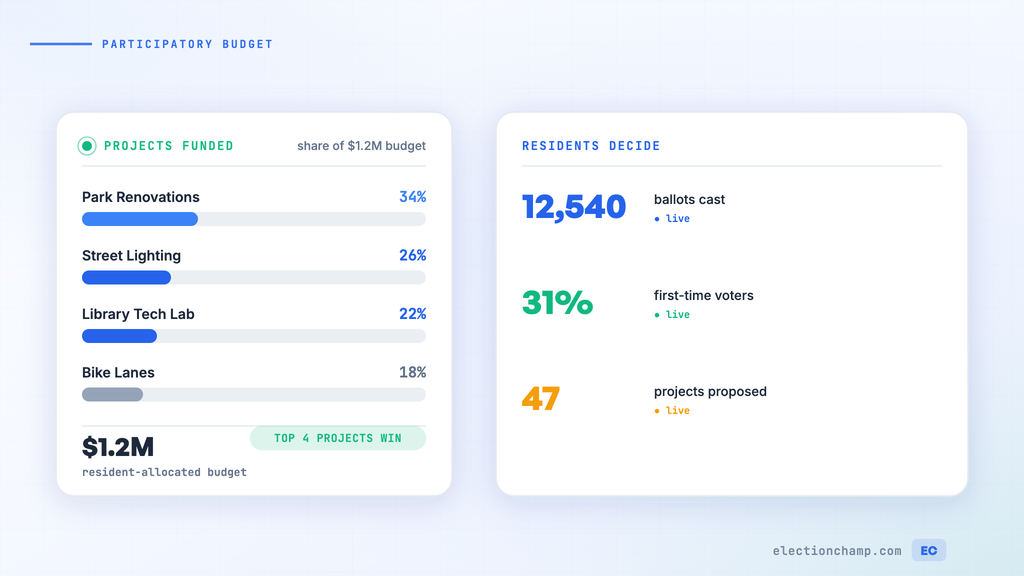
Participatory budgeting (PB) is a democratic process in which community members directly decide how to spend part of a public or organizational budget. Originating in Porto Alegre, Brazil in 1989, PB has spread to thousands of cities worldwide and has been adopted by schools, universities, and organizations as a way to make budget decisions more democratic and responsive.
The concept is simple: instead of elected officials or administrators making all spending decisions, community members propose projects, discuss priorities, and vote on how a designated portion of the budget should be allocated.
How Participatory Budgeting Works
- Define the budget: Identify the portion of the budget subject to participatory voting. This might be a specific dollar amount ($500,000 of the capital budget), a percentage (5% of discretionary spending), or a designated fund (the community improvement fund).
- Collect proposals: Community members submit project ideas that fall within the budget scope. Ideas might include park improvements, traffic calming, public art, community programs, or equipment purchases.
- Evaluate feasibility: Staff reviews proposals for feasibility, cost estimates, and compliance with regulations. Infeasible proposals are returned to the proposer with an explanation.
- Present final projects: Viable projects are compiled into a ballot with descriptions, estimated costs, and expected impact.
- Community vote: All eligible community members vote on which projects to fund.
- Implement: Winning projects are funded and implemented, with progress reported publicly.
Setting Up a PB Vote Online
ElectionChamp is well-suited for the voting phase of participatory budgeting:
- Create the election: “[City/Organization] Participatory Budget 2026”
- Build the ballot: List each eligible project as a candidate/option. Include a description, estimated cost, and location/scope in the candidate biography field.
- Choose the voting method:
Option A: Plurality — “Select up to 5 projects you’d like to fund.” Projects are funded in order of votes received until the budget is exhausted.
Option B: Ranked Choice — “Rank all projects in order of preference.” This finds the projects with the broadest community support.
Option C: Approval voting — “Vote Yes or No on each project.” Projects above a threshold are funded in order of approval percentage.
- Set a generous voting window: 14-21 days. PB votes should maximize participation.
- Promote widely: City website, social media, community events, multilingual outreach, library and community center flyers
Who Uses Participatory Budgeting
|
Organization Type |
Typical Budget |
Common Projects |
Scale |
|
Municipalities |
$100K – $30M+ |
Parks, roads, safety, public art |
City-wide or by district |
|
School districts |
$50K – $500K |
Classroom equipment, playground, technology |
District-wide or by school |
|
Universities |
$25K – $200K |
Student life, campus improvements |
Campus-wide |
|
Nonprofits |
$10K – $100K |
Programs, equipment, community projects |
Organization-wide |
|
Housing authorities |
$50K – $500K |
Common area improvements, safety, amenities |
By property or district |
|
Corporations (internal) |
$10K – $100K |
Office improvements, team activities, equipment |
Company-wide or by office |
Before the Vote
- Host community information sessions where residents can learn about each proposed project
- Create project fact sheets with photos, maps, cost estimates, and implementation timelines
- Make all information available online and in print at community locations
During the Vote
- Offer multiple voting channels: online (email/SMS notification), in-person (printed keys at community locations), and assisted voting for accessibility
- Provide multilingual ballot materials to reflect the community’s linguistic diversity
- Monitor participation by neighborhood or district — target outreach to underrepresented areas
After the Vote
- Announce results at a public event or council meeting with full transparency
- Publish complete results: every project’s vote count, participation statistics, and the list of funded projects
- Create an implementation timeline and share it publicly
- Report on project completion — close the loop by showing community members what their votes accomplished
Measuring PB Impact
|
Metric |
What to Measure |
Why It Matters |
|
Participation rate |
Number of voters / eligible population |
Core measure of democratic legitimacy |
|
Demographic equity |
Voter demographics vs. community demographics |
Are all communities represented in decisions? |
|
Proposal diversity |
Number and variety of project proposals |
Are ideas coming from across the community? |
|
Implementation rate |
Funded projects completed / funded projects total |
Accountability — did the government follow through? |
|
Satisfaction |
Post-implementation survey of voters and project beneficiaries |
Did PB improve community trust and engagement? |
|
Repeat participation |
Year-over-year voter retention |
Are people staying engaged with the process? |
Planning your next vote? Read about online voting for government and audit trail and compliance, or see pricing: free up to 20 voters, $10 up to 200, then $0.05 per voter.