ElectionChamp
Sovereignty and Self-Governance
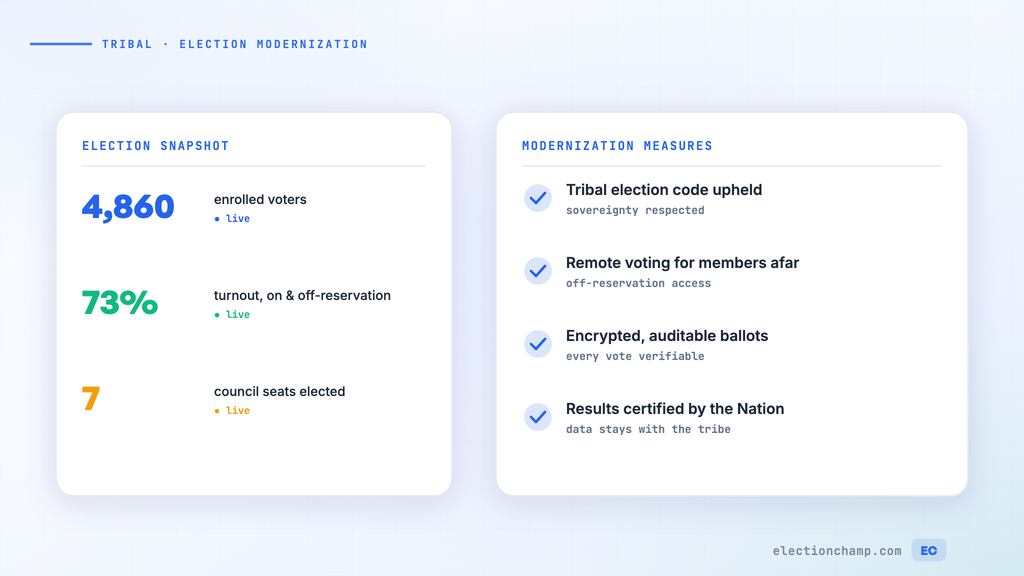
Tribal governments exercise sovereign authority over their internal affairs, including the election of their leaders and representatives. Each tribal nation has its own constitution, governance structure, and election procedures — there is no one-size-fits-all approach. This sovereignty means tribes have the freedom to adopt election methods that best serve their communities, including online voting.
This guide respects that sovereignty by offering considerations and options rather than prescriptions. Each tribe should evaluate these approaches in the context of their own constitution, culture, and community needs.
Common Tribal Government Elections
|
Election Type |
Typical Structure |
Frequency |
|
Tribal council / governing body |
Council members elected by district or at-large |
Every 2-4 years |
|
Tribal chairman / president / chief |
Direct election by all eligible members |
Every 2-4 years |
|
Secretary / Treasurer |
Direct election or council appointment |
Every 2-4 years |
|
Referendum votes |
Constitutional amendments, policy changes |
As needed |
|
Enrollment decisions |
Membership determinations |
As needed |
|
Committee elections |
Gaming commission, education board, housing authority |
Varies |
The Challenge: Reaching All Tribal Members
Many tribal nations face a fundamental participation challenge: a significant portion of their membership lives away from the reservation or tribal lands. Urban tribal members, members serving in the military, members attending distant universities, and members who have relocated for employment may find it difficult or impossible to return home to vote in person.
- According to various studies, 60-70% of Native Americans live in urban areas rather than on reservations or tribal lands
- For some tribes, off-reservation members constitute the majority of eligible voters
- Travel distances can be hundreds or thousands of miles
- Time off work and travel costs create financial barriers to in-person voting
Online voting directly addresses this challenge by allowing every enrolled member to participate regardless of where they live.
Hybrid Voting: Honoring Tradition While Expanding Access
Many tribal elections have cultural and ceremonial elements that are integral to the process. Online voting can complement rather than replace these traditions:
- Maintain traditional in-person voting at tribal headquarters or community centers for members who prefer it
- Add online voting as an additional channel for off-reservation and distant members
- Use printed keys for elders and community members who prefer a non-digital option but can’t attend in person — keys can be mailed
- Open online voting 7-14 days before the in-person election day to capture early votes
- On election day, provide printed keys at the voting site for walk-in voters
- All votes — online, SMS, and in-person — are counted together in one system
Constitutional Considerations
Before implementing online voting, tribal governments should consider:
- Does your tribal constitution specify the method of voting? If it mandates in-person or paper ballot voting, a constitutional amendment may be needed before adding online voting.
- Who is eligible to vote? Enrollment criteria, age requirements, and residency requirements vary by tribe.
- What approval thresholds are required for elections and referendums? Document these clearly in your election ordinance.
- Is there an election board or commission that oversees elections? They should be involved in evaluating and approving online voting methods.
Security and Trust
Trust in the election process is fundamental to tribal governance. Online voting must meet or exceed the security of existing methods:
- Unique voter keys: Each enrolled member receives a single-use key — no one can vote twice or vote for someone else
- Anonymous ballots: Even tribal leaders and election officials cannot see how any individual voted
- Audit trail: Complete, timestamped documentation of every administrative action provides transparency
- Results verification: Downloadable results and audit logs allow independent verification by the election board
Cultural Sensitivity
Technology implementation in tribal communities requires cultural sensitivity:
- Involve tribal elders and community leaders in the decision to adopt online voting — their endorsement builds community trust
- Ensure that online voting doesn’t replace community gathering and ceremony associated with elections
- Provide in-person assistance for members who are unfamiliar with digital technology
- Respect language diversity: if tribal language is used in governance, provide ballot materials in both the tribal language and English
Connectivity Considerations
Internet access varies significantly across tribal communities:
- Many reservations have limited broadband coverage — mobile-optimized voting is essential because cellular coverage often exceeds broadband
- ElectionChamp’s ballot is lightweight and works on any smartphone browser with a basic cellular connection
- For areas without any connectivity, printed keys can be mailed to members who then vote at a location with internet access (library, community center, tribal office)
- SMS notifications are more reliable than email in areas with limited connectivity
Planning your next vote? Read about online voting for government and audit trail and compliance, or see pricing: free up to 20 voters, $10 up to 200, then $0.05 per voter.