ElectionChamp
A Different Regulatory Landscape
Public sector union elections operate under a fundamentally different regulatory framework than private sector unions. While private sector unions fall under the LMRDA and NLRA, government employee unions are governed by a patchwork of federal, state, and local laws that vary dramatically by jurisdiction and employee type.
Understanding which rules apply to your union is the essential first step in running a compliant election.
Federal Employee Unions
Federal employees are covered by the Federal Service Labor-Management Relations Statute (Title VII of the Civil Service Reform Act of 1978), administered by the Federal Labor Relations Authority (FLRA):
- The FLRA oversees labor-management relations for most federal employees
- Federal unions must conduct elections in accordance with their constitutions and bylaws
- The LMRDA’s Title IV (officer election requirements) applies to federal employee unions that have private sector members too — pure federal unions may be exempt from LMRDA
- Postal workers’ unions are covered by both the NLRA (for collective bargaining) and LMRDA (for internal governance)
- The FLRA can investigate election complaints for federally-recognized unions
State and Local Government Employee Unions
State and local public employee unions are governed by state law, which varies enormously:
|
Regulatory Element |
States With Strong Frameworks |
States With Limited Frameworks |
States That Prohibit |
|
Collective bargaining rights |
CA, NY, IL, MA, WA, OR, NJ, CT, MN, OH |
IN, WI (limited), MI, IA |
NC, SC, GA, VA (partial), TX (partial) |
|
State labor relations board |
PERB (CA, NY), SERB (OH), IELRB (IL), PERC (WA, FL) |
Varies widely |
N/A — no bargaining framework |
|
Election oversight |
State board certifies unions and may oversee elections |
Self-governed per union bylaws |
N/A |
|
Strike rights |
Limited in most states; some permit strikes after impasse procedures |
Generally prohibited |
Prohibited |
Key State Agencies
- California: Public Employment Relations Board (PERB) — covers state employees, K-12, higher education, local government
- New York: Public Employment Relations Board (PERB) — covers all public employees under the Taylor Law
- Illinois: Illinois Educational Labor Relations Board (IELRB) for educators; Illinois Labor Relations Board (ILRB) for other public employees
- Ohio: State Employment Relations Board (SERB) — covers all public employees
- Florida: Public Employees Relations Commission (PERC)
Teacher Union Elections
Teacher unions (NEA affiliates, AFT affiliates, and independents) have specific considerations:
- State affiliates often follow the national organization’s election procedures, which may be more prescriptive than state law requires
- Building-level elections (building reps) are frequent and typically low-formality
- Local association officer elections follow the local’s bylaws, which usually mirror state or national affiliate guidelines
- School board interactions create unique timing considerations — elections often align with the academic calendar
- Summer break complicates voting access — online voting is especially valuable since teachers scatter during June-August
For teacher unions, ElectionChamp’s SMS notifications and mobile voting are critical because teachers have limited access to personal email during the school day but can check their phones during preparation periods.
Public Safety Union Elections
Police, fire, and emergency services unions have unique election challenges:
- 24-hour shift rotations make meeting-based voting nearly impossible
- Multiple stations or precincts spread across jurisdictions
- High-stress work environments leave limited time for administrative tasks like voting
- Security clearance and confidentiality concerns may affect how voter information is handled
- Online voting with extended windows (10-14 days) and SMS notifications addresses all of these challenges
Compliance Checklist for Public Sector Unions
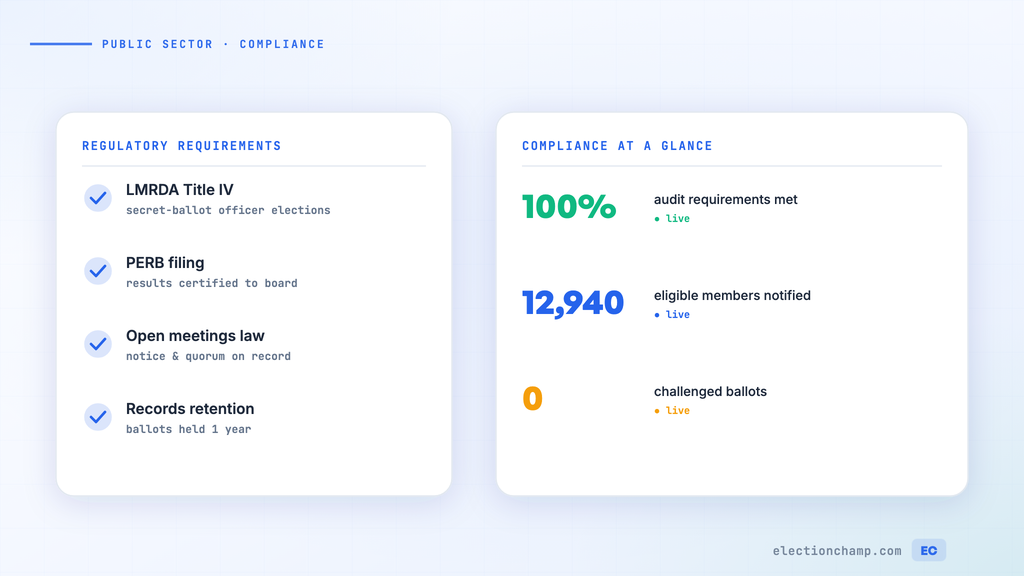
- Identify your governing law: Federal (FLRA), state (PERB/SERB/PERC), or local ordinance
- Review your union’s constitution and bylaws for election procedures that may exceed legal minimums
- Check whether your state labor relations board has specific requirements for electronic voting
- If your union has both public and private sector members, determine whether LMRDA applies to your elections
- Verify notice requirements — some states require specific notice periods or methods for union elections
- Ensure your election procedures comply with your national affiliate’s requirements (if applicable)
- Document everything — public sector unions are subject to open records laws in some states, meaning election records may be accessible to the public
Online Voting Advantages for Public Sector Unions
|
Public Sector Challenge |
How Online Voting Helps |
|
Scattered worksites (schools, stations, offices) |
One ballot link works from any location — no polling site needed |
|
Shift work (24-hour operations) |
Vote anytime during a 7-14 day window from any device |
|
Summer/seasonal breaks |
Reach members via personal email and phone regardless of work status |
|
Budget constraints |
ElectionChamp starts free (up to 20 voters) and costs just $10 for up to 200 |
|
Documentation requirements |
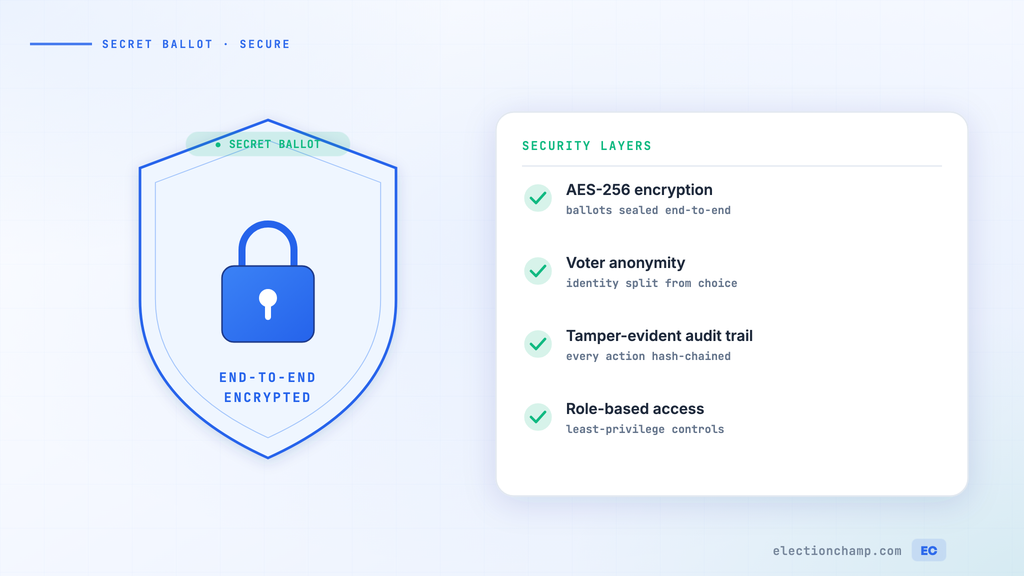
Full audit trail and downloadable records for compliance |
|
Open records concerns |
Results are documented transparently; ballots remain anonymous |
Planning your next vote? Read about union voting software and contract ratification votes, or see pricing: free up to 20 voters, $10 up to 200, then $0.05 per voter.