ElectionChamp
Understanding the Union Certification Process
When employees seek union representation, the process typically culminates in a certification election — a vote by employees to determine whether they want a union to represent them in collective bargaining. For employers, understanding this process is essential for ensuring legal compliance and maintaining a positive workplace relationship regardless of the outcome.
This guide focuses on the employer’s perspective: what to expect, what your obligations are, and how to navigate the process professionally.
The NLRB Process
The National Labor Relations Board (NLRB) oversees most private-sector union elections in the United States:
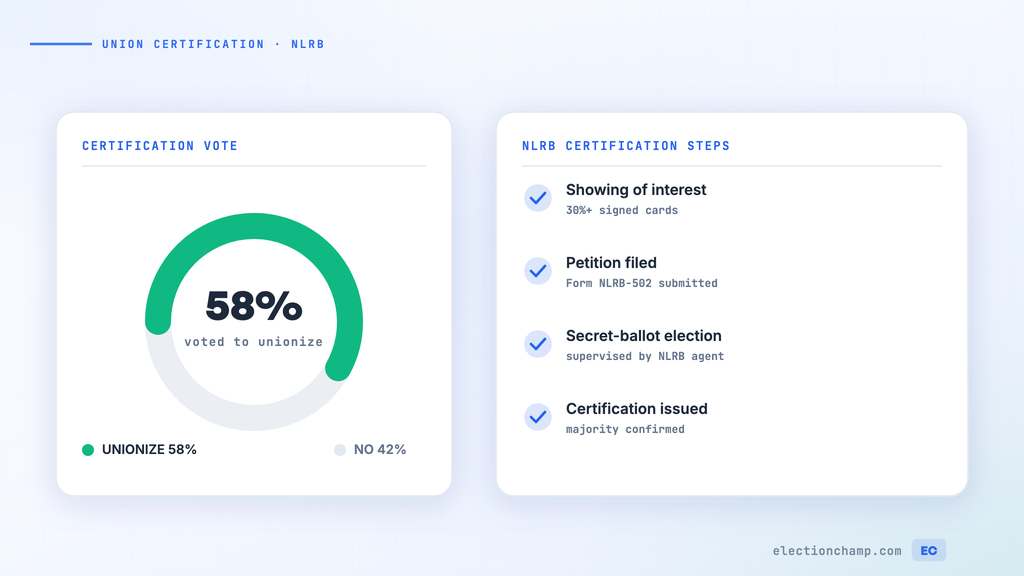
- Showing of interest: A union files a petition with the NLRB, accompanied by evidence (authorization cards or petition) that at least 30% of employees support an election.
- Investigation: The NLRB regional office investigates whether the petition meets requirements (appropriate bargaining unit, sufficient showing of interest, no bars to election).
- Agreement or hearing: The employer and union may agree on election terms (consent election), or the NLRB holds a hearing to resolve disputes about the bargaining unit.
- Election directed: The NLRB sets the date, time, location, and eligible voter list.
- Secret ballot election: Employees vote by secret ballot — either in person at the workplace or by mail.
- Results: A simple majority of votes cast determines the outcome. If the union wins, the NLRB certifies the union as the exclusive bargaining representative.
What Employers CAN Do
- Share factual information about the implications of unionization
- Explain the company’s position on union representation
- Answer employee questions honestly
- Continue normal operations during the election process
- Hire legal counsel experienced in labor relations
What Employers CANNOT Do (The TIPS Rule)
Employers must not engage in conduct that Threatens, Interrogates, Promises, or Surveils employees regarding union activity:
- Threaten: No threats of job loss, plant closure, benefit reduction, or any adverse action if employees vote for the union
- Interrogate: No questioning employees about their union sympathies, how they intend to vote, or who supports the union
- Promise: No promises of raises, promotions, or improved conditions to discourage union support
- Surveil: No monitoring of union meetings, tracking of union organizers, or surveillance of employee union activity
Violations of these rules can result in the election being set aside and a rerun ordered — or in extreme cases, a bargaining order requiring the employer to recognize the union without an election.
The Election Timeline
|
Stage |
Typical Timing |
Employer Action |
|
Petition filed |
Day 0 |
Seek labor counsel immediately |
|
Statement of position due |
8 days after petition |
File with NLRB; identify bargaining unit issues |
|
Pre-election hearing (if needed) |
14 days after petition |
Present position on unit issues |
|
Voter eligibility list due |
2 business days after direction of election |
Provide accurate list of eligible employees |
|
Election |
20-30 days after petition (typical) |
Ensure normal operations; allow NLRB access |
|
Ballot count |
Election day |
Observe count (employer may designate an observer) |
|
Objections period |
7 days after count |
File any objections if irregularities occurred |
|
Certification |
After objections resolved |
Begin bargaining obligation if union certified |
The Excelsior List
Within 2 business days after the election is directed, the employer must provide the NLRB with an Excelsior list — a list of all eligible voters including:
- Full name
- Home address
- Available personal email addresses and personal phone numbers
- Work location, shift, and job classification
This list is shared with the union to facilitate voter communication. Providing an inaccurate or incomplete list can be grounds for setting aside the election.
Maintaining Neutrality: An Emerging Approach
Some employers choose a neutrality posture during organizing campaigns:
- Neutrality agreements: The employer agrees not to campaign against the union, focusing instead on providing factual information
- Card check agreements: The employer agrees to recognize the union based on authorization card signatures without a formal election
- Labor peace agreements: The employer and union agree to rules of conduct during the organizing process
Neutrality is a strategic decision — not a legal requirement. Consult with labor counsel about the approach that best fits your organization.
If the Union Is Certified
- The employer has a legal obligation to bargain in good faith with the certified union
- Do not make unilateral changes to terms and conditions of employment during bargaining
- Appoint a skilled negotiator or hire experienced labor counsel
- Approach bargaining constructively — a good labor relationship benefits both the company and its employees
If the Union Is Not Certified
- Continue treating employees respectfully — retaliating against union supporters is illegal
- Address the underlying concerns that motivated organizing — employees sought a union for a reason
- An election bar prevents another petition for 12 months
- Use the experience as an opportunity to improve communication, working conditions, and employee relations
A Note on Electronic Voting in NLRB Elections
As of the current date, NLRB elections are typically conducted by the NLRB using its own procedures (in-person or mail ballot). The NLRB — not the employer — controls the election process. While the NLRB has explored electronic voting in limited cases, it is not the standard method.
However, online voting platforms like ElectionChamp are valuable for related internal processes: conducting employee surveys to understand workplace sentiment, running internal advisory votes, or managing voting for employee committees and representatives in non-NLRB contexts.
Planning your next vote? Read about union voting software and contract ratification votes, or see pricing: free up to 20 voters, $10 up to 200, then $0.05 per voter.