ElectionChamp

Short answer: A sample ballot template is a ready-made ballot you edit for your own vote. A good one states the election name, the deadline, and how many choices each voter gets. It lists the options in a fair order, with write-in lines and an abstain box where your rules allow them. Copy the free board election, bylaw amendment, ratification, and ranked choice ballots below.
This post gives you the wording. For layout, fonts, and accessibility, read our guide to election ballot design.
What to Include on a Sample Ballot
Every ballot, paper or online, needs the same core parts. A missing deadline or vote limit is where most counting arguments start.
- Election name and deadline, with date, time, and time zone.
- Instructions above each question, including how many choices are allowed.
- A contest heading: the office and seats, or a plain title for the measure.
- Options in a stated order.
- Write-in lines and an abstain option, if your rules allow them.
- Return instructions for paper, plus a reminder not to sign a secret ballot.
Free Sample Ballot Templates
The document holds four ballots. Check each rule against your bylaws before it goes out.
Download: Sample Ballot Templates for Boards, Bylaws, and Votes (Word .docx)
Fill in the blanks and delete the ballots you do not need. Check every rule against your bylaws, and have counsel review any vote that could be challenged.
BALLOT 1: BOARD ELECTION
[Organization Name] Board of Directors Election
Voting closes: ________ (date, time, and time zone). Seats: ____ open, each for a ____-year term.
Instructions: Vote for up to ____ candidates by marking the box next to each name. To vote for a person not listed, write the name on the write-in line and mark its box. Ballots that mark more than ____ candidates will not be counted for this contest. Do not sign this ballot.
Candidates are listed in ________ order (alphabetical, drawn by lot, or random).
[ ] ________ (Candidate 1)
[ ] ________ (Candidate 2)
[ ] ________ (Candidate 3)
[ ] Write-in: ________
[ ] I abstain from this contest.
Return this ballot to ________ by ________.
BALLOT 2: BYLAW AMENDMENT
[Organization Name] Proposed Amendment to Article ____, Section ____ of the Bylaws
Title: ________ (one line that says what the change does)
Summary: ________ (two plain sentences on what changes if it passes)
Current text: ________
Proposed text: ________
Passage requires ________ (the threshold in Article ____ of the bylaws).
A YES vote adopts the proposed text. A NO vote keeps the current text. Mark one box.
[ ] Yes, adopt the amendment
[ ] No, do not adopt the amendment
[ ] Abstain
BALLOT 3: BUDGET OR CONTRACT RATIFICATION
[Organization Name] Ratification Vote: ________ (budget, contract, or agreement)
Question: Do you approve the ________ (document name and date) as presented to members on ________?
Key terms: ________ (total amount, term, effective date, and any change in dues or assessments)
Full document: ________
An APPROVE vote ratifies it. A REJECT vote does not. If rejected: ________ (for example, the current budget stays in effect). Passage requires ________ under ________ (bylaw or contract section).
[ ] Approve
[ ] Reject
[ ] Abstain
BALLOT 4: RANKED CHOICE
[Organization Name] ________ Election (Ranked Choice)
Instructions: Rank the candidates in order of preference. Write 1 next to your first choice, 2 next to your second, and so on. Use each number once, and give each candidate only one number. Rank as many or as few candidates as you like, up to ____.
Counting method: ________ (for example, instant runoff, single transferable vote, or a points count, as set in your rules).
Rank: ____ ________ (Candidate 1)
Rank: ____ ________ (Candidate 2)
Rank: ____ ________ (Candidate 3)
Rank: ____ Write-in: ________
How to Use Each Ballot Template
Board Election Ballot Template
Set “vote for up to” to the number of open seats. Say what happens to a ballot that marks too many names, since deciding that early removes a common counting dispute. Keep write-in lines only if your bylaws permit write-ins.
For an HOA ballot template, add each seat’s term length. Check your declaration for whether each lot gets one vote or a weighted vote.
Bylaw Amendment Ballot
Show the current and proposed text, or mark deletions in strikethrough and additions underlined.
The Center for Civic Design’s guidance on writing ballot questions recommends an informative, active title and a plain explanation of what each choice does. Add the passing threshold and the article that sets it.
Budget or Contract Ratification Ballot
Name the exact document and its date, so no one can claim they voted on a different version. Summarize key terms as facts and attach the full document. Say what happens if the vote fails.
Ranked Choice Ballot
Tell voters to use each number once and give each candidate one number. For printed grid ballots, the Center for Civic Design’s ranked choice ballot guidance notes that up to 5 ranks fits two contests side by side.
Name the counting method, because instant runoff, STV, and points-based counts can pick different winners from the same ballots. In ElectionChamp, ranked choice uses a Borda Count variant (first rank earns the most points) and multi-seat STV races are counted with our free STV Excel calculator from the exported rankings. See our guide to setting up ranked choice voting.
Ballot Wording Best Practices
Neutral wording protects the result. A ballot that reads as if it favors one side gives the losing side a reason to challenge it.
- Describe the change in facts. “Raise annual dues from $________ to $________” is neutral. “A modest increase” is advocacy. Put arguments in a separate voter guide.
- Write in the positive. Avoid double negatives, such as a yes vote that repeals a ban.
- Use everyday words and short sentences.
- Put instructions where they apply. “Vote for up to 3” belongs in each contest heading.
- Use sentence case and left-aligned text. The Center for Civic Design’s usable ballot guidelines say lowercase text is more legible than all capitals, and left-aligned text is easier to read than centered text.
- Match the labels to the question. “Do you approve” gets Approve and Reject.
How to Order Candidates on a Ballot
Candidate order affects results. WBUR reported that Stanford researcher Jon Krosnick found being listed first gave a candidate an average 2-percentage-point advantage in 85 percent of the Ohio races he studied over 10 years. Pick one method and write it into your election rules:
- Alphabetical by last name. Easy to explain, though it always favors the same end of the alphabet.
- Drawing by lot in front of the candidates, with the result recorded.
- Random order per voter. Online tools can shuffle the list on each ballot, spreading the first-position advantage. ElectionChamp offers this as a ballot setting.
Listing incumbents first makes it look as if the board picked a favorite.
How Abstentions, Blank Ballots, and Write-Ins Are Counted
Under Robert’s Rules of Order, blank ballots and ballots with every name crossed out are treated as abstentions, meaning no vote at all. That is the position in Official Interpretation 2006-5. An abstain box makes the choice explicit and lets you report abstentions separately.
A rule based on votes cast leaves abstentions out of the math. Under a rule based on members present or all members, an abstention has the same effect as a no. Print your bylaws’ rule on the ballot.
For write-ins, decide before voting opens how you will treat misspellings and ineligible names, and confirm it with your bylaws and counsel.
Turning a Ballot Template Into an Online Ballot
Each paper element has an online equivalent. The table uses ElectionChamp’s settings as the example.
| On the paper template | Online ballot setting |
|---|---|
| Vote for up to ____ candidates | “Select up to” set to the number of seats |
| Write-in line | No write-in field on election questions. Collect names first with a nomination question, then list the nominees as candidates |
| Abstain box | Allow Abstain, with abstentions shown separately in results |
| Yes or No amendment, Approve or Reject budget | Motion question (yes, no, abstain); word the question so “yes” means approve |
| Rank 1, 2, 3 | Ranked choice question, counted with Borda points. For STV, export the ranked results to the free STV Excel calculator |
| Do not sign this ballot | Anonymous ballot with a single-use voter key |
One ballot can mix question types, so a board race, an amendment, and a budget vote can go out together. Read about how online elections work for the full flow from voter list to results.
Frequently Asked Questions
What should be included on a ballot?
Include the election name, the voting deadline, and instructions above each question that say how many choices are allowed. List options in a stated order, and add write-in lines, an abstain option, and return instructions where your rules call for them.
How do you word a bylaw amendment ballot?
Use a one-line title that says what the amendment does, show the current and proposed text, and explain what a yes and a no vote each mean. State the passing threshold and the bylaw article that sets it.
Should candidates be listed in alphabetical order on a ballot?
Alphabetical order is common, but research shows the first-listed candidate tends to gain votes. Drawing by lot or randomizing the order for each voter spreads that advantage. Write your method into your election rules.
Do abstentions count as votes?
Under Robert’s Rules of Order, abstentions and blank ballots are not votes cast. If your bylaws require a majority of members present or of all members, an abstention has the same effect as a no vote.
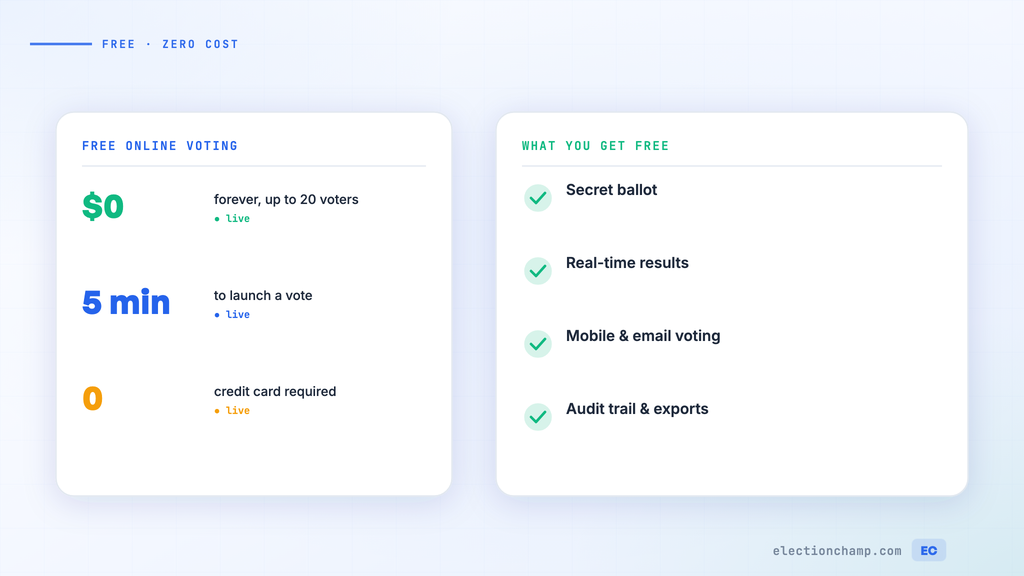
Planning your next vote? Read about how online elections work and the full feature list, or see pricing: free up to 20 voters, $10 up to 200, then $0.05 per voter.