ElectionChamp
Short answer: In Ontario, school council elections follow Ontario Regulation 612/00. Parent members are elected by secret ballot during the first 30 days of the school year, after at least 14 days’ written notice, and the chair must be a parent member. Alberta’s School Councils Regulation (Alta Reg 94/2019) leaves most election rules to your by-laws. A parent must still be elected chair.
Below: each rule with its section number, a province comparison table, and the steps for running the vote online. Your by-laws and board policies add rules, so confirm each step with them and your principal.
Ontario School Council Election Rules (O. Reg. 612/00)
Ontario school councils run under Ontario Regulation 612/00, School Councils and Parent Involvement Committees, made under the Education Act. The Ministry of Education’s school councils guide, updated November 10, 2025, restates the same rules in plain language.
Who Sits on the Council
Section 3(1) lists the members: parents, the principal, one teacher, one non-teaching staff member, a student representative in secondary schools, and one community representative. Under section 3(4), parent members must form a majority. The number of parent seats comes from your by-laws under section 3(2).
Any parent of a pupil enrolled in the school can run as a parent member (s. 4(1)). A person who works at the school cannot. A parent who works elsewhere for the same board can run only after taking reasonable steps to tell voters about that job (s. 4(2)).
When and How the Election Happens
- Timing: parent elections happen during the first 30 days of each school year, on a date the chair or co-chairs fix after consulting the principal (s. 4(4)). For a new school, the board fixes the first date (s. 4(5)).
- Notice: the principal gives written notice to every parent of an enrolled pupil at least 14 days before the election (s. 4(6)). Notice can go home with the student or be posted in an accessible place in the school (s. 4(7)).
- Voters: parents of pupils enrolled in the school (s. 4(3)).
- Ballot: “The election of parent members shall be by secret ballot” (s. 4(8)).
- Procedures: everything else, including nominations, acclamation, and ties, belongs in your by-laws. Section 15(2) requires by-laws on election procedures and filling vacancies.
Members serve from the first meeting after the election until the first meeting after the next year’s election (s. 6(1)). The first meeting must take place within the first 35 days of the school year (s. 12(2)), and the council meets at least four times a year (s. 12(1)).
Alberta School Council Elections (Alta Reg 94/2019)
Alberta school councils are required under the Education Act and the School Councils Regulation, Alta Reg 94/2019, in force since September 1, 2019. The Government of Alberta’s school councils page states that parents of students enrolled in the school must make up the majority of the council.
The Alberta regulation covers establishing a council and choosing a chair, then hands the rest to by-laws.
- Establishment meeting: a school without a council holds one within 40 days after the start of the school year (s. 2). The principal gives notice at least 10 school days before, and notice may be electronic (s. 3).
- First elections: at the establishment meeting, attendees decide the council size, terms, and executive size, and elect the first members and executive (s. 5). Only parents of enrolled students (or children in the school’s early childhood services program) may vote at that meeting (s. 6).
- Chair: a parent of an enrolled student must be elected chair (s. 8(2)). Another member may be elected only if no such parent is willing to be nominated (s. 8(3)).
- First meeting each year: within 40 days after the start of the school year, or as your by-laws specify (s. 15).
- By-laws: section 17(1) lets councils make by-laws on annual meetings, electing council and executive members, quorum, and the number of meetings. A by-law takes effect only when a majority of parents voting at a special meeting approve it (s. 17(2)).
The regulation does not fix an AGM date, so your by-laws set it. The Calgary Board of Education’s sample by-laws, for example, put it within 20 days after the start of the school year. Your by-laws govern, and the regulation says nothing on secret ballots, ties, or acclamation.
Records matter too. Section 14(2) requires the council to keep minutes of each meeting at the school, and section 14(3) requires keeping them at least seven years. Record election results in the minutes.
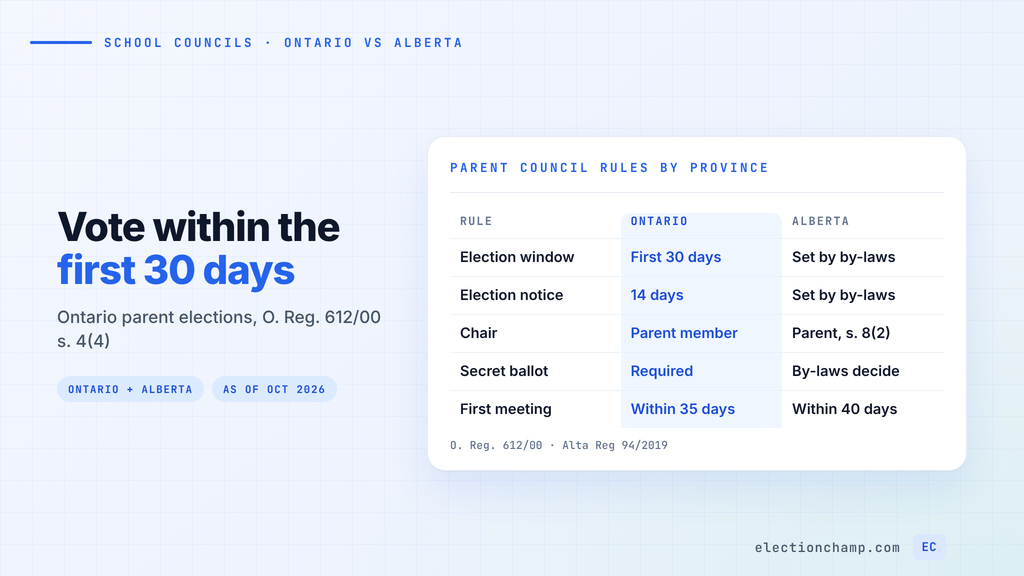
Ontario vs Alberta School Council Rules Compared
| Rule | Ontario (O. Reg. 612/00) | Alberta (Alta Reg 94/2019) |
|---|---|---|
| Parent majority | Required, s. 3(4) | Required (Government of Alberta) |
| Election window | First 30 days of the school year, s. 4(4) | Set by by-laws, s. 17(1) |
| Election notice | At least 14 days, written, by the principal, s. 4(6) | By-laws; 10 school days for an establishment meeting, s. 3 |
| Secret ballot | Required for parent members, s. 4(8) | Not addressed; by-laws decide |
| Who votes | Parents of enrolled pupils, s. 4(3) | Parents at the establishment meeting, s. 6; then by-laws |
| Chair | Parent member, not a board employee, elected by members, s. 8 | Parent of an enrolled student, unless none will stand, s. 8(2) and (3) |
| Staff as parent members | Not if employed at the school, s. 4(2) | Not addressed; check board policy |
| First meeting | Within the first 35 days, s. 12(2) | Within 40 days, or per by-laws, s. 15 |
| Meetings per year | At least 4, s. 12(1) | Set by by-laws, s. 17(1)(e) |
| Quorum | Majority of members, with parents a majority of those present, s. 12(3) | Set by by-laws, s. 17(1)(g) |
| Acclamation and ties | By-laws, s. 15(2) | By-laws, s. 17(1) |
How to Run a School Council Chair Election
In Ontario, the chair or co-chairs are elected by the members of the council, not by all parents (s. 8(2)). The chair must be a parent member, and a board employee cannot hold the role (s. 8(3)). Co-chairs are allowed only if your by-laws provide for them (s. 8(1)). The principal sits on the council but cannot vote (s. 14(3)).
Members’ terms start at the first meeting after the election (s. 6(1)), so the chair vote fits on that agenda. Confirm who counts as a voting member and check quorum before you vote.
In Alberta, check your by-laws for who elects the executive. It may be all parents at the AGM or the council members alone. Either way, section 8(2) requires a parent as chair unless no parent will stand.
Treat the chair race like any other officer election: publish the nominees, give each a short statement, and use a secret ballot when two or more people run.
How to Run a Parent Council Election Online
Neither regulation mentions online voting. Before you move the vote online, read your by-laws and your school board’s school council policy, and agree on the plan with your principal. The principal handles notice in Ontario and usually controls the parent contact list.
- Set the date early. In Ontario, count back from day 30 of the school year. Notice must go out at least 14 days before voting starts. The Ministry’s guide suggests planning the fall election in June.
- Call for nominations. Ask each candidate for a short statement and confirm eligibility, including the Ontario rule on board employees.
- Build the voter list. In Ontario, each parent of an enrolled pupil is an eligible voter (s. 4(3)), so two parents of the same child can each vote. Use the contact details the school holds, under board privacy rules.
- Set up the ballot. Use a “select up to” question with one choice per open parent seat. Add candidate bios and random candidate order so no name benefits from ballot position.
- Offer a paper or in-person option. Some parents have no email on file. Printed voter keys handed out at a school event let them vote on the same ballot.
- Close and record. Announce results to parents and record them in the minutes of the first meeting.
With ElectionChamp’s school election software, each parent gets a single-use 16-character voter key by email, SMS, or a printed card. They vote in a browser with no app or account. A school with up to 20 parent voters runs free, and up to 200 costs US$10 flat. For a broader look at parent groups, see our guide to PTO and PTA elections.
Acclamation
Neither province defines acclamation in its regulation, so your by-laws decide. One approach: if there are fewer nominees than open seats, all nominees are acclaimed and no vote is held. One Toronto school council’s election procedures, approved in June 2021, say exactly that. Decide in writing what happens when nominees equal seats. If your by-laws are silent, add a clause before next fall.
Ties
Ties are also a by-law matter. Write the rule down before voting opens. Options include a runoff between the tied candidates, a random draw, or seating both if a spare seat exists. The Toronto council procedures above use a random draw if a tie persists. Online, a runoff ballot can go out within a day.
Anonymity and the Secret Ballot
Ontario requires a secret ballot for parent members (s. 4(8)). Online, that means no one, including the principal and the chair, can link a vote to a parent. In ElectionChamp, ballots are anonymous by design: administrators see whether a parent voted, never how. Each key works once, so no one votes twice. Read more on how ballot secrecy works online.
Filling Vacancies After the Fall Election
Seats often stay empty after the fall vote. In Ontario, vacancies are filled as your by-laws provide (s. 7(1)). If the by-laws call for an election, it follows the section 4 rules with necessary modifications, including notice and a secret ballot (s. 7(2)). A vacancy does not stop the council from acting (s. 7(3)).
The Ministry guide notes that a council can fill a vacancy by election or appointment, depending on its by-laws. It also warns that if parent members fall below a majority, the council cannot operate until the seats are filled.
In Alberta, section 16(1) lets the board suspend a council when quorum cannot be reached after a meeting has been rescheduled two or more times. A new council then forms within 40 school days of the next school year (s. 16(3)). Filling seats quickly protects quorum.
Frequently Asked Questions
When are school council elections held in Ontario?
Under section 4(4) of O. Reg. 612/00, parent member elections are held during the first 30 days of each school year. The chair or co-chairs fix the date after consulting the principal. The principal must give every parent written notice at least 14 days before the election.
Who can be the chair of a school council?
In Ontario, the chair must be a parent member elected by the council’s members, and a board employee cannot be chair (O. Reg. 612/00, s. 8). In Alberta, a parent of an enrolled student must be elected chair unless no such parent is willing to be nominated (Alta Reg 94/2019, s. 8).
Do school council elections have to be by secret ballot?
In Ontario, yes. Section 4(8) of O. Reg. 612/00 says parent members are elected by secret ballot. Alberta’s School Councils Regulation does not address secret ballots, so your council’s by-laws decide.
Can parent council elections be held online?
Neither the Ontario nor the Alberta regulation addresses online voting. An anonymous online ballot can meet Ontario’s secret ballot rule. Check your by-laws and your school board’s policy, and agree on the process with your principal before you start.
Planning your next vote? Read about school election software and officer elections, or see pricing: free up to 20 voters, US$10 up to 200, then US$0.05 per voter.