ElectionChamp
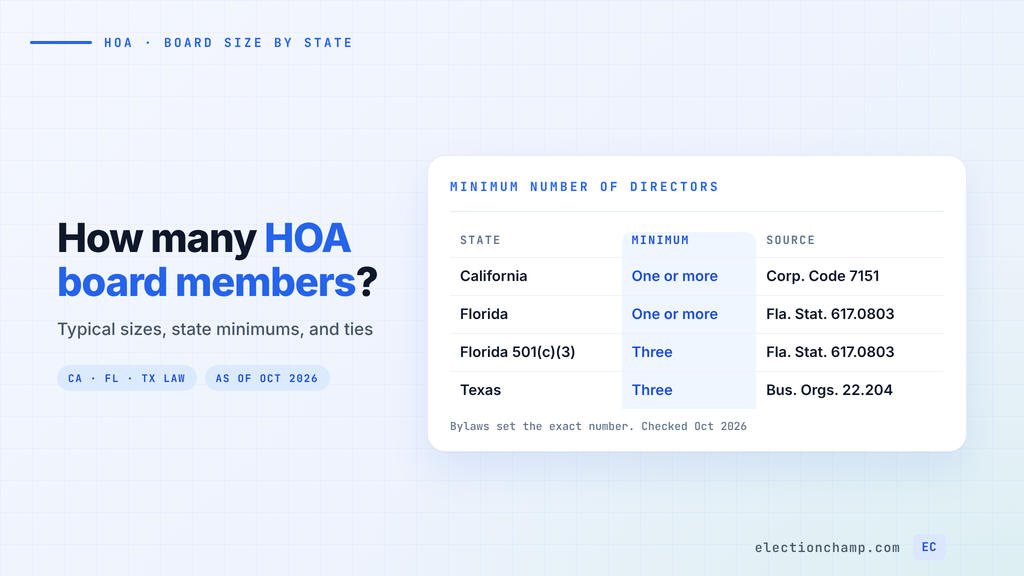
Short answer: Most HOAs do well with 3, 5, or 7 board members. Three suits small communities, five suits most mid-size ones, and seven suits large or complex associations. Pick an odd number so votes cannot tie. Your bylaws set the exact number, and state law sets the floor: Texas nonprofit corporations need at least three directors, while California and Florida allow fewer unless an exception applies.
Below: typical sizes, state minimums, tie risk, staggered terms, and how to change your board size with a member vote.
How Many Board Members Should an HOA Have?
There is no single correct number. The right size gives you enough people to share the work and reach quorum, without so many seats that you cannot fill them every election.
Here is how the common sizes tend to work in practice.
| Board size | Usually fits | Watch out for |
|---|---|---|
| 3 | Small or self-managed communities, or any HOA where volunteers are scarce | One absence leaves two people deciding; one vacancy can stall quorum |
| 5 | Most mid-size HOAs, including those with a management company | You need enough candidates to fill two or three seats each election |
| 7 | Large associations, multiple sections, amenities, or active committees | Slower meetings and more seats to fill; quorum needs four people |
| 9 or more | Master associations or communities with seats for each section | Hard to fill; often better handled with committees |
A useful test: count how many owners ran in your last two elections. If you struggled to fill three seats, a seven-seat board will leave chairs empty.
Board Size by Community Size
Treat unit count as a starting point. A 60-home community with a pool and a gate may need more hands than a 200-home community with only common landscaping. Size the board to the workload the directors keep after committees and any manager take their share.
What State Law Requires for HOA Board Size
Most state HOA statutes leave board size to your governing documents. The minimum usually comes from the state’s nonprofit corporation law, because many associations are incorporated as nonprofit corporations. Here is what the statutes say in three large HOA states, checked October 2026.
| State | Minimum directors | Source |
|---|---|---|
| California (nonprofit mutual benefit corporation) | One or more, as the bylaws set | Corp. Code 7151 |
| Florida (nonprofit corporation) | One or more; three or more if the corporation is 501(c)(3) exempt | Fla. Stat. 617.0803 |
| Texas (nonprofit corporation) | Three | Tex. Bus. Orgs. Code 22.204 |
California
California Corporations Code 7151 says the number or minimum number of directors “may be one or more.” The bylaws must state a fixed number, a method for setting it, or a range with the exact number fixed by the board or the members. Once members are admitted, any bylaw change to a fixed number, a minimum, or a maximum needs member approval.
California also caps director terms. Under Corp. Code 7220, elected directors serve terms of no more than four years, as fixed in the articles or bylaws. Civil Code 5100(a)(2) requires an election for each board seat when its term expires and at least once every four years.
Florida
Florida’s HOA statute, Chapter 720, does not fix a board size. Section 720.306(9) covers who can serve, how directors are elected, and how vacancies are filled. The number itself comes from your articles or bylaws under Fla. Stat. 617.0803, which requires one or more directors. A corporation that is exempt under 501(c)(3) needs three or more.
Florida also sets eligibility rules that affect how easily you can fill seats. Under Fla. Stat. 720.306(9)(b), an owner who is delinquent to the association when nominations close cannot run. A director who falls more than 90 days delinquent is deemed to have abandoned the seat.
Texas
Texas Business Organizations Code 22.204 says a nonprofit corporation with a board “may not have fewer than three directors.” The certificate of formation or bylaws set the number. If neither says anything, the number stays at the size of the initial board. A reduction cannot shorten a sitting director’s term.
The Texas Property Code adds composition rules for property owners’ associations. Under Tex. Prop. Code 209.00591, two people who share a primary residence cannot both serve (associations with fewer than 10 residences are exempt). Bylaws can require some directors to live in the subdivision, but not all of them.
If your association is in another state, or is unincorporated, read your state’s nonprofit corporation act and HOA statute. Then confirm with your bylaws and counsel.
Why HOA Boards Use an Odd Number of Board Members
An odd number of board members prevents a tie when every director votes. Under Robert’s Rules, which many bylaws adopt, a majority vote needs more yes votes than no votes, so a tie means the motion fails. The official Robert’s Rules FAQ explains how a chair’s vote can make or break a tie.
Odd boards still tie when a director is absent or abstains. A five-member board with one person missing can split 2 to 2. Odd numbers lower the risk of a tie but cannot rule it out.
Board Quorum by Board Size
Board quorum is usually a majority of the authorized seats. California sets that default in Corp. Code 7211(a)(7), and Texas uses the lesser of a majority or a number of at least three set in your documents under Tex. Bus. Orgs. Code 22.213. With a majority rule, the math looks like this.
| Board seats | Quorum (majority of seats) | Votes to pass at a bare quorum | Tie possible with full board |
|---|---|---|---|
| 3 | 2 | 2 | No |
| 4 | 3 | 2 | Yes |
| 5 | 3 | 2 | No |
| 6 | 4 | 3 | Yes |
| 7 | 4 | 3 | No |
On a five-member board with a bare quorum, two directors can pass a motion. Set meeting dates early so most of the board attends.
What Happens When a Seat Goes Vacant
A vacancy can turn an odd board into an even one until the seat is filled. Your bylaws usually say how to fill it. In Florida, unless the bylaws say otherwise, the remaining directors can fill a vacancy by majority vote, even if they are below quorum. The board can also hold an election instead, and the new director serves the rest of the term (Fla. Stat. 720.306(9)(c)). Fill vacancies quickly, especially on a three-member board, where one empty seat leaves no margin.
HOA Board Composition: Officers, Seats, and Who Can Serve
Size is the number of seats. Composition is who fills them and what roles they hold.
- Officers. Most bylaws name a president, a secretary, and a treasurer, and many add a vice president. On a three-member board, every director usually holds an office. Check your bylaws to see whether the board or the members choose officers.
- Section or class seats. Communities with multiple phases or property types sometimes reserve seats for each one. Texas expressly allows seats elected from designated sections under Tex. Prop. Code 209.00591.
- Developer seats. During the development period, the declarant often appoints some directors. In Texas, owners must elect at least one-third of the board within the timeframes in Tex. Prop. Code 209.00591.
- Eligibility. State law and your documents may bar delinquent owners, require residency for some seats, or bar co-residents from serving together, as described above.
Staggered Terms for HOA Board Members
With staggered terms, only part of the board is up for election each year, so experienced directors stay in place. Florida allows directors to be divided into classes under Fla. Stat. 617.0806. Texas allows the same under Tex. Bus. Orgs. Code 22.209, and the terms of each class do not need to match.
Common patterns with two-year terms look like this.
| Board size | Seats elected in year one | Seats elected in year two |
|---|---|---|
| 3 | 2 | 1 |
| 5 | 3 | 2 |
| 7 | 4 | 3 |
Three-year terms on a three, six, or nine-seat board give you an even split: one third of the seats each year. In California, keep every term at four years or less to stay within Corp. Code 7220 and Civil Code 5100.
Staggering also shapes the ballot. A year with three open seats is a multi-winner race, so voters pick up to three candidates and the top three win. In ElectionChamp you set that with “select up to” and the total number of winners. Our guide to running an HOA board election from start to finish covers nominations, notices, and counting.
How to Change Your HOA Board Size
Changing board size almost always means amending the bylaws, and sometimes the articles or certificate of formation. In California, once members are admitted, the change requires member approval under Corp. Code 7151. In Texas, the number changes by amendment or in the manner the certificate or bylaws provide, under Tex. Bus. Orgs. Code 22.204(b).
- Find where the number lives. Check the articles or certificate of formation, the bylaws, and the declaration. Note the amendment threshold each one requires.
- Pick the new size and a transition plan. Decide how new seats phase in, or how seats phase out as terms end. In Texas, a reduction cannot cut short a sitting director’s term.
- Set up staggering. When you add seats, give some new seats a shorter first term so the classes stay balanced.
- Draft the amendment. Quote the current text, the new text, and the effective date. Have counsel review it.
- Hold the member vote. Send notice as your bylaws require and give owners a clear yes or no question. Count votes against the full membership if your threshold is based on total voting interests.
- Record and update. File the amendment where required, update your election calendar, and announce how many seats are open at the next election.
Amendment votes often need a supermajority, which is hard to reach at a single meeting. If your bylaws allow electronic voting, an online ballot gives every owner time to vote. If they do not, our guide on how to amend your HOA bylaws to allow online voting explains how to add it. You can put both changes in one amendment vote.
With HOA online voting on ElectionChamp, the amendment goes on the ballot as a motion with yes, no, and abstain options. If owners hold different voting interests, add a weight column to the voter list. Results arrive the moment voting closes, with a CSV you can file with the minutes. Pricing is per election: free up to 20 voters, $10 up to 200, then $0.05 per voter.
Frequently Asked Questions
Can an HOA have only 2 board members?
It depends on your state and documents. Texas nonprofit corporations need at least three directors. California and Florida nonprofit law allow one or more, but a two-member board ties on any split vote. Most bylaws set three or more, so check yours and confirm with counsel.
What happens if an HOA board vote is tied?
Under Robert’s Rules, which many bylaws adopt, a motion needs more yes votes than no votes, so a tie means the motion fails. Check whether your bylaws give the president a tie-breaking vote or set a different rule.
Can an HOA board have an even number of members?
Yes, if the bylaws allow it. Nothing in the California, Florida, or Texas statutes reviewed here requires an odd number. Even boards can tie when every director votes, so most associations choose 3, 5, or 7 seats.
How many board members are needed for a quorum?
Board quorum is usually a majority of the authorized seats: 2 of 3, 3 of 5, or 4 of 7. California and Texas law set defaults, and your bylaws may set a different number within the limits of those laws.
Planning your next vote? Read about HOA online voting and board elections, or see pricing: free up to 20 voters, $10 up to 200, then $0.05 per voter.