ElectionChamp
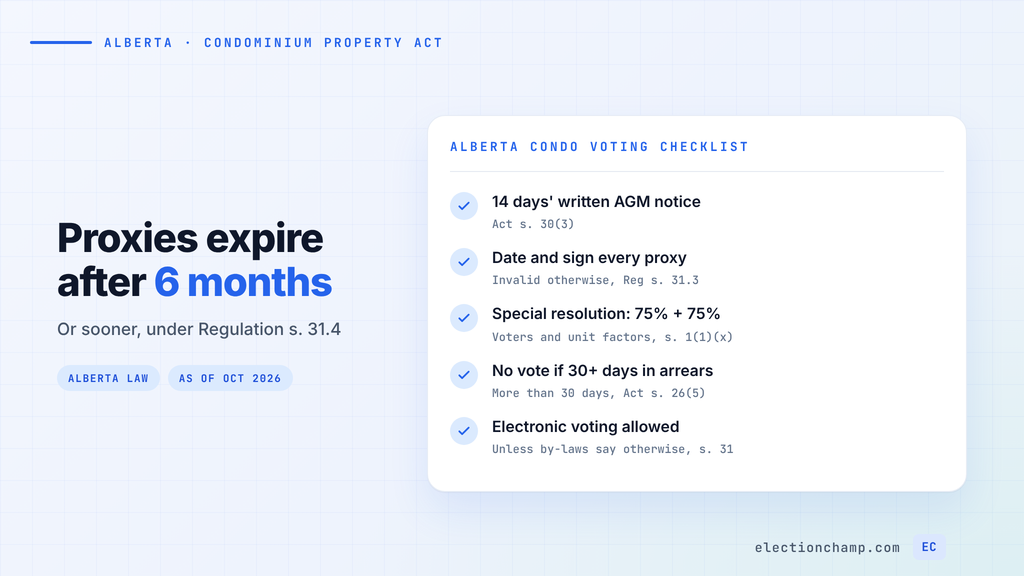
Short answer: Alberta condo voting rules come from the Condominium Property Act (RSA 2000, c C-22), the Condominium Property Regulation (Alta Reg 168/2000), and your by-laws. Owners and notified mortgagees vote in person or by proxy. Proxies must be dated and signed and expire within six months. Special resolutions need 75% of all eligible voters and 75% of unit factors. Meetings and votes can be held electronically unless your by-laws say otherwise.
This guide lists each rule with its section number. It also covers the owner vote default that took effect in February 2026 and the new Condominium Dispute Resolution Tribunal. Your by-laws add their own rules, so confirm each step with your declaration, by-laws, and counsel.
Which Laws Govern Alberta Condo Voting
Three layers apply to every Alberta condominium corporation. The Condominium Property Act sets the core rules on voting rights, resolutions, general meetings, and electronic attendance. The Condominium Property Regulation fills in the detail on proxies, minutes, and records.
Your by-laws sit on top. Under section 32(1) of the Act, the by-laws regulate the corporation and its administration, and section 32(2) binds every owner and occupant to them. Section 32(3) lets the owners amend, repeal, or replace any by-law by special resolution. Quorum is a good example of a by-law rule: the Act leaves it to your by-laws, according to the Centre for Public Legal Education Alberta (CPLEA) condo meetings guide, reviewed March 2026.
The law changed recently. Most amendments from the Service Alberta Statutes Amendment Act, 2024 came into force on February 15, 2026, according to the Government of Alberta’s condominium page and CCI North Alberta. If your by-laws or proxy forms predate that, review them before your next AGM.
Alberta Condo Voting Rules at a Glance
The table collects the rules a board needs for a general meeting. Act section numbers follow the consolidated Act; Regulation numbers follow the consolidated Regulation.
| Rule | What it says | Source |
|---|---|---|
| Who votes | Owners vote; a first mortgagee that gave the corporation written notice and is present votes ahead of the owner | Act s. 26(2) and (3) |
| Proxies allowed | An owner or mortgagee may vote personally or by proxy | Act s. 26(4) |
| Arrears | No vote if contributions or other amounts owed are more than 30 days in arrears | Act s. 26(5) |
| Voting basis | One vote per owner by default; any owner may call for a unit factor vote before the result is announced | Act as amended Feb 15, 2026 (Government of Alberta) |
| Ordinary resolution | Majority of persons present or represented by proxy, or written and signed by owners holding over 50% of unit factors | Act s. 1(1)(r), 26(6) |
| Special resolution | At least 75% of all persons entitled to vote, representing at least 75% of total unit factors | Act s. 1(1)(x), 26(6) |
| First AGM | No later than 12 months after the condominium plan is registered | Act s. 30(1) |
| Later AGMs | No later than 15 months after the previous AGM | Act s. 30(2) |
| AGM notice | Written notice at least 14 days before, to owners and notified mortgagees | Act s. 30(3) |
| Special general meeting | Board must convene one on written request of owners holding at least 15% of unit factors | Act s. 30.1(2) |
| Electronic attendance and voting | Allowed unless the by-laws expressly provide otherwise; electronic attendees count as present in person | Act s. 31(1) |
| Proxy form and expiry | Dated and signed; expires at the stated date, six months after it was given, or when the giver stops owning, whichever is first | Reg s. 31.3, 31.4 |
| Minutes | Sent within 60 days after the AGM, with vote results for each resolution and each board candidate | Reg s. 20.5 |
| Quorum | Set by your by-laws | Your by-laws (CPLEA) |
Two of these rules catch boards most often. The arrears rule removes a vote, so check the ledger before you issue ballots or accept proxies. The special resolution threshold counts everyone entitled to vote, including owners who stay home.
Owner Votes, Unit Factor Votes, and the 2026 Change
Every Alberta unit has a unit factor, which sets its share of common property and contributions. Before 2026, section 26(1) of the Act tied an owner’s voting rights to the unit factor. The 2024 amendments, in force February 15, 2026, introduced a simple default instead.
Under the new default, each owner gets one vote, and an owner of several units still has one vote. The Government of Alberta says any owner can call for a unit factor vote, but only before the owner vote result is announced. Your by-laws can set a different simple vote, such as one vote per unit.
If an owner calls for a unit factor vote, you need each voter’s unit factor ready and a way to weight ballots. Keep your unit factor schedule from the condominium plan next to the voter list on meeting day.
Ordinary and Special Resolutions in Alberta
Ordinary Resolutions
An ordinary resolution passes at a properly convened meeting by a majority of all persons present or represented by proxy, under section 1(1)(r)(i). CPLEA describes ordinary resolutions as covering day-to-day operations and lists changing the meeting venue and removing a board member before the end of a term as ordinary resolution matters.
Special Resolutions
A special resolution under section 1(1)(x)(i) needs a majority of at least 75% of all persons entitled to vote. Those voters must also hold at least 75% of total unit factors. Both thresholds must be met. Under section 32(3), any by-law change needs a special resolution.
The denominator is the whole eligible ownership. A building with 100 eligible voters needs at least 75 yes votes holding 75% of unit factors, even if only 80 owners attend. Turnout is the obstacle, and proxies and electronic votes help boards reach the threshold.
Written Resolutions Without a Meeting
Section 26(6) offers a route that skips the meeting. An ordinary resolution can pass in writing when signed by owners holding more than 50% of unit factors, under section 1(1)(r)(ii). A special resolution can pass when agreed to in writing by at least 75% of eligible voters holding 75% of unit factors, under section 1(1)(x)(ii). Whether an electronic signature satisfies “in writing” for your corporation is a question for your counsel.
Alberta Condo Proxy Rules
Proxy rules live in Part 2.2 of the Regulation. A proxy that misses a required element is invalid, so build your form around these points.
- Who can hold one: any individual, under Reg s. 31.2(1). A proxy given to a minor or to a non-individual is invalid under s. 31.2(2).
- Managers and staff: a proxy given to a condominium manager, a corporation employee, or a management company employee is invalid unless it is limited to establishing quorum, under s. 31.2(3).
- Required content: electronic or hard copy, showing the giver’s name and unit number, the proxy holder’s name, the date, and the giver’s signature, under s. 31.3(1).
- Revocation: allowed in electronic or hard copy format, under s. 31.3(2). If an owner gives more than one valid proxy, only the most recent counts, under s. 31.2(5).
- Expiry: the earliest of the stated expiry date, six months after it was given, or the date the giver stops being an owner or mortgagee, under s. 31.4.
- Corporation rules: the corporation may adopt reasonable rules on presenting, verifying, and registering proxies, and proxies must be certified before or at the start of the meeting, under s. 31.5.
The six month expiry means a proxy collected for last year’s AGM will not carry over. Issue fresh proxy forms with every meeting notice. For a general proxy checklist, see our guide to proxy voting rules and forms.
Electronic Meetings and Online Voting in Alberta Condos
Section 31(1) of the Act is the key provision for condo online voting. Unless the by-laws expressly provide otherwise, a person may attend a general meeting by electronic means, and a meeting may be held entirely by electronic means. A person entitled to vote may vote “by any electronic, telephonic or other method that the corporation has made available for that purpose.”
Section 31(1)(d) deems an electronic attendee present in person for all purposes under the Act. “Electronic means” is defined in section 1(1)(j.2) as a method of electronic or telephonic communication that lets everyone attending hear each other. A meeting not held entirely by electronic means must be held in the municipality where the units are located, unless an ordinary resolution approves another location, under section 31(2).
Read your by-laws first. Older by-laws written for in-person meetings may restrict electronic attendance, and section 31 yields to by-laws that expressly say so. If yours do, a special resolution under section 32(3) can amend them. Our article on adding online voting to your AGM covers the meeting logistics.
How to Run an Alberta Condo AGM Vote Online
- Check the calendar. Confirm the AGM falls within 15 months of the last one (s. 30(2)) and send written notice at least 14 days ahead (s. 30(3)).
- Build the voter list. List each owner, and each first mortgagee that gave written notice under s. 26(3). Remove votes for accounts more than 30 days in arrears (s. 26(5)).
- Prepare proxies. Send a compliant proxy form with the notice. Set a deadline for proxy registration under your s. 31.5 rules.
- Load unit factors. Record each unit’s factor so you can switch to a unit factor vote if an owner calls for one.
- Open voting. Give each voter a single-use credential for the method the corporation has made available under s. 31(1)(c).
- Record results. Minutes must show results for ordinary resolutions, persons and unit factors for and against special resolutions, and votes for each candidate (Reg s. 20.5).
ElectionChamp handles steps 5 and 6. Each voter gets a unique single-use 16-character key by email, SMS, or printed card, and the key deactivates once the ballot is submitted. For a unit factor vote, add a weight column to the voter list with each unit’s factor as a whole number; results then show weighted totals. Ballots stay anonymous, results export as CSV for the minutes, and every administrative action lands in an exportable audit trail.
Keep your records. CPLEA says the board keeps original votes for 12 months and resolution results for three years, under the retention schedule in the Regulation. If a dispute arises over a general meeting, Alberta’s Condominium Dispute Resolution Tribunal began operating April 1, 2026. Its jurisdiction includes disputes about general and special general meetings. The application fee is C$150, which includes guided negotiation and up to four hours of mediation.
Frequently Asked Questions
Can Alberta condo owners vote online?
Yes, in most cases. Section 31(1) of the Condominium Property Act lets owners attend general meetings electronically and vote by any electronic, telephonic, or other method the corporation makes available, unless the by-laws expressly provide otherwise. Electronic attendees are deemed present in person.
How long is a condo proxy valid in Alberta?
A proxy expires on the earliest of the expiry date it states, six months after it was given, or the date the giver stops being an owner or mortgagee, under section 31.4 of the Condominium Property Regulation. It must be dated and signed to be valid.
What is a special resolution for an Alberta condo?
Under section 1(1)(x) of the Condominium Property Act, a special resolution needs at least 75% of all persons entitled to vote, representing at least 75% of total unit factors. It can pass at a meeting or in writing. By-law changes require one.
Can an owner in arrears vote at an Alberta condo meeting?
No. Section 26(5) of the Condominium Property Act bars an owner or mortgagee from voting if contributions or other amounts owed to the corporation are more than 30 days in arrears. The same applies to the mortgagee’s vote for that unit.
Planning your next vote? Read about condo online voting and board elections, or see pricing: free up to 20 voters, US$10 up to 200, then US$0.05 per voter.