ElectionChamp
Decision-Making Without a Conference Room
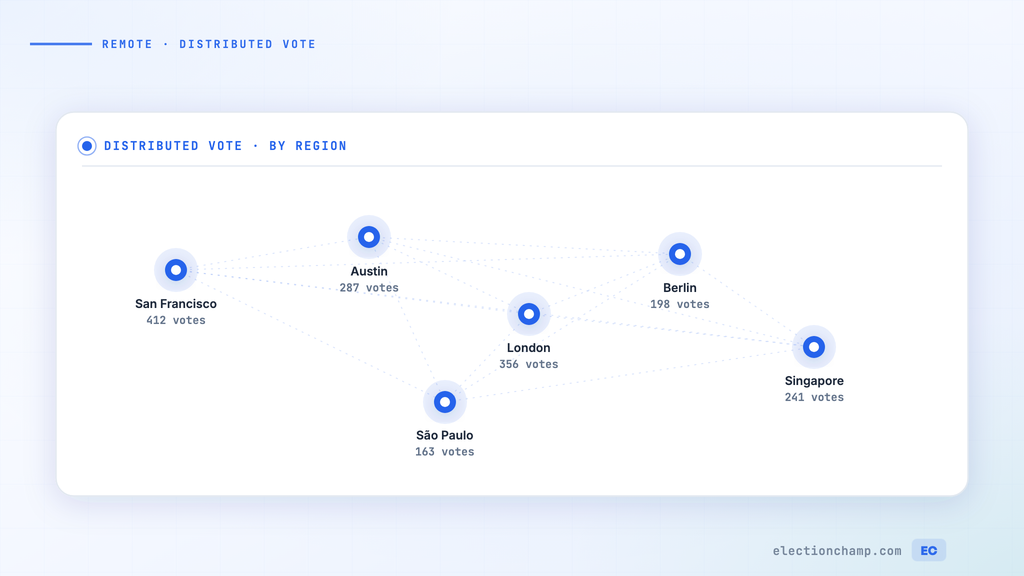
Remote and distributed companies have transformed how work gets done — but many still struggle with how decisions get made. Without the casual alignment of hallway conversations or the forced consensus of an all-hands meeting, remote teams need structured processes to make collective decisions efficiently and fairly.
Online voting provides that structure. Whether it’s a strategic decision, a policy change, or a team preference, a formal vote gives every team member an equal voice regardless of their timezone, communication style, or willingness to speak up on a video call.
Why Remote Teams Need Structured Voting
- The loudest voice wins problem: In video meetings, extroverts and senior team members dominate discussions. Quieter team members, non-native speakers, and those in less-favorable timezones get sidelined.
- Timezone inequality: When decisions are made in real-time meetings, team members in unfavorable timezones always lose influence.
- Decision fatigue: Distributed teams make fewer decisions because coordinating synchronous discussion is expensive. Important choices get delayed.
- Documentation gaps: Verbal agreements on Zoom calls are poorly documented. Who decided what, and when?
- Consent vs. consensus confusion: Silence on Slack doesn’t mean agreement. Formal voting makes the actual level of support visible.
Asynchronous Voting: The Remote Team Superpower
Asynchronous voting — where team members vote on their own schedule within a defined window — is perfectly suited for distributed teams:
- Every team member gets the same information, the same options, and the same amount of time to consider their vote
- No timezone is disadvantaged — a 48-72 hour voting window accommodates everyone
- Introverts and deliberate thinkers have time to process without real-time pressure
- The result is documented automatically — no ambiguity about what was decided
- Participation is measurable — you know exactly who weighed in, unlike a Slack poll where non-responses are ambiguous
What Remote Teams Can Vote On
|
Decision Type |
Example |
Voting Method |
Window |
|
Strategic direction |
“Which market should we expand into next?” |
Ranked Choice |
5-7 days |
|
Policy decisions |
“Should we adopt a 4-day work week?” |
Yes/No (Plurality) |
3-5 days |
|
Tool selection |
“Which project management tool should we use?” |
Plurality or Ranked |
3-5 days |
|
Team preferences |
“When should our team offsite be?” |
Plurality |
2-3 days |
|
Compensation structure |
“How should we allocate the bonus pool?” |
Ranked Choice |
5-7 days |
|
Cultural decisions |
“What should our team values be?” |
Multi-select Plurality |
5-7 days |
|
Process changes |
“Should we switch from daily to weekly standups?” |
Yes/No (Plurality) |
2-3 days |
Before the Vote
- Share context asynchronously first: Post a document or video explaining the decision, the options, and the rationale for each. Give team members 2-3 days to read and ask questions before voting opens.
- Define the stakes: Is this vote binding or advisory? Will the CEO make the final call informed by the vote, or does the majority win? Be explicit.
- Set a clear timeline: “Voting opens Monday 9 AM UTC, closes Wednesday 9 PM UTC. Results shared Thursday.”
- Choose the right voting method: Yes/No for binary decisions. Plurality for picking one option from several. Ranked Choice when you want the option with broadest support.
During the Vote
- Send a single reminder at the midpoint — don’t over-communicate
- Monitor participation through the ElectionChamp dashboard
- Don’t discuss the vote in public channels while it’s open — this can create pressure
After the Vote
- Share results promptly with the full team
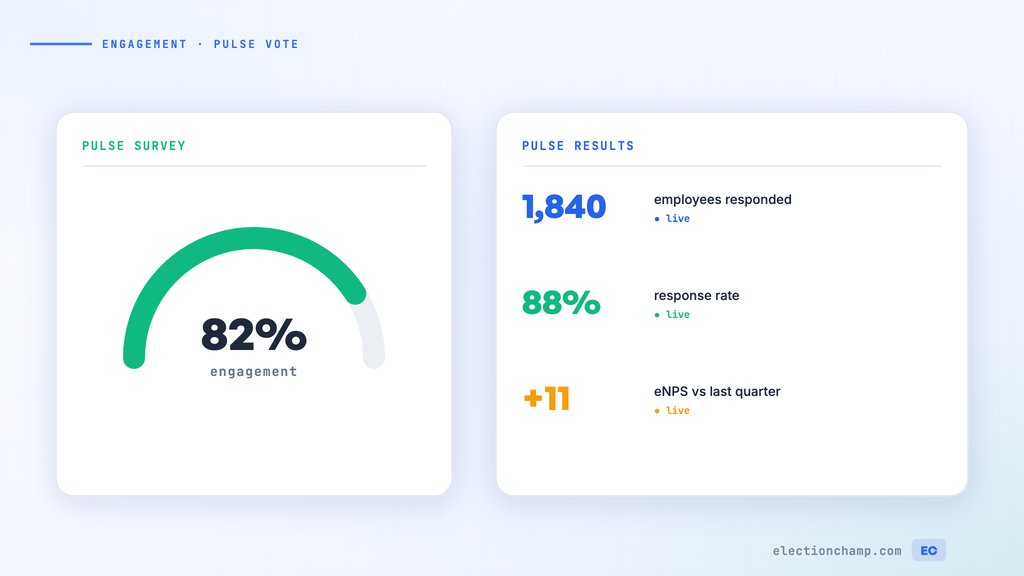
- Include participation metrics: “23 of 28 team members voted (82%)”
- Communicate what happens next based on the result
- Archive the results for future reference — decisions should be traceable
Integrating Voting into Remote Culture
The most effective remote companies don’t use voting as a one-off — they make it a regular part of how decisions get made:
- Quarterly strategy votes: Let the team weigh in on priorities for the next quarter
- Monthly retro votes: “What should we keep doing? What should we change?”
- Annual culture votes: Team values, work policies, benefits preferences
- Ad hoc decisions: Whenever a choice affects everyone, put it to a vote rather than making a unilateral call
Over time, this creates a culture where every team member feels heard regardless of their location, timezone, or communication style. That sense of agency is one of the most powerful retention tools a remote company has.
Remote Voting vs. Slack Polls
|
Feature |
Slack/Teams Poll |
ElectionChamp Vote |
|
Anonymity |
Not anonymous — everyone sees who voted for what |
Fully anonymous — no one sees individual votes |
|
One vote per person |
Depends on poll tool — some allow multiple votes |
Enforced — one unique key per person |
|
Audit trail |
None — polls can be deleted or modified |
Complete timestamped audit log |
|
Result security |
Results visible in real-time (can influence later voters) |
Results can be hidden until voting closes |
|
Participation tracking |
No way to know who didn’t vote |
Dashboard shows exactly who hasn’t voted |
|
Documentation |
Buried in chat history |
Downloadable CSV with complete records |
|
Seriousness signal |
Feels casual — “just a poll” |
Feels official — signals the decision matters |
Slack polls are fine for “where should we order lunch from?” For decisions that matter — and that you want documented — use a proper voting platform.
Planning your next vote? Read about online voting for businesses and polls, surveys, and motions, or see pricing: free up to 20 voters, $10 up to 200, then $0.05 per voter.