ElectionChamp
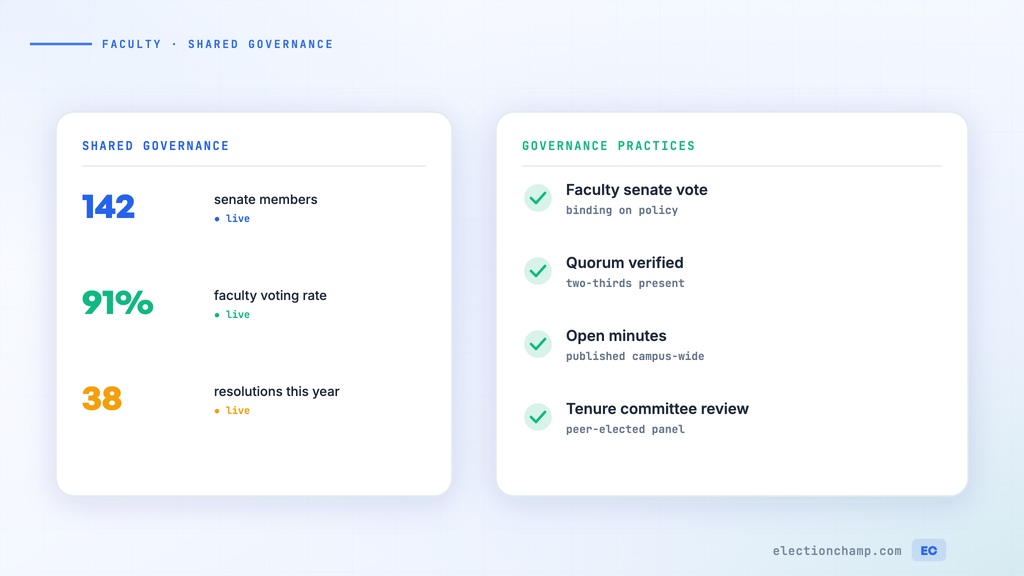
Shared Governance in Higher Education
Faculty governance is a cornerstone of higher education. Academic senates, faculty councils, and university committees make decisions about curriculum, tenure standards, academic freedom, research policies, and institutional priorities. These governance bodies derive their legitimacy from representative elections — yet faculty election participation is often disappointingly low.
Online voting addresses the participation problem while maintaining the formality and documentation that shared governance requires.
Types of Faculty Governance Elections
|
Election Type |
Voting Population |
Frequency |
Stakes |
|
Faculty Senate / Academic Council |
All full-time faculty (sometimes adjuncts) |
Annual |
High — sets academic policy |
|
Senate President / Chair |
Senate members or full faculty |
Annual or biennial |
High — leads the governance body |
|
Department representatives |
Faculty within each department |
Annual |
Medium — represents dept. in senate |
|
Standing committees |
Full faculty or senate members |
Annual |
Medium — curriculum, tenure, budget, etc. |
|
Tenure & promotion committees |
Senior faculty |
Annual or as needed |
Very High — career-defining decisions |
|
Faculty union officers |
Union members (if unionized) |
Per union bylaws |
High — negotiates contract terms |
|
Ad hoc committees |
Selected or elected faculty |
As needed |
Varies by issue |
The Faculty Participation Problem
Faculty governance elections consistently suffer from low turnout. Contributing factors:
- Scheduling conflicts: Faculty teach at different times, hold office hours, conduct research, and attend conferences — convening for an in-person vote is nearly impossible
- Multiple campuses: Universities with branch campuses, medical schools, or research centers have faculty spread across locations
- Adjunct and part-time faculty: These growing segments of the workforce often feel excluded from governance or face logistical barriers to participation
- Perceived irrelevance: Some faculty don’t engage in governance because they don’t see its impact on their daily work
- Complex ballots: Elections for multiple committees with many candidates can feel overwhelming when done on paper
Step 1: Define the Electoral Structure
- Identify which positions are elected vs. appointed
- Determine the voting constituency for each position (all faculty, by department, by rank, by college/school)
- Review senate bylaws for election procedures, nomination requirements, and term limits
Step 2: Manage Nominations
- Use ElectionChamp’s Nominations ballot type for an initial nomination phase where faculty can write in colleagues
- Alternatively, accept nominations from a nominating committee and supplement with self-nominations and petitions
- Collect candidate statements and CVs — faculty voters want to know candidates’ qualifications and priorities
Step 3: Build the Ballot
- Create a separate ballot question for each position or committee.
- Use Plurality voting for single-seat positions (Senate President, Department Representative).
- Use Plurality with multiple winners for multi-seat committees (“Elect 3 members to the Curriculum Committee”).
- Consider STV (Single Transferable Vote) for proportional representation across schools or departments. Collect ranked ballots in ElectionChamp, then run the exported ranked results through ElectionChamp’s free STV Excel calculator for the final count.
- Enable Random Order to prevent alphabetical bias — studies show first-listed candidates receive more votes.
- Include candidate statements in the ballot using the candidate biography feature.
Step 4: Launch and Monitor
- Set a 10-14 day voting window — faculty need time to fit voting around their schedules
- Send notifications via email to university email addresses
- Send at least two reminders during the voting period
- Monitor participation by department or school to identify pockets of low engagement
Multi-Constituency Elections
University governance often involves complex electoral structures with multiple constituencies:
|
Approach |
When to Use |
Setup |
|
Single election, all faculty |
University-wide positions (Senate President, at-large seats) |
One election with full faculty voter list |
|
Separate elections by department |
Department representatives to senate |
Create one election per department with department-specific voter list |
|
Separate elections by college/school |
College-level representatives |
Create one election per college |
|
Combined ballot |
All positions on one ballot, but results analyzed by constituency |
One election with Voter Labels for department/college |
Accreditation and Governance Documentation
Regional accreditation bodies evaluate shared governance practices. Online voting strengthens your documentation:
- Election records demonstrate that faculty governance bodies are democratically elected, not appointed
- Participation rates show the level of faculty engagement in governance
- Audit trails prove that elections were conducted fairly and transparently
- Archived results provide a historical record of governance evolution over time
- Download and include election records in your accreditation self-study materials
Accreditors like the Higher Learning Commission (HLC), SACSCOC, NEASC, and others all examine whether institutions have effective faculty governance. Documented, transparent election processes demonstrate this convincingly.
Planning your next vote? Read about online voting for universities and officer elections, or see pricing: free up to 20 voters, $10 up to 200, then $0.05 per voter.