ElectionChamp
Short answer: OpaVote is free for elections with up to 25 voters and 10 candidates, with up to 3 elections running at once. Above that, you pay $10 for every 125 voters or 20 candidates, so 250 voters cost $20 and 1,000 voters cost $80. Paid election data is kept for 3 months free, then $40 a year. These figures come from OpaVote’s pricing page as of October 2026.
This guide walks through the free tier limits, the block pricing with worked examples, and the fees people miss. It also covers what OpaVote does well and how the cost compares with ElectionChamp at the same election sizes. Since it is our product, we have kept the comparison to published, dated facts.
How OpaVote Pricing Works in 2026
OpaVote charges per election. There is no monthly subscription for standard elections. According to the OpaVote pricing page (checked October 3, 2026), you choose between a free tier and pay as you go.
On pay as you go, the price is “$10 for every 125 voters or 20 candidates in your election.” Think of it as buying $10 blocks. Each block covers up to 125 voters and up to 20 candidates. OpaVote’s published table pairs each price with both caps, so your election needs enough blocks to cover whichever number is larger.
| OpaVote price per election | Max voters | Max candidates |
|---|---|---|
| Free | 25 | 10 |
| $10 | 125 | 20 |
| $20 | 250 | 40 |
| $40 | 500 | 80 |
| $80 | 1,000 | 160 |
| $160 | 2,000 | 320 |
| $800 | 10,000 | 1,600 |
Source: OpaVote pricing table, as of October 2026. Pay as you go also allows an unlimited number of elections. OpaVote lists custom plans with priority support for high-volume customers, priced by contacting their team.
One detail matters for some groups. OpaVote notes that voter limits apply to Elections and Counts, while Polls get unlimited voters for the same price. Polls are open to anyone with the link, so they suit informal surveys more than member elections.
What the OpaVote Free Tier Includes
The free tier is generous for very small groups. As of October 2026, it includes:
- Up to 25 voters per election
- Up to 10 candidates per election
- Up to 3 elections running at the same time
- Email voter notifications
- Election data kept for up to 10 weeks
The candidate cap is the limit people hit first. A club with 18 members and a ballot listing 12 names across several officer roles is over the free limit, even though the voter count is small. That election moves to the $10 block.
The 10-week data window is the other limit to plan around. Save any results or records you need before it ends. Check your bylaws for how long your organization must keep election records.
OpaVote Cost Examples by Election Size
Here is how the block math plays out for typical elections. These are illustrative examples, calculated from the published formula as of October 2026.
- Parenting group, 60 voters, 8 candidates: one block covers both numbers. Cost: $10.
- Small club, 22 voters, 12 candidates: the voter count fits the free tier, but 12 candidates exceeds the cap of 10. Cost: $10.
- Nonprofit, 110 members, 24 candidates across officer and committee seats: voters fit one block, but candidates need two. Cost: $20.
- Association, 300 members, board race with 6 candidates: 300 voters need three blocks of 125. Cost: $30.
- Union local, 1,000 members, 15 candidates: eight blocks cover the voters. Cost: $80.
- Large membership, 5,000 voters: forty blocks. Cost: $400, before any custom pricing OpaVote might offer.
Two things push the price up faster than expected. A voter count just over a block boundary (126, 251, 501) buys a whole extra block. A long ballot with many candidates can also cost more than the voter count alone suggests. OpaVote’s page does not spell out how candidates are counted across several ballot questions, so confirm with them before you budget a long ballot.
OpaVote Data Retention Fee and Other Costs
The election price is not always the full cost. Two other charges are worth knowing before you commit.
Data Retention Fee
Paid elections keep their data for three months at no charge. After that, OpaVote charges “$40 for every year after that,” per the pricing page. If your board wants results and records to stay online for a year after the vote, budget roughly $40 on top of the election price. For a $10 election, that retention fee is four times the election cost.
If you only need a record of the outcome, exporting and archiving what you need inside the three-month window avoids the fee.
Paid Support
OpaVote describes itself as completely self-service. Its support page (checked October 3, 2026) offers free help for documentation questions and malfunctioning features. Help beyond that, such as choosing a voting method or correcting an election, costs “$50 for up to 30 minutes of assistance.” First-time administrators should factor that in.
OpaVote Review: What It Does Well
OpaVote has real strengths, especially for groups that care about counting rules.
- Depth on ranked methods. It supports instant runoff voting (IRV), single transferable vote (STV), and Condorcet voting, plus approval and Borda count. Its help pages list more than 20 voting methods.
- Fine control over ranked counts. Administrators can set tie-breaking rules, candidate elimination options, and fractional precision for STV, according to the OpaVote Counts help page.
- Counts for ballots collected elsewhere. Counts lets you “tally ranked ballots you have collected in other ways (e.g., paper ballots or another online voting system) and share the results online.” You can upload ballots in the BLT file format.
- Low entry price. The free tier covers 25 voters, and one $10 block covers up to 125.
- Anonymous by default. Per the elections help page, most elections are set so that no one, including OpaVote, can see how a voter voted. Automatic reminder emails can go to non-voters every three days.
If your bylaws name a specific IRV or STV counting rule, OpaVote is a strong fit. The tradeoffs are mostly practical. Voting links go out by email (administrators can also hand out voting codes), help beyond the basics is paid, and long ballots or long data retention add cost. For a primer on the methods themselves, see our guide to plurality, ranked choice, and approval voting compared.
OpaVote vs ElectionChamp: Cost at the Same Sizes
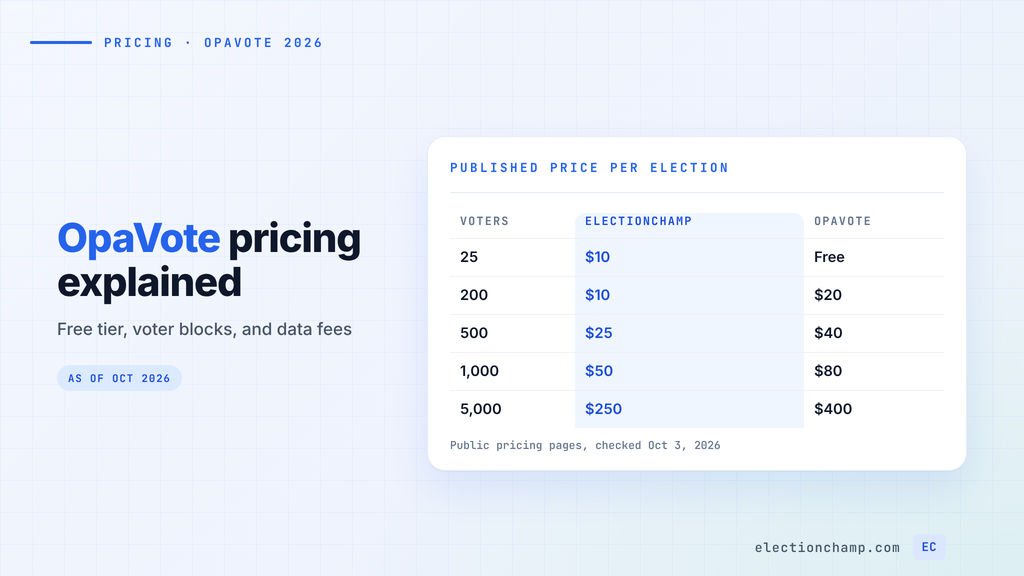
ElectionChamp prices each election on total capacity, meaning voters plus any spare keys. It is free up to 20 voters, $10 flat for 21 to 200 voters, and $0.05 per voter above 200. Candidate count does not change the price. Here is how the two compare at common sizes, using public pricing as of October 2026.
| Voters | OpaVote | ElectionChamp |
|---|---|---|
| 20 | Free | Free |
| 25 | Free | $10 |
| 125 | $10 | $10 |
| 200 | $20 | $10 |
| 300 | $30 | $15 |
| 500 | $40 | $25 |
| 1,000 | $80 | $50 |
| 5,000 | $400 | $250 |
OpaVote figures assume the candidate count fits the voter-based blocks. The 300 and 5,000 rows are calculated from OpaVote’s formula. Sources: OpaVote pricing and our pricing page.
OpaVote wins at 21 to 25 voters, where its free tier is larger. The two tie at 26 to 125 voters. From 126 voters up, we cost less at every size, and the gap grows with long ballots.
The feature sets differ too. With us, every feature is on every plan, including weighted voting. Voter keys go out by email, SMS, or printed keys, and we offer free email support for administrators and voters. One honest caveat: our ranked choice option scores rankings with a Borda count variant, and for multi-seat STV races we provide a free STV Excel calculator that counts the ranked results you export. If your rules require IRV, OpaVote handles it natively. Our side-by-side OpaVote comparison covers the feature differences in detail.
When to Choose OpaVote and When to Pick an OpaVote Alternative
Choose OpaVote if your bylaws require IRV, Condorcet, or a specific STV rule. It is also the natural pick when you already collected paper ballots and only need a trusted ranked count, or when your group has 21 to 25 voters and a short ballot.
Look at an OpaVote alternative if any of these apply:
- You have more than 125 voters and want a lower per-election price.
- Your ballot lists many candidates across several seats.
- You want voters reached by SMS or printed keys as well as email.
- You expect to need setup help and would rather not pay per half hour.
For a wider view of the market, our online voting software comparisons put the main vendors side by side. Our breakdown of online voting software pricing in 2026 covers the rest of the field.
Frequently Asked Questions
Is OpaVote free?
Yes, for small elections. As of October 2026, OpaVote is free for up to 25 voters and 10 candidates per election, with up to 3 elections at once. Data from free elections is kept for up to 10 weeks.
How much does OpaVote cost for 500 voters?
$40, as long as the election has 80 candidates or fewer. OpaVote charges $10 for every 125 voters or 20 candidates, per its pricing page as of October 2026.
Does OpaVote charge to keep election data?
Yes. Paid elections keep data for three months free, then OpaVote charges $40 for every year after that. Free elections keep data for up to 10 weeks.
What is a good OpaVote alternative?
It depends on your rules and size. ElectionChamp is free up to 20 voters, $10 up to 200, then $0.05 per voter, with no candidate-based pricing. If your bylaws require IRV or Condorcet counting, OpaVote remains a strong choice.
Planning your next vote? Read about online voting software comparisons and the full feature list, or see pricing: free up to 20 voters, $10 up to 200, then $0.05 per voter.