ElectionChamp
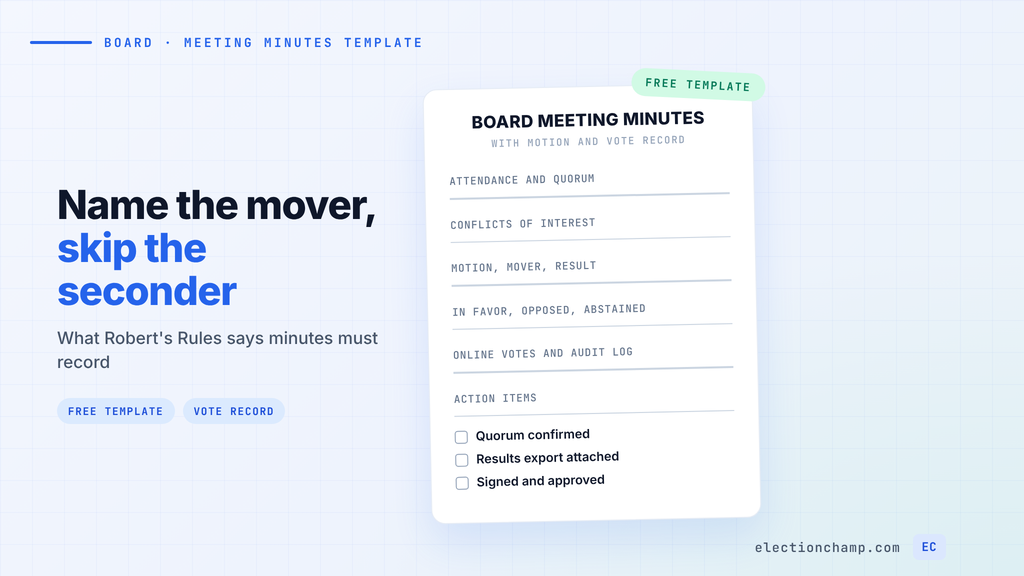
Short answer: A board meeting minutes template records the meeting type, date, attendance and quorum, conflicts of interest, each motion with the mover’s name, the vote count and result, action items, and adjournment. Minutes record decisions and leave out debate. The secretary signs them, the board approves them at its next meeting, and you keep them permanently. Copy the free template below, which includes a vote record.
The template follows Robert’s Rules and adds what most free templates skip: a vote record for every motion and a log for online votes between meetings. If the meeting includes director or officer voting, our guide to board elections covers the ballot side.
Board Meeting Minutes Template
Fill in the blanks, delete sections your bylaws do not require, and copy the motion block once per motion.
Download: Board Meeting Minutes Template (Free, Editable) (Word .docx)
[Organization Name]
Minutes of the [Regular / Special / Annual] Meeting of the Board of Directors
Date: ________ Location or video link: ________
Presiding: ________ (chair) Recording: ________ (secretary)
1. Attendance and quorum
Directors present: ________ Directors absent: ________
Also present (staff, guests, counsel): ________
Quorum: ________ directors present; ________ required. Quorum was [ ] present [ ] not present.
2. Call to order and agenda
The chair called the meeting to order at ________. The agenda was [ ] approved as circulated [ ] approved as amended: ________
3. Conflicts of interest
[ ] No conflicts were disclosed.
Disclosed: ________ (director, agenda item, nature of the interest)
Handling: ________ (left the room for item ___, did not vote, other)
4. Approval of previous minutes
The minutes of the meeting held ________ were [ ] approved as distributed [ ] approved as corrected: ________
5. Reports
Treasurer’s report: received and filed. [ ] Attached
Other reports: ________ (name and subject only; attach written reports)
6. Motions and votes (one block per motion)
Motion no.: ________
Motion text: “Moved that ________.”
Moved by: ________ Seconded by: ________ (if your rules require it)
Amendments adopted: ________
Vote required: [ ] majority [ ] two-thirds [ ] other: ________
Method: [ ] voice [ ] show of hands [ ] roll call [ ] ballot [ ] general consent
In favor: ____ Opposed: ____ Abstained: ____ Recused: ____
Roll call (if taken): Yes: ________ No: ________ Abstain: ________
Result: [ ] Adopted [ ] Failed [ ] Postponed to ________ [ ] Referred to ________
7. Votes and actions taken since the last meeting
Matter: ________
Method: [ ] online member vote [ ] written consent of directors [ ] other: ________
Voting period: ________ to ________ Eligible voters: ____ Ballots cast: ____
Results: ________ (for, against, abstain, or votes per candidate)
Result declared by ________ on ________
Attached: [ ] results export [ ] audit log [ ] signed consents
8. Action items
Task: ________ Owner: ________ Due: ________
9. Executive session
The board met in executive session from ________ to ________ to discuss ________ (general nature only: personnel, legal, contract). Action taken: ________
10. Next meeting and adjournment
Next meeting: ________. The meeting adjourned at ________.
Submitted by: ________, Secretary Date: ________
Approved on: ________ [ ] as distributed [ ] as corrected. Secretary’s initials: ____
How to Write Board Meeting Minutes
- Before the meeting: copy the agenda into the template with the directors’ names and your quorum number.
- During the meeting: log attendance, arrivals, and departures, since they change quorum. For each motion, write the exact wording, mover, method, and count.
- Within a few days: type the draft, attach reports, mark it “Draft,” and send it to the chair, then the board.
- At the next meeting: take corrections, approve, sign, and file.
What Board Meeting Minutes Must Include
Robert’s Rules sets the standard content, as summarized by the Arkansas Cooperative Extension Service and parliamentarian C. Alan Jennings in Robert’s Rules For Dummies:
- Opening paragraph: kind of meeting, organization name, date, time, place, whether the regular chair and secretary attended, and whether the previous minutes were approved.
- Each main motion: the final wording, the mover’s name, and the outcome. Leave out withdrawn motions. The seconder’s name is not required unless your rules require it.
- Votes: the count on each side for a counted vote, and each name for a roll call.
- Points of order and appeals: with the chair’s ruling.
- Closing: adjournment time and the secretary’s signature.
Board minutes also record attendance and quorum, which prove the board could act, plus conflict disclosures if your policy requires them.
How to Record Motions and Votes in Minutes
Match the record to the voting method, so anyone can check the result from the minutes alone.
| Vote method | What to record | Example line |
|---|---|---|
| Voice vote | The result | “The motion was adopted.” |
| Counted vote (show of hands) | Numbers on each side | “Adopted, 6 in favor, 2 opposed, 1 abstaining.” |
| Two-thirds vote | Count and method | “Adopted by a two-thirds show of hands, 8 to 1.” |
| Roll call | Each name and vote | “Yes: Ahmed, Brooks, Chen. No: Diaz. Abstain: Evans.” |
| Ballot | Totals from the tellers, no names | “Ballots cast: 9. Lee 6, Patel 3. Lee elected treasurer.” |
| General consent | That no one objected | “Without objection, the agenda was approved.” |
Record abstentions and recusals as separate numbers. A director who leaves the room over a conflict is recused. One who stays and declines to vote has abstained.
What Not to Include in Board Meeting Minutes
Robert’s Rules In Brief calls summarizing reports and debate the most frequent minutes mistake, as quoted by Michigan State University’s Office of Academic Governance. Leave out these:
- Debate and opinions: who argued what, or “heated discussion.”
- Guest speakers’ remarks: give the name and subject only (RONR 12th edition 48:5(6)).
- Full reports: attach them, unless the board orders the text entered.
- Executive session detail: note the general topic and any action. California HOA executive session minutes are excluded from the 30-day member access rule in Civil Code 4950.
- Legal advice: note that counsel briefed the board, and ask counsel how to word it.
- Secret ballot choices: totals only.
How to Record Votes Taken Online Between Meetings
Section 7 of the template logs both kinds of between-meeting votes.
Member Votes and Elections Run Online
At the next board meeting, record the question, voting window, eligible voters, ballots cast, results per option including abstentions, and who declared the result. Attach the results export and the audit log.
In ElectionChamp, the results download is a CSV of each question, candidate, count, percentage, and winner. The audit log exports as a timestamped CSV of every administrative action. Administrators can see who voted but never how, so the files hold totals only, as minutes should. Yes, no, or abstain questions run as motions and resolutions ballots.
Board Decisions Made Between Meetings
Whether directors can act outside a meeting depends on state law and bylaws. Many nonprofit statutes require the written consent of every director, and some HOA statutes restrict it further, so confirm with your bylaws and counsel.
When it is allowed, file the signed consents with the minutes and list the action at the next meeting. Votes that must be recorded by name need a roll call or signed consents, since an anonymous ballot cannot show who voted which way. See our posts on board resolutions and consent votes and Robert’s Rules for online voting.
Who Approves Board Minutes and How Long to Keep Them
The secretary drafts and signs the minutes. The board approves them at its next regular meeting, usually by general consent after the chair asks for corrections. Corrections go in the minutes being corrected. After approval, the secretary writes “Approved” with the date and initials.
Members usually approve annual meeting minutes at the next annual meeting, unless your bylaws let the board or a committee approve them sooner. Two outside deadlines:
- California HOAs: minutes, a marked draft, or a summary must be available to members within 30 days of a board meeting (Civil Code 4950(a)).
- Form 990 filers: Part VI asks whether meetings and written actions were documented contemporaneously, meaning by the later of the next meeting or 60 days after. Emails that explain the action, its timing, and who decided can count (Minnesota Council of Nonprofits summary of the Form 990 instructions).
Keep approved minutes and attachments permanently. Florida condominium associations must keep minutes permanently under Florida Statutes section 718.111(12)(b). Others should check their state nonprofit act and records policy.
Frequently Asked Questions
How do you write board meeting minutes?
Record the meeting type, date, attendance, and quorum, then each motion’s exact wording, mover, vote count, and result. Add action items and the adjournment time, leave out debate, and have the board approve the draft at its next meeting.
Do board meeting minutes need to name who seconded a motion?
Not under Robert’s Rules. The mover’s name is recorded, but the seconder’s name is not required unless your organization’s own rules require it.
How long should a nonprofit keep board meeting minutes?
Keep them permanently. Some statutes require it, such as Florida’s rule for condominium associations, so confirm your state law and records policy.
Should board minutes record how each director voted?
Record names for roll call votes and when your bylaws, state law, or conflict policy require it. Otherwise record the result or the count. Never record individual choices on a secret ballot.
Planning your next vote? Read about board elections and motions and resolutions, or see pricing: free up to 20 voters, $10 up to 200, then $0.05 per voter.