ElectionChamp
Short answer: HOA quorum requirements set the minimum share of voting interests that must take part before members can act at a meeting. Your bylaws usually set the number. If they are silent, state law fills the gap: 30% in Florida, one-third for California mutual benefit corporations, and 10% for Texas nonprofit corporations. Owners present in person and by proxy count, and in some states absentee or electronic ballots count too.
This guide shows how to find your number and who counts toward it. It also covers three state statutes, what to do when a meeting falls short, and how to reach quorum next time.
What Is an HOA Quorum?
A quorum is the minimum participation needed for a meeting to conduct business. Without it, votes taken at the meeting can be challenged, and many boards simply adjourn.
Quorum measures participation. Once quorum is met, a separate rule decides whether a motion passes. In Florida, member decisions need a majority of the voting interests present, in person or by proxy, at a meeting with quorum. The statute or governing documents can say otherwise (Fla. Stat. 720.306(1)(a)).
Member Quorum vs Board Quorum
An HOA has two different quorums, and people mix them up.
- Member quorum applies to annual meetings, special meetings, and board elections. It is a share of all owners’ voting interests, and it is the one that usually fails.
- Board quorum applies to board meetings. It is a share of the directors. In Texas, the default for nonprofit corporations is a majority of directors, unless the bylaws set a smaller number of at least three. A director present by proxy does not count (Tex. Bus. Orgs. Code 22.213).
The rest of this guide is about member quorum.
How HOA Quorum Requirements Are Set
Your number comes from a stack of documents. Check them in this order.
- State HOA statute. Some states set a default or override for associations, such as Florida Chapter 720 or the California Davis-Stirling Act.
- Nonprofit corporation law. If your association is incorporated, the state nonprofit code may set a default member quorum.
- Declaration (CC&Rs) and articles of incorporation. These define who votes and how many votes each lot carries.
- Bylaws. Most associations state the quorum percentage here, often in the section on member meetings.
A statute can cap or replace what your documents say. Florida’s 30% default applies “unless a lower number is provided in the bylaws.” If your documents and the statute seem to conflict, confirm with your bylaws and counsel before the meeting.
What Percentage Is a Quorum?
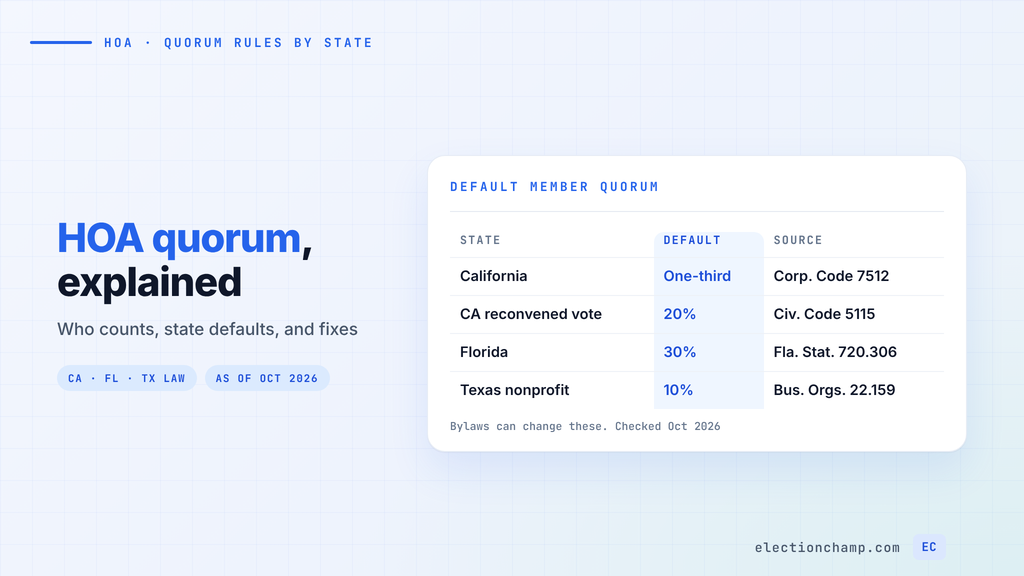
No single percentage applies everywhere. Your bylaws set the number, and associations use a wide range, as the table below shows. Where the bylaws are silent, state defaults fill the gap: 30% in Florida, one-third for California mutual benefit corporations, and one-tenth for Texas nonprofit corporations.
Quorum is counted in voting interests, as your declaration defines them. Many associations give one vote per lot or unit. Some assign votes by unit size or class, so check before you count heads.
Here is the math for a 240-lot association with one vote per lot:
| Quorum in bylaws | Lots needed | Lots that can stay home |
|---|---|---|
| 10% | 24 | 216 |
| 20% | 48 | 192 |
| 30% | 72 | 168 |
| One-third | 80 | 160 |
| Majority | 121 | 119 |
Round up. A quorum of 30% of 245 lots is 73.5, so you need 74. Count lots or voting interests: two co-owners of one lot usually share one vote.
Who Counts Toward Quorum
The methods that count depend on your state and documents. This table shows how each method is treated in the states covered here.
| Method | Counts toward quorum? | Example |
|---|---|---|
| In person | Yes, everywhere | Owner signs in at the meeting |
| Proxy | Yes, where proxies are allowed | Florida and Texas quorum rules count members present by proxy |
| Absentee or electronic ballot | Often, with limits | Texas counts it only for items on the ballot; Florida counts online voters as present |
| Secret ballot (California elections) | Yes, if quorum is required | Every ballot the inspector receives counts as a member present |
How Proxies Affect Quorum
A valid proxy puts the owner’s vote in the room, so it counts toward quorum. Texas nonprofit law counts members holding the required share of votes “in person or by proxy” (Tex. Bus. Orgs. Code 22.159). Florida uses the same phrase in 720.306(1)(a).
Proxies only help if they are valid. In Florida, a proxy must be dated, signed, and state the date, time, and place of the meeting. It covers that meeting and lawful adjournments, and it expires 90 days after the original meeting date (Fla. Stat. 720.306(8)). For forms and rules, read our guide to HOA proxy voting.
Absentee and Electronic Ballots
In Texas, an absentee or electronic ballot can count as an owner present and voting for quorum “only for items appearing on the ballot.” If the owner shows up and votes in person, the in-person vote wins (Tex. Prop. Code 209.00592(b)).
In Florida, a member voting through an online system adopted under 720.317 “shall be counted as being in attendance at the meeting for purposes of determining a quorum.” The board must first adopt the system by resolution, with consent and opt-out procedures (Fla. Stat. 720.317).
HOA Quorum by State: California, Florida, and Texas
These are the defaults and special rules we verified in statute text in October 2026. Your bylaws may set a different number within what the law allows.
| State | Default member quorum | Rules worth knowing | Source |
|---|---|---|---|
| California | One-third of the voting power for mutual benefit corporations | Election ballots count as members present. A failed election can reconvene with a 20% quorum. | Corp. Code 7512, Civ. Code 5115 |
| Florida | 30% of total voting interests, unless the bylaws set a lower number | Proxies count. Online voters count as present. Uncontested candidates take office even without quorum. | Fla. Stat. 720.306 |
| Texas | One-tenth of the votes, for nonprofit corporations, unless the certificate or bylaws say otherwise | Absentee and electronic ballots count only for items on the ballot. | Bus. Orgs. Code 22.159, Prop. Code 209.00592 |
California
Civil Code 5115(d)(1) says a quorum is required only if the governing documents or other law require one. When one applies, each ballot received by the inspector of elections counts as a member present. Corporations Code 7512 sets one-third of the voting power as the member quorum for mutual benefit corporations. A bylaw can set a lower number, but a meeting attended by less than one-third can then vote only on matters described in the notice.
California also gives boards a way out of a failed election. Under 5115(d)(2), the association can adjourn to a date at least 20 days later. At the reconvened meeting, the quorum to elect directors drops to 20% of members, voting in person, by proxy, or by secret ballot, unless the governing documents allow something lower. General notice of the reconvened meeting must go out at least 15 days before it. For voting procedure details, see our California HOA electronic voting guide.
Florida
Florida HOAs under Chapter 720 default to 30% of total voting interests, and the statute only lets bylaws set a lower number. Florida also has a rule that saves many annual meetings. If there are no more qualified candidates than open seats, and floor nominations are not required, no election is held. Those candidates “commence service on the board of directors, regardless of whether a quorum is attained at the annual meeting” (720.306(9)(a)).
Texas
Texas Property Code Chapter 209 governs voting methods, while the Business Organizations Code sets the default quorum for incorporated associations at one-tenth of the votes. Under 209.00592(a-1), the association must offer owners at least one of absentee ballot, proxy, or electronic ballot. Each one helps reach quorum within the limits above.
What Happens When an HOA Meeting Has No Quorum
The meeting can still open, but members cannot act on items that need a member vote. Most bylaws let the members present adjourn to a later date. Here is the usual sequence.
- Record the count. Note in the minutes how many voting interests were present in person, by proxy, and by ballot, and that quorum was not met.
- Adjourn to a set date. Adjourning, rather than canceling, keeps proxies alive in states like Florida, where a proxy covers lawful adjournments.
- Check for a reduced quorum rule. Your bylaws or state law may lower quorum at the reconvened meeting. California does this for director elections.
- Send notice again. Follow the notice rules for the reconvened meeting. California requires general notice at least 15 days ahead.
- Add a voting method. If owners did not come the first time, give them a way to take part without attending, where your documents allow it.
Who stays on the board after a failed election depends on your bylaws and state law. Confirm with your bylaws and counsel before you assume anything.
How to Reach Quorum at Your Next HOA Meeting
Start the quorum work when the meeting notice and proxy forms go out, not the week of the meeting. These tactics work within most governing documents.
- Let owners vote without attending. If your documents and state allow absentee or electronic ballots, offer them. Owners who vote online count toward quorum in Florida and, for ballot items, in Texas.
- Collect proxies early. Send the proxy form with the meeting notice. Track returns against your quorum target, lot by lot.
- Publish the number. Tell owners exactly how many lots are needed and how many have responded so far.
- Remind more than once. Plan reminders at set intervals until the deadline, and stop sending them to owners who have already responded.
- Fix your contact list. Bounced emails and old phone numbers are lost votes. Clean the list before notice goes out.
- Consider a bylaw amendment. If quorum fails every year, a lower quorum or electronic voting clause may be the real fix. Follow your amendment procedure.
Online voting covers several of these at once. In ElectionChamp, each owner gets a single-use voter key by email or SMS, the dashboard shows who has voted (never how), and paid elections include up to 5 reminders. If some owners still want paper, a hybrid election lets you issue printed keys and track both in one place. Setup and testing are free, so you can check the process against your documents before launch. Read more about HOA online voting or our guide to reaching quorum faster with online voting.
Frequently Asked Questions
What percentage is a quorum?
It depends on your bylaws and state law. Your bylaws usually set the member quorum. Where they are silent, state defaults apply: 30% in Florida, one-third for California mutual benefit corporations, and one-tenth for Texas nonprofit corporations.
What is a typical HOA quorum requirement?
There is no single typical number. Your bylaws usually set it. Where they are silent, state law applies: 30% in Florida, one-third for California mutual benefit corporations, and one-tenth for Texas nonprofit corporations.
Do proxies count toward HOA quorum?
Yes, where proxies are allowed. Florida and Texas count members present in person or by proxy toward quorum. A proxy must be valid under your state law and documents to count.
What happens if an HOA meeting does not have a quorum?
Members cannot act on items that need a member vote. The members present usually adjourn to a later date. In California, a failed director election can reconvene at least 20 days later with a 20% quorum.
Can an HOA lower its quorum requirement?
Often, by amending the bylaws through their amendment procedure. Florida bylaws can set a quorum below 30%. In California, a bylaw quorum below one-third limits votes at thinly attended meetings to matters described in the notice.
Planning your next vote? Read about HOA online voting and board elections, or see pricing: free up to 20 voters, $10 up to 200, then $0.05 per voter.