ElectionChamp
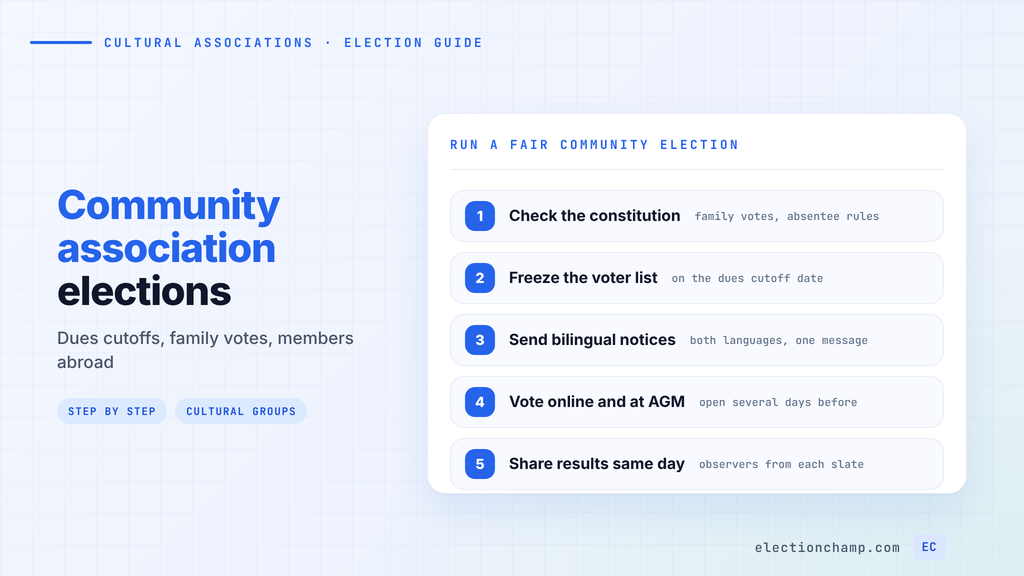
Short answer: To run a community association election, start with your constitution: who counts as a member, the dues cutoff, how many votes a family membership carries, and whether absentee or online voting is allowed. Appoint a neutral election committee and publish the voter rules before nominations open. Send notices in the languages your members read. Then vote at the AGM, online, or both, and share results the same day.
This guide is for cultural, heritage, and diaspora associations: regional and language-based societies, cultural centers, and temple community committees. They run on volunteers and long memories, so a clean process protects the community after the vote. The steps are the same for a cultural association election or a community society election.
Community Association Election Rules to Check First
Read your constitution and bylaws before you announce a date. Write down the answers to these questions:
- Which membership classes can vote, and how many votes a family membership carries.
- The date by which dues must be paid to vote.
- Who appoints the election committee, and who is barred from serving on it.
- How nominations work, including deadlines and seconders.
- Whether absentee, proxy, mail, or online voting is allowed, and for which votes.
- The notice period and quorum for the general body meeting.
Four published constitutions from US cultural associations show how much the answers vary:
| Association | Who votes | Dues cutoff | Absentee or online |
|---|---|---|---|
| Gujarati Samaj of Greater Austin | Each spouse and each family member 18 or older (Art. 4.4.2) | Member at least 48 hours before the election (Art. 11.14) | No absentee or proxy voting unless the constitution permits it (Art. 4.3) |
| Telugu Association of Greater Charlotte Area | Single and youth members get one vote, families get two (Sec. 3.0) | In good standing 60 days before the vote | No provision found |
| Telugu Association of San Antonio | Individuals get one vote, families get two (Art. 2) | Dues paid by September 30 for an October election | Mail or electronic votes allowed, except for executive committee elections (Art. 3) |
| NYTTA | Life members only, with votes for husband and wife | No cutoff date | No provision found |
If your constitution is silent on online voting, or bars absentee ballots, amend it first as one of your bylaw and policy votes. Society law also matters. In British Columbia, members can take part and vote in meetings by telephone or another medium under section 83 of the Societies Act. Proxy voting requires a bylaw that permits it under section 85. Rules elsewhere vary by state and province, so confirm with your bylaws and counsel.
Membership Eligibility and Dues Cutoffs
A dues cutoff stops a last-minute membership drive from deciding the election. The examples above range from 48 hours to 60 days. A longer cutoff gives the committee time to check payments.
- Announce the cutoff date in every renewal reminder, at least a month ahead.
- Freeze the voter list on the cutoff date, with a timestamped export from your payment records.
- Have two committee members from different circles check the list against payments.
- Let members confirm their own status privately by email.
- Update contact details for life members, whose emails are often years old.
If your bylaws let members join or renew at the door, plan for it. In ElectionChamp, spare keys are blank voter slots for latecomers, and they count toward capacity.
Family vs Individual Votes
Family memberships are common in cultural associations, and constitutions handle them in three ways:
- One vote per family membership: the household decides together.
- One vote per spouse: TAGCA, TASA, and NYTTA give a family membership two votes.
- One vote per adult: GSGA gives a vote to each spouse and each family member 18 or older.
Where each adult has a vote, give each adult their own voter key and their own email or phone number. Each person then casts a private ballot. If a household shares one inbox, collect a second contact before the cutoff.
The alternative is one key with a weight of 2. You add a weight column to the voter list with a whole number per voter, and results show weighted totals. One person then casts both votes, so check that your bylaws allow it. For budgeting, 180 family memberships with two votes each means 360 voters, which costs $18 on ElectionChamp.
Members Abroad or Traveling
Diaspora association voting has a distance problem. Many members spend weeks with family overseas, often during summer or major holidays. An in-person-only election shuts them out, and some constitutions bar absentee voting outright. Fix the rule first, then plan for distance:
- Pick dates away from peak travel and the festivals your community observes.
- Keep online voting open for several days before the AGM.
- State the closing time with its time zone in every notice.
- Confirm current emails for members who are away during the cutoff check.
- Name a committee contact who answers voter questions by email while voting is open.
Voters need only a browser on a phone or computer, with no app or account. Paid elections allow up to five reminders, and free elections allow one.
Multilingual Election Notices and Ballots
Your members may read English, the heritage language, or both. Put both versions in the same notice so no group receives a different message.
- Have two readers from different circles check the translation before it goes out.
- Print candidate names in both scripts on the ballot, spelled the way each candidate approves.
- Set a helper rule: volunteers can explain the steps, but the member makes every choice alone.
Ballots and notification emails can be written in any language, so a bilingual ballot needs no workaround. For more turnout tactics, see our guide to nonprofit voter engagement.
Managing Factions and Building Trust
Long-running associations often have family networks, regional subgroups, or rival slates. The losing side accepts a result when the process was clear before anyone knew who would win.
Set Up a Neutral Committee
The constitutions above each limit who runs the vote. GSGA bars two members of the same family membership from serving on its committee together (Art. 11.3). TAGCA bars current directors, and NYTTA makes committee members ineligible for nomination. Pick one rule and apply it to everyone.
Publish the Rules Before Nominations Open
Share the cutoff date, votes per family, nomination deadline, and seconder rule in writing. GSGA requires a nominator plus two seconders, all in writing (Art. 11.6). Add a campaign rule for official channels. GSGA bars canvassing inside the hall within three hours of the election (Art. 11.21). The online equivalent is no campaigning in the association’s WhatsApp groups or newsletter beyond the candidate statements.
Keep the Ballot Secret and the Count Visible
Use anonymous ballots, so the committee can see who voted but never how. Limit dashboard access to the committee, and invite each slate to name an observer for the results release. An exportable audit trail that logs every admin action, plus a downloadable results file, answers most questions afterward. Set a deadline for written challenges, such as seven days after results.
AGM Logistics and Election Timeline
Work backward from the AGM date, and let your bylaw deadlines override this schedule:
| When | Task | Owner |
|---|---|---|
| 8 weeks before | Confirm bylaw rules, appoint the committee, book the hall | Executive committee |
| 6 weeks before | Announce the dues cutoff and call for nominations | Election committee |
| Cutoff date | Freeze and check the voter list | Election committee and treasurer |
| 3 weeks before | Send the bilingual meeting notice and candidate statements | Secretary |
| 1 week before | Open online voting and send voter keys | Election committee |
| AGM day | Confirm quorum, take in-person votes, close, announce | President and election committee |
Notice periods differ: GSGA publishes election details at least 10 days ahead (Art. 11.16), and TASA gives 15 to 45 days notice (Art. 3). Check whether online votes count toward quorum under your bylaws.
On the day, run a hybrid vote. Members in the hall vote with printed keys, scanned with a phone camera, and those votes are tracked with the online ballots in one place. With association voting software like ElectionChamp, results are instant when voting closes, so you can announce winners before the hall empties. A society with 150 voting members pays $10. Our guide to adding online voting to your AGM covers the meeting itself.
Frequently Asked Questions
Who can vote in a community association election?
Your constitution decides. Most cultural and community associations limit votes to members in good standing who paid dues by a cutoff date. Cutoffs in published constitutions range from 48 hours to 60 days before the vote.
Can a family membership have more than one vote?
Often yes. Some associations give a family membership two votes, one for each spouse. Others give a vote to every adult in the family, and some allow one vote per household. Follow your constitution.
Can members living abroad vote in our association election?
Yes, if your bylaws allow absentee or online voting. Some constitutions bar absentee voting, so amend them first. Then keep online voting open for several days and state the closing time with its time zone.
How do you keep a community association election fair when there are factions?
Appoint a neutral election committee, publish the rules before nominations open, and use secret ballots. Invite each slate to name an observer, share the results file, and set a deadline for written challenges.
Planning your next vote? Read about association voting software and bylaw and policy votes, or see pricing: free up to 20 voters, $10 up to 200, then $0.05 per voter.