ElectionChamp
Short answer: Nonprofit AGM voting in Canada follows the act your corporation was incorporated under. Federal nonprofits use the Canada Not-for-profit Corporations Act (CNCA): members may join and vote electronically unless the by-laws say otherwise, but absentee voting (proxy, mail-in, or online) needs a by-law clause. Ontario nonprofits use the ONCA, which allows virtual and hybrid meetings and electronic votes unless the articles or by-laws limit them.
This guide sets out each rule with its section number, taken from the federal Justice Laws site, Corporations Canada guidance, and Ontario sources. Your articles and by-laws add their own rules, so check your declaration, by-laws, and counsel before you set a date.
Which Law Governs Your Nonprofit’s AGM
Look at your certificate of incorporation. If Corporations Canada issued it, the Canada Not-for-profit Corporations Act and its Regulations apply. If Ontario issued it, the Not-for-Profit Corporations Act, 2010 (ONCA) applies.
Other provinces have their own statutes. Alberta societies follow the Alberta Societies Act, and British Columbia societies follow the BC Societies Act. Their meeting and voting rules differ from the CNCA and ONCA, so this guide does not cover them.
Registered charity status does not change which act applies. A charity can be federal, Ontario, or provincial, and the corporate statute still sets the meeting rules.
CNCA Rules for AGMs and Member Voting
AGM Timing and Notice
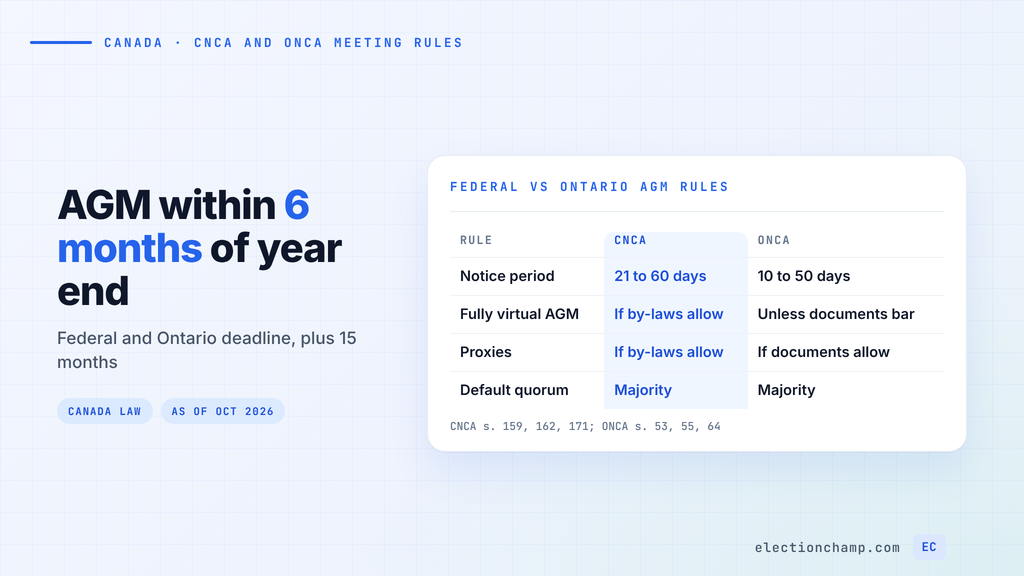
Section 160 of the CNCA and the Regulations set the calendar. The first annual meeting must be held within 18 months of incorporation. After that, each AGM must be held within 15 months of the last one and within 6 months of the end of the preceding financial year. Corporations Canada repeats this on its guidance page on members.
Notice periods depend on the method your by-laws choose, under section 162 and the Regulations:
- Mail, courier, or personal delivery: 21 to 60 days before the meeting.
- Email or another electronic method: 21 to 35 days before the meeting.
- Notice board: posted at least 30 days before the meeting.
- Publication (more than 250 members): once in each of the three weeks before the meeting.
If your by-laws allow electronic notice, Corporations Canada says they must also offer a non-electronic alternative. If the by-laws name no valid method, notice goes by mail or personal delivery, 21 to 60 days out.
Electronic Meetings and Electronic Voting
Under section 159(4), anyone entitled to attend may take part by phone or online, unless the by-laws say otherwise. They count as present. A meeting held entirely online is different. Section 159(5) allows it only if the by-laws provide for it.
Voting at the meeting is by show of hands unless a member demands a ballot (section 165). Unless the by-laws say otherwise, a vote may also be held entirely by electronic means, and people attending electronically may vote that way (sections 165(3) and 165(4)).
Absentee Voting: Proxy, Mail-in, or Online
Absentee voting means voting without attending. Section 171(1) lets the by-laws provide for any prescribed method, and the Regulations prescribe three:
- Voting by proxy.
- Voting by mailed-in ballot.
- Voting by telephone, electronic, or other communication facility.
If your by-laws are silent, absentee voting is not permitted, according to Corporations Canada’s default rules. When the by-laws do allow it, they must also set out procedures for collecting, counting, and reporting the results.
The Regulations add a standard for mail-in and electronic absentee votes. The system must gather votes in a way that permits later verification. It must also present the tallied votes to the corporation without the corporation being able to tell how each member voted.
Proxy rules in the Regulations are specific. A proxyholder does not need to be a member. A proxy is valid only for the meeting it was given for, or that meeting after an adjournment. A form prepared by anyone other than the member must name the meeting in bold type, state the member’s right to appoint a different proxyholder, and include a blank for the date of signature.
ONCA Rules for Virtual Meetings and Voting
AGM Timing and Notice
Ontario directors must hold an AGM at least once every 15 months and within 6 months of the end of the last fiscal year, as CLEO’s Nonprofit Law Ontario guide summarizes it. Notice goes out at least 10 and no more than 50 days before the meeting (section 55). Financial statements, or a summary, go to members at least 5 business days before the AGM.
Virtual and Hybrid Meetings Since October 2023
Ontario’s Bill 91, the Less Red Tape, Stronger Economy Act, 2023, amended the ONCA effective October 1, 2023. Members’ meetings may now be held entirely by phone or electronic means, or as a hybrid, unless the articles or by-laws limit this (section 53). The meeting must let everyone entitled to attend participate reasonably.
For an electronic meeting, the notice does not need a physical place. It must include instructions for attending and participating (section 55). Unless the articles or by-laws expressly provide otherwise, a members’ vote may be held entirely by electronic means or as a mix of electronic and in-person voting (section 58).
Proxies and Quorum Under ONCA
A member may appoint a proxyholder only if the articles or by-laws allow proxy voting (section 64), per CLEO’s voting and quorum page. The proxyholder can be a non-member unless your documents require a member. If the articles and by-laws set no quorum, a majority of members entitled to vote is the quorum (section 57).
For mailed-in ballots outside a meeting, we did not find a clear ONCA default in the sources we checked. Check your articles, by-laws, and counsel before using one.
CNCA vs ONCA: Side-by-Side Comparison
| Rule | CNCA (federal) | ONCA (Ontario) |
|---|---|---|
| Later AGMs | Within 15 months of the last AGM and 6 months of year end (s. 160) | Every 15 months and within 6 months of year end |
| Notice period | 21 to 60 days by mail; 21 to 35 days electronic (s. 162) | 10 to 50 days (s. 55) |
| Joining electronically | Allowed unless by-laws say otherwise (s. 159(4)) | Allowed unless articles or by-laws limit it (s. 53) |
| Fully virtual AGM | Only if by-laws provide for it (s. 159(5)) | Allowed unless articles or by-laws limit it (s. 53) |
| Electronic vote at the meeting | Allowed unless by-laws say otherwise (s. 165) | Allowed unless articles or by-laws expressly say otherwise (s. 58) |
| Absentee voting | Only methods named in by-laws: proxy, mail-in, electronic (s. 171) | Proxies only if articles or by-laws allow (s. 64) |
| Proxyholder must be a member | No (Regulations) | No, unless your documents require it (s. 64) |
| Default quorum | Majority of members entitled to vote (s. 164) | Majority of members entitled to vote (s. 57) |
| Special resolution | Two thirds of votes cast | Two thirds of votes cast |
The biggest practical gap is the fully virtual AGM. A federal nonprofit needs a by-law that allows it. An Ontario nonprofit has it by default unless its documents say no.
What Your By-laws Must Say Before You Vote Online
Read your by-laws for each of these points before you announce an online vote:
- Whether a meeting may be held entirely online (CNCA requires a clause; ONCA allows it unless limited).
- Which absentee methods members may use, if any (CNCA requires the by-law to name them).
- The procedure for collecting, counting, and reporting absentee votes (CNCA).
- Whether proxies are allowed and whether a proxyholder must be a member.
- How notice is given, including a non-electronic option if email is the main method (CNCA).
- Quorum, if it differs from the default majority.
Changing some of these clauses takes more than a board vote. Corporations Canada’s model by-law notes that, under section 197(1), changing the manner of giving notice or the method of absentee voting requires a special resolution of the members. Plan that vote at least one meeting before the AGM where you want to use the new method.
If you are adding online voting to an existing meeting format, our guide to adding online voting to your AGM covers the meeting logistics.
Member Votes, Director Votes, and Special Resolutions
Members and directors vote on different things. Members typically elect directors, appoint the public accountant, and approve fundamental changes. Directors make board decisions at board meetings. Your by-laws decide the details, such as how many seats are open and how candidates are nominated.
Under both acts, an ordinary resolution passes with a majority of the votes cast. A special resolution needs two thirds of the votes cast, according to Corporations Canada. CNCA fundamental changes, such as amalgamation or continuance, need a special resolution. Your articles can set a higher threshold.
Board meetings follow separate rules. Under the ONCA, directors cannot appoint a proxyholder for board meetings (section 23, per CLEO). An ONCA electronic board meeting must let all attendees communicate simultaneously and instantaneously (section 34, per Bill 91). Keep member votes and board votes as separate ballots so the record is clean. Our guide to board elections shows how to set up director races.
How to Run a Compliant Online AGM Vote
- Confirm your act and pull the current by-laws and articles.
- Check the by-law clauses listed above. If a clause is missing, schedule a special resolution first.
- Set the AGM date inside both deadlines: 15 months from the last AGM and 6 months from year end.
- Fix the record date and build the voter list of members entitled to vote.
- Send notice inside your act’s window (21 to 60 days by mail or 21 to 35 days electronic under the CNCA; 10 to 50 days under the ONCA), with joining and voting instructions.
- Run each motion and election as its own ballot question, and record quorum at the opening.
- Report results to members and keep the records with your minutes.
For the CNCA’s anonymity standard, pick a tool where the organizer can see who voted but never how. ElectionChamp ballots work that way. Each member gets a single-use 16-character voter key, administrators cannot see individual choices, and a timestamped audit log records every administrative action. That fits the shape of the Regulations’ verification and anonymity tests, but confirm with your by-laws and counsel that it fits your procedures. Our page on nonprofit online voting explains the setup, and the guide to reaching quorum faster helps with turnout. ElectionChamp pricing is per election: free up to 20 voters, US$10 up to 200, then US$0.05 per voter.
Frequently Asked Questions
Can a nonprofit in Canada hold its AGM online?
Yes, with conditions. A federal CNCA corporation can hold a fully online meeting only if its by-laws provide for it (section 159(5)). An Ontario ONCA corporation can hold a fully online or hybrid meeting unless its articles or by-laws limit it (section 53). Other provinces follow their own acts.
Is electronic voting allowed under the CNCA?
Yes. Unless the by-laws say otherwise, a vote at a members’ meeting may be held entirely by electronic means (section 165). Voting electronically without attending is absentee voting, which needs a by-law clause under section 171 and a system that keeps each member’s vote anonymous and verifiable.
What are the absentee voting methods under the CNCA?
The Regulations prescribe three: proxy, mailed-in ballot, and voting by telephone or electronic communication facility. Your by-laws must name the methods you use and set procedures for collecting, counting, and reporting results. Changing the method requires a special resolution.
When must a Canadian nonprofit hold its AGM?
Under both the CNCA and the ONCA, within 15 months of the previous AGM and within 6 months of the end of the last financial year. A new CNCA corporation must hold its first annual meeting within 18 months of incorporation.
Planning your next vote? Read about nonprofit online voting and board elections, or see pricing: free up to 20 voters, US$10 up to 200, then US$0.05 per voter.