ElectionChamp

Short answer: To run a youth sports league board election, start with your bylaws: the annual meeting date, notice period, quorum, and who counts as a voting member. Build the voter list from registration, usually one vote per family. Take nominations a few weeks ahead and confirm each nominee will serve. Vote at the annual meeting, online, or both. Then record the result and hand over records, accounts, and bank signers.
Little League, soccer clubs, and minor hockey associations are run by parent volunteers who turn over every few seasons. This guide is for the parent running this year’s election.
Youth Sports League Board Roles and Terms
Board structure depends on your league’s charter. Little League’s help center says the membership elects the board each year, and the new board then elects officers from among its members. The required officers are president, vice president, treasurer, secretary, player agent, safety officer, and coaching coordinator.
Its guide to local board roles requires at least one manager and one volunteer umpire on the board. At least 25% of the board must be people who are not current managers or coaches. Its election article sets the minimum board size at seven.
Soccer clubs and hockey associations more often elect people directly into named offices, often on two-year staggered terms. The St. Albert Minor Hockey Association elects its president in even years and its secretary in odd years (Section 2.13), so the whole board never turns over at once.
Youth Sports Bylaws Voting Rules to Check First
Read your bylaws or constitution before you announce anything. Write down the answers to these questions:
- The annual meeting date and the notice period.
- Who votes, and how many votes a family with several players gets.
- The quorum for the annual meeting.
- Nomination deadlines, and whether floor nominations are allowed.
- Whether voting can happen online or by absentee ballot.
- Whether winners need a majority of votes cast or just the most votes.
Four published sets of bylaws show how much the answers vary:
| League bylaws | Who votes | Notice | Quorum |
|---|---|---|---|
| Little League sample constitution | One parent per player (two max), plus coaches and volunteers | 10 calendar days | 20% of regular members or 40, whichever is less |
| Lynnfield Youth Soccer Club | Board, volunteer coaches, and one parent per family | 2 weeks | 25 voting members |
| St. Albert Minor Hockey Association | Adults 18 and over, one vote per family | 21 days | 25 voting members |
| Medicine Hat Minor Hockey Association | One vote per athlete, cast by a parent | 21 days | 15 people, including the chair |
Online voting rules differ most. Little League’s sample constitution allows electronic membership meetings and absentee ballots for board elections (Article VII, Sections 1 and 5). For a soccer club board vote, the Park Ridge Soccer Club bylaws allow a paper, online, or email ballot (Section V.c.ii). St. Albert requires a written ballot handed out at the meeting (Section 2.15). If yours are silent or require paper, amend them first as one of your bylaw and policy votes. Confirm with your bylaws and counsel when a result could be disputed.
Who Can Vote: Registered Families and One Vote per Family
Most youth leagues give the vote to families of registered players, plus volunteers. Bylaws treat families with several players in one of three ways:
- One vote per family: Lynnfield and St. Albert cap every household at one vote.
- One vote per player, capped: Little League gives one membership per registered player, up to two per parent.
- One vote per player: Medicine Hat gives each athlete member a vote, so two players means two votes.
Build the voter list from your registration export. Remove duplicate households, pick one email per family, and add qualifying volunteers. Put a registration cutoff date in the election notice, and have a second board member check the list before you send anything.
If your bylaws give one vote per player, you can keep one ballot per family and weight it. In ElectionChamp, add a weight column to the voter list, so a family with two registered players carries a weight of 2. Results then show weighted totals.
When to Hold the AGM: A Youth Sports Election Timeline
Timing follows your season. Little League calls the board election the first official act of the new season. Lynnfield holds its annual meeting in June, and Park Ridge votes in November with terms starting January 1.
Work backward from the meeting date, and let your bylaw deadlines override this:
| When | Task | Owner |
|---|---|---|
| 8 weeks before | Confirm open seats, bylaw rules, and the voting method | President and secretary |
| 6 weeks before | Appoint a nominating committee and call for nominations | Board |
| 4 weeks before | Set the voter list cutoff and check it against registration | Secretary and registrar |
| 3 weeks before | Send the formal meeting notice with the agenda | Secretary |
| 2 weeks before | Close nominations and post candidate statements | Nominating committee |
| Meeting day | Confirm quorum, hold the vote, announce and record results | President and election committee |
Nominations and Conflicts of Interest
Running Nominations
Little League’s process starts with a nominating committee that presents interested candidates, then opens nominations to the floor. Any member in good standing can be nominated. Lynnfield wants written nominations four weeks out, and St. Albert 10 days out. Some hockey bylaws limit floor nominations: Medicine Hat accepts them only for a seat with no nominee (Section 5.3).
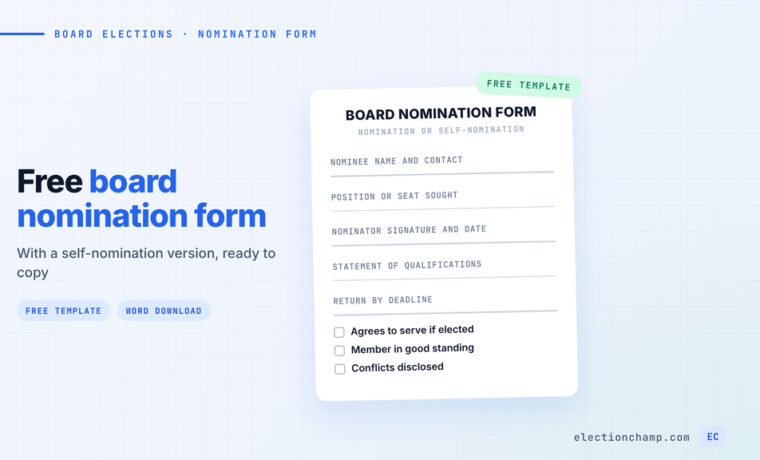
Ask every nominee to confirm in writing that they will serve, and collect a short candidate statement. ElectionChamp has no write-in line on election questions, and the ballot locks at launch. If your bylaws allow floor nominations, take them before voting opens. A nomination question lets remote members put names forward too. Then list every nominee on the ballot. Our nominating committee guide covers this step in depth.
Handling Conflicts of Interest
On a parent board, conflicts are normal. A player agent’s child goes through tryouts, or a coach votes on field time for their own team. Disclosure and recusal handle most of it.
- Little League bars a relative of the president or treasurer from disbursing funds without majority board approval (Article IX, Section 5).
- Lynnfield requires board members with an interest to state it and abstain from the vote (Appendix B).
- Park Ridge has every board member complete a conflict of interest disclosure statement (Section XI.a).
If your league has no policy, the IRS publishes a sample conflict of interest policy in Appendix A of its Form 1023 instructions. Adopt one, collect signed disclosures right after the election, and keep candidates off the committee that runs the vote.
How to Run the Board Vote Online
Online voting reaches families who cannot get to a weeknight meeting. When your bylaws allow it, use this sequence:
- Create one ballot question per office. For at-large seats, use one question with “select up to” set to the number of open seats.
- Add candidate photos and statements, and turn on random candidate order.
- Import the family voter list, with a weight column if your bylaws give one vote per player.
- Open voting a few days before the meeting and close it there, so in-person families can vote with printed keys.
Check your majority rule first. Little League’s election article says nominees need 50 percent of the vote plus 1. Its sample constitution elects the candidates with the most votes when candidates outnumber seats (Article VII, Section 6). Follow your own constitution.
With association voting software like ElectionChamp, each family gets a single-use voter key by email or text. Ballots are anonymous: admins can see who has voted, but never how. Results are instant at close. A league with 180 families pays $10 for the election, and one with 350 families pays $17.50.
Board Transition After the Election
In Little League, the new board meets after the election to elect officers. Then work through the handover:
- Record the results and the new officers in the minutes.
- Update bank signers. Little League has the treasurer sign checks co-signed by another officer.
- Transfer admin access to registration, website, email, and social accounts, plus insurance and field permit files.
- Run background checks on new board members. The Little League sample constitution includes this requirement (Article III, Section 2(d)).
- Update your league’s officer contacts with the national or district body.
Give outgoing officers this checklist and a deadline. For other league votes, see our guide to sports league and club elections online.
Frequently Asked Questions
How do Little League board elections work?
Members in good standing elect the board at the annual meeting, and the new board then elects officers from among its members. Little League requires at least seven board members, including a player agent, safety officer, and coaching coordinator.
Who can vote in a youth sports league board election?
Your bylaws decide. Most leagues give the vote to parents or guardians of registered players, plus volunteers such as coaches. Many limit each family to one vote, while others give one vote per registered player.
Can a youth sports league hold its board election online?
Yes, if your bylaws allow it. The Little League sample constitution allows electronic meetings and absentee ballots for board elections. Some bylaws require a written ballot at the meeting, so amend them first. Confirm with your bylaws and counsel.
Can coaches serve on a youth sports league board?
Usually yes. Little League requires at least one manager on the board, and at least 25% of the board must not be current managers or coaches. Coaches should disclose conflicts and abstain on votes about their own teams.
Planning your next vote? Read about association voting software and bylaw and policy votes, or see pricing: free up to 20 voters, $10 up to 200, then $0.05 per voter.