ElectionChamp
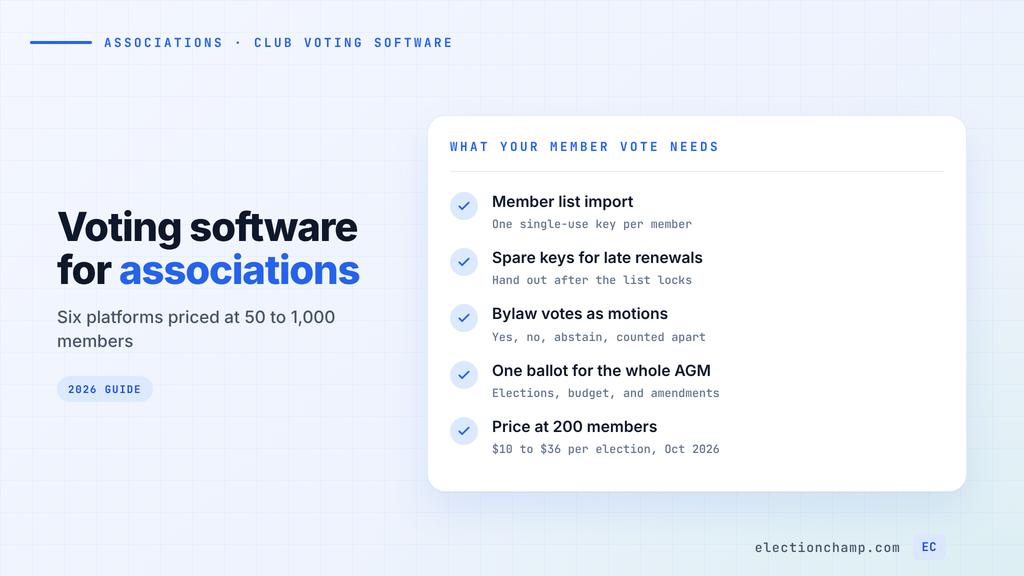
Short answer: The best voting software for associations gives each member a single-use ballot key, keeps ballots anonymous, and puts officer races, bylaw changes, and AGM motions on one ballot. It should also stay affordable from 50 to 1,000 members. As of October 2026, published prices at 200 members run from $10 to $36 per election. ElectionChamp costs $10 up to 200 voters, then $0.05 per voter, with every feature included.
This guide is for professional associations, alumni groups, social and sports clubs, and community associations. It compares six platforms: ElectionChamp (ours), ElectionBuddy, OpaVote, Simply Voting, Election Runner, and eBallot. Every price comes from the vendor’s public pricing page, checked October 3, 2026 (OpaVote re-checked November 19, 2026), and we name where competitors are stronger.
What Associations and Clubs Need From Voting Software
Association and club votes have a few habits that generic poll tools handle badly. Members renew on a cycle, bylaws set who is eligible, and the annual meeting often bundles an election with several motions. Check these requirements before you compare prices.
| Requirement | Why it matters | What to check in the software |
|---|---|---|
| Member list import | Only members in good standing should get a ballot | CSV import with one unique key per member, and email or SMS delivery |
| Renewal cutoff | Members who renew after the record date still expect to vote, if your bylaws allow it | Spare keys you can hand out after launch, and a clear rule on when the list locks |
| Bylaw and policy votes | Amendments often need a two-thirds or other supermajority, set by your bylaws | Yes/no/abstain motions with abstentions reported separately |
| AGM motions | Annual meetings mix elections, budget approval, and resolutions | Different voting methods for different questions on one ballot |
| Member classes | Some associations give certain classes more votes, or vote by chapter | Weighted voting, and whether it costs extra |
| Anonymity and records | A close or contested result needs a defensible record | Admins see who voted but never how; timestamped log of admin actions |
Many older bylaws say nothing about online voting, or they require ballots cast at a meeting. Some need an amendment first. Confirm with your bylaws and counsel before you pick a tool. Our guide to professional association election best practices covers nominations, notice, and governance in more depth.
Voting Software for Associations Compared
Here is how the six platforms differ on free tiers, billing, and genuine strengths. Details are from each vendor’s site as of October 2026.
| Platform | Free tier | Pricing model | Stands out for |
|---|---|---|---|
| ElectionChamp | Up to 20 voters, all features | Pay per election, no subscription | Every feature on every plan, including weighted voting, SMS, and motions |
| ElectionBuddy | Up to 20 voters | Per election, four tiers; meeting votes priced separately | Long track record, mailed and printed ballots, proxy transfers on Premium, API and phone support on Professional |
| OpaVote | Up to 25 voters | $10 per 80 voters ($10 per 100 after 2,000) | Ranked methods (IRV, STV, Condorcet) and counting ballots collected elsewhere |
| Simply Voting | Up to 10 voters | Online calculator; annual plans save 15% or more | SOC 2 Type I; telephone voting and voter segmentation as paid extras |
| Election Runner | Up to 20 voters | Per election, published tiers up to 300 voters | Simple flat tiers for small groups, education discounts |
| eBallot | None | Monthly subscription with a minimum term, or annual Business license | Managed and self-service options |
Sources: ElectionBuddy pricing, OpaVote pricing, Simply Voting pricing, Simply Voting SOC 2 page, Election Runner pricing, eBallot pricing, and ElectionChamp pricing.
How Much Does Association Election Software Cost?
For a club or association with 50 to 1,000 members, published self-service prices run from $10 to $99 per election as of October 2026. Larger lists, mailed ballots, and managed elections are usually quoted. The table shows published prices at three common member counts.
| Platform | 50 members | 200 members | 1,000 members |
|---|---|---|---|
| ElectionChamp | $10 | $10 | $50 |
| ElectionBuddy | $29 (Plus) | $29 (Plus) | $99 (Premium) |
| OpaVote | $10 | $30 | $130 |
| Election Runner | $19 | $36 | Custom quote |
| Simply Voting | Calculator only | Calculator only | Calculator only |
| eBallot | $6.99 a month, 6-month minimum | Not published | Business from $2,500 a year |
The details behind each number:
- ElectionChamp prices on total capacity, meaning voters plus any spare keys. Setup and testing are free, and you pay by card at launch.
- ElectionBuddy bills on the size of your voter list, whatever the turnout. SMS is a $29 add-on on Plus and included on Premium. Its separate meeting-vote product is free up to 20 voters and 5 motions, then $197 for up to 75 voters.
- OpaVote charges $10 per 80 voters, with no per-candidate charge, as of November 2026. Data is kept 12 weeks free, then $40 a year.
- Election Runner is free up to 20 voters, $19 up to 100, and $36 up to 300. Above 300 you request a custom price.
- Simply Voting shows an estimate after you enter your voter count. Weighted votes, online nominations, and voter segmentation cost extra.
- eBallot Essential Pro covers up to 50 voters, so the 6-month minimum comes to $41.94. eBallot for Business is $2,500 a year and varies by vote.
Price a full year, because most associations vote more than once. A 200-member club with an AGM election and one bylaw vote pays $20 a year on ElectionChamp, $58 on ElectionBuddy, $60 on OpaVote, and $72 on Election Runner at published prices. Our online voting pricing guide covers more sizes.
Best Club Voting Software and Association Platforms: Reviews
ElectionChamp
We built ElectionChamp for groups that run a few governance votes a year and want no subscription. It is free up to 20 voters, $10 flat up to 200, then $0.05 per voter. Weighted voting, SMS, and every other feature come on every plan. For multi-seat STV, you export ranked results to our free STV Excel calculator.
For associations, the useful parts are single-use 16-character voter keys and anonymous ballots that admins cannot trace. One ballot can hold an officer race with candidate photos and bios, a bylaw amendment as a yes/no/abstain motion, and a ranked or approval question. Spare keys cover late renewals. Printed keys let members vote at the AGM with a phone, and the dashboard tracks online and in-person votes together. Results are instant at close and download as CSV.
The trade-offs: we hold no SOC 2 or ISO certification; security rests on AES-256 encryption at rest and SSL/TLS in transit. Our ranked choice method is a Borda count variant, so check it against your bylaws if they name instant runoff. Free elections get 1 reminder and paid elections get up to 5. Our page on association voting software shows common setups.
ElectionBuddy
ElectionBuddy has a long track record and the widest service range here. Premium ($99, up to 1,000 voters) adds SMS, two-factor authentication, voting groups, and proxy transfers. Professional (from $299) adds mailed and printed ballots, postcard notices, API access, and phone support.
Weighted voting starts on Plus ($29, up to 350 voters), and results on the free plan stay accessible for 30 days. It fits associations that need mailed ballots or proxy transfers from one vendor.
OpaVote
OpaVote is strong on ranked methods, including instant runoff, STV, and Condorcet. Its Counts feature tallies ballots collected elsewhere, which helps when some members voted on paper. The free tier covers 25 voters per election, so a very small club can run a vote at no cost. It fits best when your bylaws name a specific ranked method.
Simply Voting
Simply Voting states on its site that it is SOC 2 Type I certified. That matters if a larger association has a procurement review that asks for a SOC 2 report. Telephone voting helps members who will not vote online. Prices appear only through the calculator, and weighted votes and online nominations cost extra.
Election Runner
Election Runner has simple flat tiers and is popular with schools. For a club under 300 members, the published price is easy to budget. Above 300 you need a quote, so it suits smaller groups best.
eBallot
eBallot offers managed and self-service elections, which suits an association that wants a vendor to run the vote. It has no free tier. The subscription minimums fit groups that vote often better than a club with one annual election.
Running AGM Motions and Bylaw Votes Online
The annual meeting is where association voting gets complicated. A typical AGM ballot holds a board election, approval of last year’s minutes, the budget, and one or two bylaw amendments. Look for software that handles all of it in one ballot, so members get one link and one key.
- Set the record date. Pull your member list on the cutoff date in your bylaws. Remove lapsed members and add a few spare keys if late renewals may vote.
- Match each question to its method. Officer seats use plurality or ranked choice. Amendments and budgets use yes/no/abstain motions. Committee slates with several seats can use STV.
- Write the threshold into the instructions. If an amendment needs two-thirds of votes cast, say so on the ballot. Software counts votes; your bylaws decide whether a motion passes.
- Plan for the room. Members at the meeting can vote with printed keys on their phones, so in-person and remote votes land in the same count.
Our page on bylaw and policy votes shows how to set up amendment ballots. For meeting logistics, see adding online voting to your AGM.
How to Choose a Member Voting Platform
Work through these steps with your secretary or election committee:
- Read your bylaws. Note eligibility, the record date, notice period, quorum, voting method, and any supermajority rules.
- Count eligible members. Use your renewal records, then add spare keys for latecomers.
- Price a full year. Multiply the per-election price by every vote you expect, including bylaw changes and special votes.
- Check special needs. Mailed ballots or proxy transfers point to ElectionBuddy. A required IRV count points to OpaVote. A mandatory SOC 2 report points to Simply Voting.
- Run a test. Send a ballot to two or three board members first. ElectionChamp setup and testing are free.
Frequently Asked Questions
What is the best voting software for a small club?
For a club under 200 members, look for per-election pricing with no subscription. As of October 2026, published prices at 50 members are $10 on ElectionChamp and OpaVote, $19 on Election Runner, and $29 on ElectionBuddy. Clubs of 20 or fewer can vote free on several platforms.
Can an association hold its AGM votes online?
Often yes, but it depends on your bylaws and the law where you are incorporated. Some bylaws require votes cast at a meeting and need an amendment first. Confirm with your bylaws and counsel before you send ballots.
How do you handle members who renew after the voter list is set?
Set a record date in line with your bylaws and import the list as of that date. If late renewals may vote, add spare keys before launch and hand them out as members renew. On ElectionChamp, spare keys count toward capacity.
Is online association voting anonymous?
It is on platforms that separate ballots from voter identities. On ElectionChamp, admins can see whether a member voted but never what they chose, and no setting overrides that. Ask any vendor the same question before you buy.
Planning your next vote? Read about association voting software and bylaw and policy votes, or see pricing: free up to 20 voters, $10 up to 200, then $0.05 per voter.