ElectionChamp
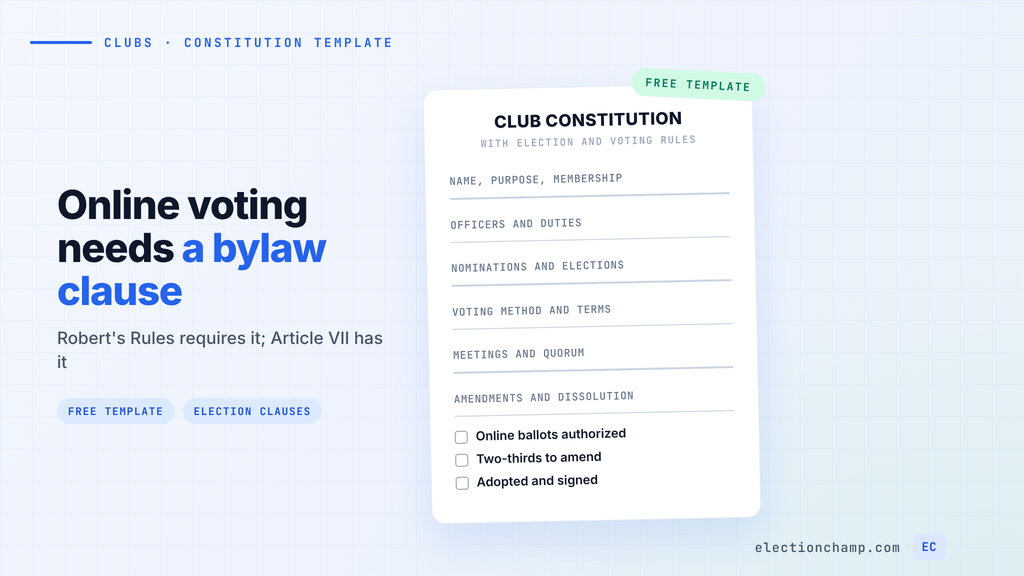
Short answer: A club constitution template covers your club’s name, purpose, membership, dues, officers and their duties, nominations, elections and voting method, terms, vacancies, removal, meetings and quorum, committees, finances, amendments, and dissolution. Copy the free template below. Its election article authorizes online secret ballots, which Robert’s Rules permits only when your bylaws say so.
It combines constitution and bylaws in one document. For the voting side, see our page on club and association voting.
Free Club Constitution Template
Fill each blank, pick one bracketed option, and delete what you don’t need.
Download: Club Constitution Template With Election Rules (Word .docx)
Constitution of ________ (the “Club”)
Adopted: ________ Last amended: ________
Article I. Name
The name of this organization is ________.
Article II. Purpose
The purpose of the Club is to ________. [Student clubs: The Club is a registered student organization at ________ and follows its policies.]
Article III. Membership
1. Membership is open to any person who ________ [supports the Club’s purpose / is an enrolled student at ________]. The Club does not discriminate on the basis of ________.
2. Each member with current dues is in good standing and has one vote.
3. Members may resign in writing. The Executive Committee may expel a member for ________ after written notice and a chance to respond, subject to appeal at the next general meeting.
Article IV. Dues
Annual dues are set by [the members / the Executive Committee] and are due by ________. Members ____ days overdue lose good standing.
Article V. Officers and Duties
1. The officers are President, Vice President, Secretary, and Treasurer. Together they form the Executive Committee, which manages the Club between general meetings.
2. President: chairs meetings and speaks for the Club. Vice President: acts when the President is absent. Secretary: keeps minutes, the membership roll, and notices. Treasurer: manages funds and reports at each general meeting.
3. Officers must be members in good standing for ____ months and may hold one office at a time.
Article VI. Nominations
1. At least ____ days before the election, the Secretary announces the open offices and the nomination deadline.
2. Any member in good standing may nominate an eligible member, including themselves, by ________ [form / email to the Secretary]. Nominees must accept in writing by the deadline.
3. [Optional: A Nominating Committee of ____ members proposes at least one candidate per office.] Write-in votes [are / are not] permitted.
Article VII. Elections and Voting Method
1. Officers are elected each year by secret ballot. Ballots may be cast in person, on paper, or through an online voting system that confirms eligibility, accepts one ballot per member, and keeps each vote secret.
2. Voting stays open for at least ____ days.
3. Voting method [choose one]: [ ] Plurality: the candidate with the most votes wins. [ ] Majority: a candidate needs more than half the votes cast; if no one has a majority, a runoff between the top two is held within ____ days.
4. A tie is decided by [a runoff / drawing lots]. A sole nominee for an office is [elected by acclamation / listed on the ballot].
5. An Election Officer who is not a candidate oversees the vote, certifies the results, and announces them within ____ days. Election records are kept for ____ months.
Article VIII. Terms of Office
Officers serve ____-year terms beginning ________, or until their successors are elected. No officer may serve more than ____ consecutive terms in one office.
Article IX. Vacancies
The Vice President fills a vacancy as President. The Executive Committee fills other vacancies for the rest of the term [by appointment / by special election within ____ days].
Article X. Removal
An officer may be removed for ________ by a two-thirds vote of members voting, at a meeting or by ballot. The officer receives written notice ____ days before the vote and may respond.
Article XI. Meetings and Quorum
1. The annual meeting is held in ________ to elect officers and receive reports. General meetings are held ________.
2. The President, the Executive Committee, or ____ members in writing may call a special meeting. Notice goes to all members at least ____ days ahead by ________.
3. Meetings may be in person, by video, or both. Members on video who can hear and be heard count as present.
4. Quorum for general meetings is ____ [number / percent] of members in good standing. A ballot vote is valid if [any number / at least ____ percent] of members vote.
Article XII. Committees
The Executive Committee may create committees, which report to it and may not spend funds without its approval.
Article XIII. Finances
The fiscal year runs from ________ to ________. Funds are held in an account in the Club’s name. Spending over $____ needs the approval of ________. The Treasurer presents a financial report at the annual meeting.
Article XIV. Parliamentary Authority
Robert’s Rules of Order Newly Revised governs where it does not conflict with this constitution.
Article XV. Amendments
Amendments need a two-thirds vote of members voting, at a meeting or by ballot (including online). The full text must reach all members at least ____ days before the vote.
Article XVI. Dissolution
The Club may be dissolved by a two-thirds vote of members voting, after ____ days’ notice. After debts are paid, remaining assets go to ________.
Adopted on ________. President: ________ Secretary: ________
Constitution vs Bylaws: What Is the Difference?
A constitution holds the short, rarely changed framework. Bylaws hold the working procedures. The University of New Mexico Student Activities Center says a constitution normally needs a two-thirds vote to amend, while bylaws often need a simple majority.
Under Robert’s Rules, bylaws change only with previous notice and a large majority, commonly two-thirds, according to parliamentarian C. Alan Jennings. A club bylaws template follows the same outline with more procedural detail.
| Document | What it holds | Usual vote to change |
|---|---|---|
| Constitution | Name, purpose, membership, officers, meetings, quorum, amendments | Two-thirds, with notice |
| Bylaws | Dues, officer duties, committees, election procedures | Simple majority in many student groups; two-thirds with notice under Robert’s Rules |
| Combined document (this template) | All of the above | Two-thirds, with notice (Article XV) |
Election Clauses That Allow Online Voting
Four clauses in the template do the work.
- Authorize online ballots in writing. Robert’s Rules requires specific bylaw authorization for email or internet voting, per Jennings’s guide to absentee and online voting. Article VII.1 provides it.
- Pick plurality or majority. Robert’s Rules decides elections by majority unless your bylaws say otherwise, and balloting continues until someone has one (Robert’s Rules for conducting elections). With three candidates, that can force a second round, which plurality avoids.
- Keep “or until their successors are elected.” If the election slips, current officers keep serving and no office sits empty.
- Set a ballot threshold. An online ballot stays open for days, so Article XI.4 sets its own participation minimum, separate from meeting quorum.
How to Adopt a Constitution for a Club
- Draft it: a small group fills in the template and settles each bracketed option.
- Circulate it: send the draft to prospective members ahead of the meeting so edits arrive early.
- Adopt it: at the organizing meeting, take each article in turn, vote on changes, then vote to adopt the whole document.
- Enroll members: from the moment the document is adopted, only enrolled members can vote, per Jennings’s charter meeting guide. Members sign a form agreeing to follow the rules and pay dues.
- Sign and file it: the new President and Secretary sign and date it for the club’s records.
Student Club Constitution Requirements
Student unions often set required clauses. UNM’s guide lists an advisor article and an anti-discrimination statement from its charter form, and requires the latest revision date at the top of the first page.
How to Run Your Club’s First Election
- Freeze the voter list: members in good standing on a set cutoff date.
- Run nominations for the period in Article VI and collect written acceptances.
- Build one ballot question per office, using the Article VII method.
- Open voting for the full window and send a reminder.
- Have the Election Officer certify the result and record it in the minutes.
For online ballots, ElectionChamp sends each member a single-use 16-character voter key by email, SMS, or printed key. Administrators see who voted but never how. Results appear when voting closes, with a CSV for your records. It is free up to 20 voters and $10 for 21 to 200. See our officer elections page and five-step setup guide.
Frequently Asked Questions
What should a club constitution include?
Name, purpose, membership, dues, officers, nominations, elections, terms, vacancies, removal, meetings and quorum, committees, finances, amendments, and dissolution. Student clubs usually add an advisor article.
Is a club constitution the same as bylaws?
No. A constitution holds the framework and is harder to change. Bylaws hold detailed procedures. Many small clubs combine both in one document.
Can a club hold elections online?
Yes, when its governing documents allow it. Under Robert’s Rules, email or internet voting needs specific authorization in the bylaws, so add an online ballot clause first and confirm with your bylaws and counsel.
How do you amend a club constitution?
Follow its amendment article. A common rule is written notice of the exact wording to all members, then a two-thirds vote of members voting.
Planning your next vote? Read about club and association voting and officer elections, or see pricing: free up to 20 voters, $10 up to 200, then $0.05 per voter.