ElectionChamp
One Union, Many Locations
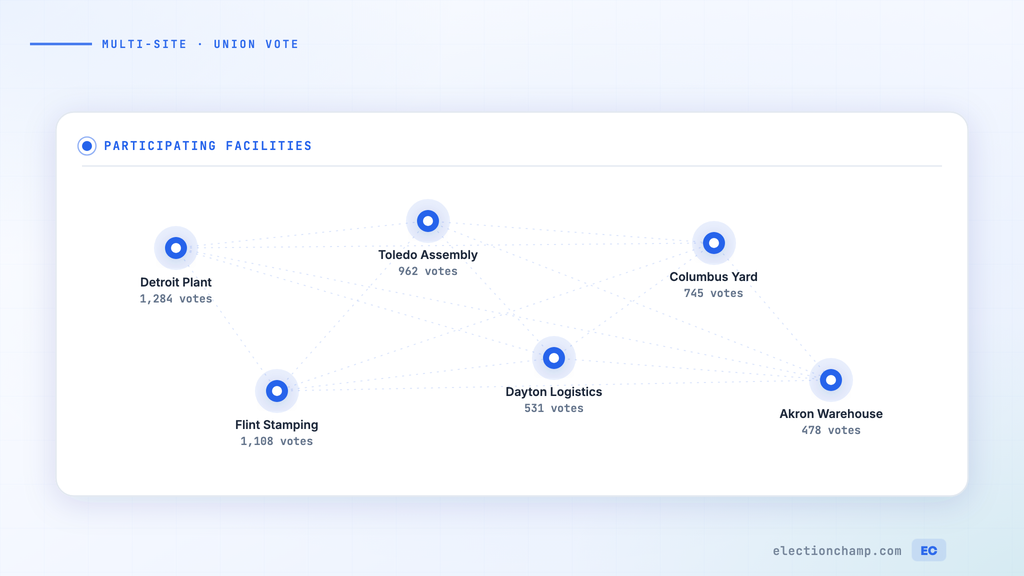
Many unions represent members across multiple worksites, cities, states, or even countries. A single SEIU local might cover healthcare workers at a dozen hospitals. An IBEW local might have members on construction sites scattered across a metropolitan area. A national union runs elections across every state.
Multi-location elections introduce logistical challenges that paper-based voting simply can’t handle. Online voting eliminates geography as a barrier, giving every member equal access regardless of where they work.
Key Challenges and Solutions
|
Challenge |
Paper Ballot Reality |
Online Voting Solution |
|
Geographic distance |
Multiple polling locations or expensive mail campaigns |
One ballot link works from any location |
|
Different time zones |
Confusion about when polls open/close |
Set one timezone; system converts for each voter’s location |
|
Shift coverage |
Voters must leave work to reach polling site |
Vote from any device, any time during the window |
|
Language diversity |
Print ballots in multiple languages |
Provide multilingual voter instructions in the ballot setup |
|
Consistent process |
Different sites may handle ballots differently |
One centralized system ensures identical experience everywhere |
|
Result consolidation |
Collecting and combining results from multiple sites |
All votes in one dashboard; results calculated instantly |
Unified vs. Location-Based Ballots
The first decision is whether all locations vote on the same ballot or each has a distinct ballot:
Unified Ballot (One Election for All)
- All members vote for the same positions (President, VP, Secretary-Treasurer, etc.)
- One election setup in ElectionChamp with one voter list containing all members
- Simplest to administer and produces a single set of results
- Best for: Local union officer elections, contract ratifications, strike authorization votes
Location-Based Ballots (Separate Elections by Site)
- Each location has its own ballot with location-specific positions (site reps, stewards)
- Create a separate election in ElectionChamp for each location
- Members only see candidates relevant to their worksite
- Best for: Steward elections, site committee elections, location-specific policy votes
Hybrid Approach
- One election with both union-wide questions and location-specific questions is possible by including all questions on one ballot
- Alternatively, run one union-wide election plus separate site-specific elections
- Use Voter Labels to tag members by location for post-election analysis
Time Zone Management
When members span multiple time zones, clear communication prevents confusion:
- Set the election timezone to your union headquarters’ timezone
- In all communications, state the closing time in multiple zones: “Voting closes at 5:00 PM Eastern / 4:00 PM Central / 3:00 PM Mountain / 2:00 PM Pacific”
- ElectionChamp automatically adjusts the displayed time based on the voter’s device — but reinforcing it in your communications prevents any ambiguity
- Set a generous voting window (10-14 days) so timezone differences become irrelevant — everyone has ample time
Language and Communication Considerations
Multi-location unions often have linguistically diverse membership:
- Provide voter instructions in all languages spoken by your membership — use ElectionChamp’s Voter Instructions field for each ballot question
- Send notification emails in the member’s preferred language if possible
- Have bilingual stewards available at each worksite to assist members
- Candidate bios and ballot question text should be translated consistently across all languages
Step-by-Step: Running a Multi-Location Election
- Compile a unified voter list: Gather contact information from all locations. Include a location identifier column (facility name, site code, or city) for tracking purposes.
- Verify contact information with site reps: Have a steward or rep at each location confirm that emails and phone numbers are current.
- Create the election: Set it up for the longest comfortable voting window — 10-14 days accommodates all schedules and time zones.
- Build the ballot: Include all union-wide positions. Use Random Order to prevent ballot position effects.
- Enable SMS + Email notifications: SMS is critical for reaching members at remote sites or those without regular email access.
- Generate Manual Keys for locations with limited connectivity: Download and distribute to site reps for worksite distribution.
- Launch and coordinate: Alert site reps simultaneously so the rollout feels unified across all locations.
- Monitor participation by location: Use Voter Labels to track which sites have high/low turnout and target reminders accordingly.
Communication Strategy by Location
|
Channel |
Purpose |
Who Manages |
|
ElectionChamp Email/SMS |
Official ballot delivery and reminders |
Central election committee |
|
Site-specific announcements |
Break room postings, shift-change announcements |
Local stewards / site reps |
|
Union website/social media |
General election awareness and timeline |
Communications team |
|
Virtual town halls |
Candidate forums accessible from all locations |
Election committee |
|
Physical flyers |
QR codes and voting instructions at each worksite |
Site reps |
Post-Election: Analyzing Multi-Location Results
- Download the full results CSV — overall results are calculated automatically
- If you used Voter Labels for location, you can analyze participation rates by site (note: you can see if a member voted, but never how they voted)
- Identify sites with low turnout for targeted communication improvement next cycle
- Share results simultaneously to all locations — use ElectionChamp’s one-click results distribution so no site hears the outcome before another
Ready to modernize your organizational voting? Start for free at ElectionChamp.com — secure, anonymous, and mobile-friendly voting for every organization.